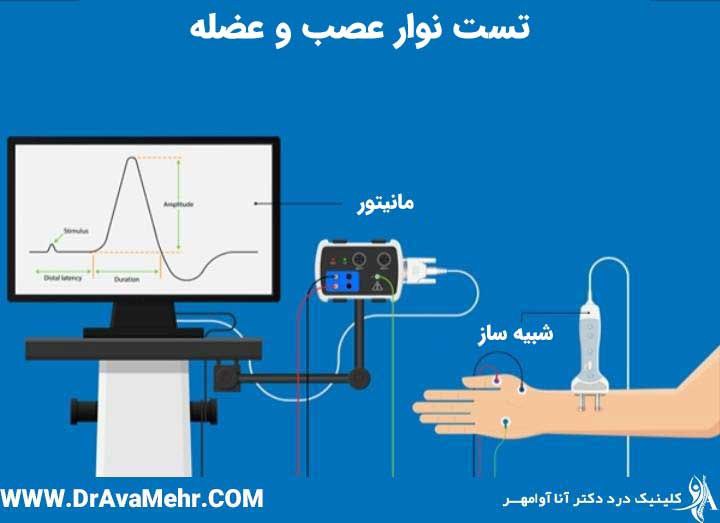
Nerve and muscle tape test, which is known as electromyography (EMG) in English, is a method that can be used to measure the response of muscles to electric shock. In this way, by performing a nerve and muscle strip test, the doctor evaluates the health or damage of the nerves and muscles of the patient's body and uses the results in the diagnosis and treatment of the person.
Another part of the nerve and muscle belt is called NCV. In this part of the test, the nerve strip is tested. After the electrical signals are sent, these signals quickly spread throughout the body and send a message to the muscles. The speed and strength of the electrical signals sent by the brain are examined in the neural tape test (NCV). If the speed or strength of the electrical signals from the normal muscle nerve strip is lower, the person will face neurological problems.
Is it possible to take a nerve and muscle strip test from all nerves?
In general, doctors use the nerve and muscle strip test to check two main nerve groups:
1- Sensory nerves that detect pain, touch and pressure.
2- Motor nerves that move muscles.
To better understand how to take the nerve and muscle tape, it is better to first learn how the muscles of the body work. The motor nerves of the human body, which are called motor neurons, send electrical signals to the muscles of the body. These signals originate from the brain and contain information that determines how the muscles of the body move.
After the electrical signals are sent from the brain, they reach the motor nerves and muscles of the body through the spinal cord. Finally, this electrical stimulation causes electrical activity in the muscles of the body, as a result of which the desired muscle contracts. In this way, it can be said that a muscle that is resting does not have any electrical activity.

How is the nerve and muscle strip done?
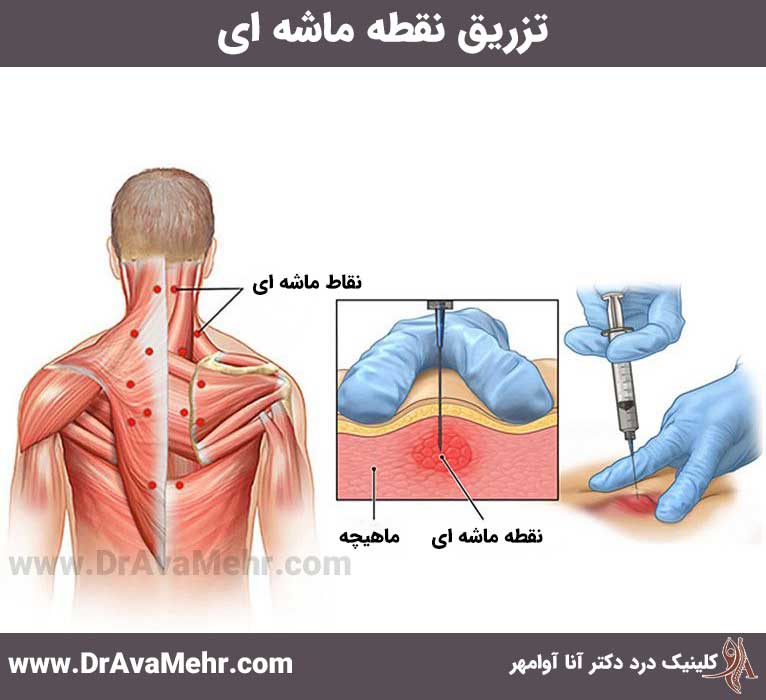
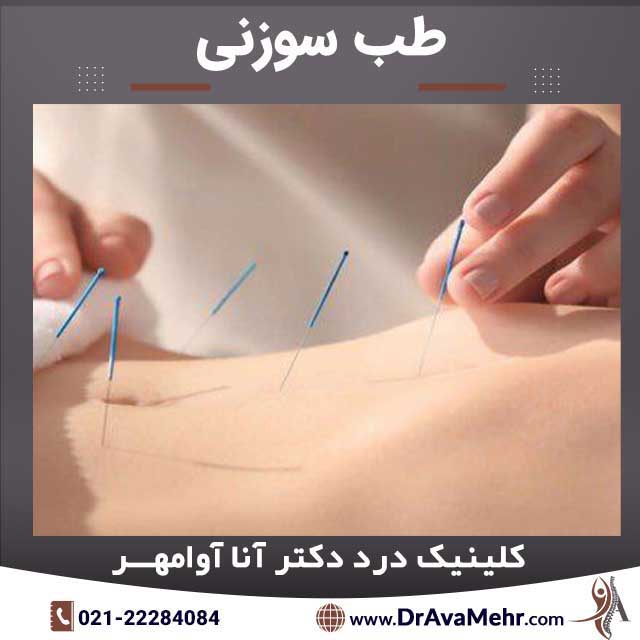
In an electromyography test, a specialist doctor inserts a small needle with an electrode into one of your muscles. This helps to record and check the electrical activity of the target muscle. At the same time as the muscles relax or contract, the mentioned needle electrode records the electrical activity of your muscle.
This needle electrode is connected to the computer through a cable and helps the doctor to see the received information through the computer screen. In fact, the received information appears on the screen as waves. Also, sometimes the doctor may hear pulses of electrical activity using an audio amplifier.
At the last stage, after receiving the waves, the specialist doctor analyzes this information with the aim of detecting the presence or absence of signs of possible problems. For example, suppose your muscle is injured, in this situation two situations may occur:
-
- This muscle shows abnormal electrical activity during rest.
- This muscle creates abnormal wave patterns in its electrical activity as a result of damage caused during contraction.
Needle strip nerve and muscle
During the nerve and muscle strip test, the doctor first places electrodes on the patient's skin. Then, in the next step, through these electrodes, a small electrical impulse is created on the person's muscle. The subject will feel this electrical impulse as a shock to the nerves. Finally, the response to this shock is recorded by the device and provided to the doctor.
Depending on the reason for the test and which muscles and nerves are being evaluated, this process can be different for nerve and muscle testing. But in general, during this test you will experience the following steps:
-
- According to the opinion of the doctor, the test is performed sitting or lying down.
- After that, the doctor finds the desired muscle.
- The doctor then inserts a small needle with an electrode into your muscle. You may feel discomfort or mild pain when the needles are inserted into your muscles.
- Next, the doctor will ask you to rest your muscles.
- After that, you will be asked to use the target muscle in certain ways, such as lifting or bending. By doing this, the device measures and displays the electrical activity of your muscle while using it.
- As soon as the doctor receives and records the desired information from your muscle, he will remove the needle from the muscle. Until the test is over, the doctor repeats this process in the next muscles.
- Finally, the needle electrodes are removed from your body.
If the specialist doctor has requested to do a nerve and muscle tape test for further investigations of your muscle problems, you should pay attention to the following points before doing the test:
-
- Take a shower before the test and wear comfortable and loose clothes.
- If you are using blood thinners (anticoagulants) such as warfarin, you should discuss this with your doctor. Because blood thinners may increase the risk of bleeding after EMG. Do not stop taking prescribed medicines without consulting your doctor.
- Inform your doctor if you use any electrical medical equipment.
Is nerve and muscle testing painful?
The nerve and muscle test is an outpatient and very convenient test. But since this procedure uses a needle, you may feel pain or discomfort when the doctor inserts the needle into the skin and muscle. However, most people can pass this test without problems. It is also possible that after completing the steps, the muscles that have been tested will be sensitive for a few days.
How long does the nerve and muscle test take?
It usually takes about 20 minutes to complete the nerve and muscle test. However, this time may change depending on the number of muscles tested.
What happens after the nerve and muscle test?
After the nerve and muscle test, these muscles may become sensitive and you may feel pain at the test site for a few days. Since the muscle soreness from the test is not severe, it should improve in less than a week. It is also possible that you will see some bruising where the needles entered your skin.
Risks caused by nerve and muscle testing
In general, nerve and muscle testing is a safe and completely safe method. So that after performing this test, no complaints will be registered from the clients. Some people, especially those on blood thinners, may experience more bleeding at the needle site after the test.
Abnormal side effects caused by nerve and muscle test
As mentioned, nerve and muscle testing is a safe diagnostic method with rare complications. However, it is possible to see bleeding, infection and limited nerve damage in the place where the needle electrode is inserted into the muscle. If you experience any of the following side effects after performing the nerve and muscle test, you should contact your medical center and doctor and inform them of the conditions:
-
- failure to stop bleeding at the needle site
- Feeling pain or extreme sensitivity at the place where the needles are placed
- Signs of infection such as redness, heat, swelling or fever
Goal From performing nerve and muscle tape test
Physical medicine and rehabilitation doctors use the nerve and muscle strip test in order to diagnose all kinds of muscle and nerve disorders and check the health of nerve and muscle coordination. In fact, the nerve and muscle test shows whether the muscles of the body respond to nerve signals correctly or not.
Types of nerve strips and Muscle
Nerve and muscle strip of the hand (upper limb)
When the doctor wants to check the functioning of the muscles in the upper part of the patient's body, he uses the nerve and muscle tape of the hand. By using this test, the doctor will be able to identify the source of the numbness, pain or numbness of these muscles.
The neck nerve and muscle tape is used in patients who have problems in the neck area. For example, doctors use this method to examine patients who have arthritis or cervical disc.
Leg nerve band (lower limb)
When the doctor wants to check the functioning of the lower body muscles of the patient, he uses the leg nerve strip. The doctor will be able to diagnose and examine problems related to the back and legs by using the foot nerve tape. In this way, if a person feels pain in the area of the soles of the feet, ankles, knees, or back, the doctor will use this method to diagnose the causes of these symptoms.
When a person has arthritis or other problems due to lumbar disk or an external injury in the back or hip area, a nerve and muscle tape is used to diagnose the causes of numbness and numbness in the leg.

Nerve and muscle
Now that we know the nerve and muscle tape test and how it works, the question arises, what is the muscle tape to diagnose? Doctors usually use this test to diagnose the disease of people who have one of the following symptoms.
-
- Muscle weakness
Tingling or numbness in arms, legs, hands, feet, or face
- muscle spasms, spasms or jumps
- Paralysis of one of the muscles of the body
If you see a specialist doctor with symptoms related to a nerve or muscle disorder, the doctor may use a nerve and muscle test for a more accurate diagnosis. Such symptoms may include:
-
- More More
- Anesthesia
- Muscle weakness
- Muscle pain or cramps
- Certain types of limb pain
Also, the results of the EMG test are often used to help diagnose or rule out a number of the following diseases:
-
- Muscle disorders, such as muscular dystrophy or polymyositis
- Diseases that affect the connection between the nerve and muscle, such as myasthenia gravis
Nerve disorders outside the spinal cord (peripheral nerves), such as carpal tunnel syndrome or peripheral neuropathy
- Disorders that affect the motor neurons of the brain or spinal cord, such as amyotrophic lateral sclerosis or polio
- Disorders that affect the nerve root, such as a herniated disc in the spine
What are the cases where nerve and muscle tape is done with caution or is it prohibited
Before performing the nerve and muscle tape, the specialist doctor obtains information about the clinical condition of the person during a consultation session
Bring so that this test can be done with caution if needed.
-
- Blood coagulation disorders
People who have coagulation disorders or have hemophilia should consult a spine specialist before the test so that the condition is under control.
-
- The presence of a battery or PACEMAKER in the heart
The heart battery may be disturbed during the test.
-
- Infectious diseases such as hepatitis or AIDS
Since some infectious diseases such as AIDS or hepatitis are contagious, it is necessary to inform the doctor in order to comply with health matters.
Since the nerve and muscle strip is used to diagnose various diseases, its interpretation is not an easy task and can only be done by a specialist doctor. However, for a better understanding of this test, it is better to get acquainted with the different parts of this test.
-
- Amplitude: The electrical signal is displayed as a wave and the amplitude is the height of this signal.
- CV: CV, also known as conduction velocity, is the rate at which an electrical impulse travels along a nerve.
- Time: shows the width of an electric wave.
- Conduction block: Decreased signal across an anatomical area such as the wrist and indicates nerve entrapment such as carpal tunnel syndrome.
- Reflex F : F is a kind of electrical wave in which the impulse moves towards the spine and then returns down along this fiber.
- H reflex: The H wave is the electrical equivalent of a reflex in the leg. An electrical impulse goes to the person's spinal cord through a sensory nerve and then returns along a motor nerve.
What do EMG test results mean?
Although the answer of EMG test is very useful and helpful, usually the doctor alone cannot make a final diagnosis for the patient's problems through this. In this way, for an accurate and final diagnosis, it is necessary for the doctor to evaluate the results of this test along with other medical tests.
Nerve and muscle tape test is performed by doctors specializing in physical medicine and rehabilitation or neurology. Because performing this test and observing the results of it requires sufficient knowledge and skills, and these specialists have a complete understanding of the peripheral muscles and nerves of the body.
The cost of nerve tape and Muscle
The cost of the nerve and muscle test is determined based on the equipment used in the test, the number of services performed, the tests and tests required, the center for conducting the nerve and muscle test, etc. In this way, the final cost of this test may be different according to the conditions of each person. However, nerve and muscle testing is possible with additional insurance and can reduce the costs of this test.

Nerve and muscle tape is a useful and sensitive diagnostic test. For this reason, in order to receive accurate results, patients are always advised to refer only to reputable and specialized centers. The nerve strip test is performed in Tehran with the help of experienced specialists and the use of the best medical equipment in Dr. Ana Avamehr's clinic.
test Nerve and muscle tape for children
In some situations, doctors use nerve and muscle tape to diagnose a specific disease or to check how children's nerves and muscles function. Due to the sensitivity of children and their low tolerance threshold, it is a bit difficult to perform the nerve and muscle strip test for children.
Generally, nerve and muscle tests are used in children with the aim of investigating problems related to nerves and muscles in different areas such as hands, face, anus and pelvic floor. At the Dr. Ana Avamehr clinic, due to the presence of advanced equipment and the presence of experienced specialists, special services are provided for children.