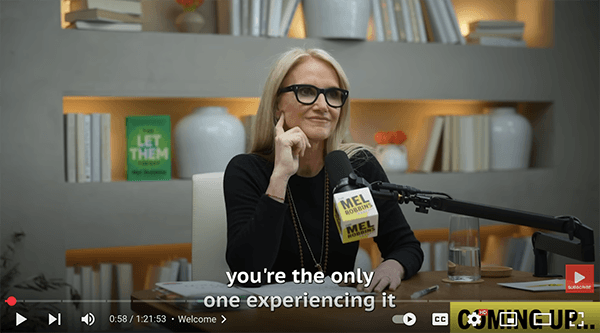


In this The podcast discusses insights and practical strategies provided by Dr. Julie Smith, a leading clinical psychologist. The main thrust of the discussion is that mental struggles and anxiety are a natural part of the human experience and there are tools to overcome them and move forward.
If you don't have time to read, you can listen to the audio version. But if you prefer to read the text, the full content is available below. This content is with you in any way that is more convenient for you.
1. Normalizing Mental Struggles: You Are Not Alone
One of Dr. Jolly's most important messages is that experiencing anxiety, uncertainty, or difficult times is not a minority, but rather a universal and human thing.
- Key point: "One in four people face some kind of mental health problem during the year." This fact is illustrated by the allegory of "white rice" (symbolizing everyone) and "wild rice" (symbolizing those who are struggling).
- "Knowing that what you are going through is a natural human experience, even when you feel alone, is very empowering. You don't need to judge yourself or feel inadequate.”
- Normalizing these feelings reduces judgment and paves the way for acceptance and growth. This perspective gives people hope that the current situation is temporary and that there are tools for improvement.
2. Emotional Toolkit: Skills for Life
Instead of focusing solely on therapy skills, Dr. Jolly emphasizes the importance of "life skills" for everyone. He calls this collection his "emotional toolbox".
- Managing emotions: Negative emotions such as Grief, href="https://ravanshenas.net/%d9%be%d8%b1%d8%ae%d8%a7%d8%b4%da%af%d8%b1%db%8c/">anger or Anxiety They are not a sign of defects, but they contain important information.
- The goal is not to get rid of negative emotions, but we should examine them with curiosity to find out what message is hidden in them. In this case, you can act more prepared and get through it without any damage." They cannot be removed.
- Key Point: “You cannot take the actors of the mind off the stage, but you control the spotlight.”
- “Thoughts come and go. You choose which one to pay attention to and this choice shapes how you feel.”
3. Changing the Narrative: From Being a Victim to Being a Predator
Facing difficult life situations (such as Dr. Jolly's cancer diagnosis) can often create feelings of helplessness or victimhood. Shifting perspective from victim to predator is a powerful tool.
- Key point: The victim is “just walking around and avoiding threats and traps and trying to survive,” while the predator “has a purpose… and uses all that motivation and action to make something happen.”
- Dr. Jolly says of her cancer diagnosis: “This cancer is not coming after me. I'm looking for it, you better be careful." This shift in perspective allows people to take action, even when fear is present.
- This approach is not about eliminating fear, but about using it as a stimulus for purposeful action. It helps people feel in control when facing life's challenges.

4. Challenges of Relationships and Comparison: Boundaries and Conscious Choices
Dr. Jolly also addresses common challenges in interpersonal relationships and human tendency to compare with others and provides tools to effectively deal with these issues.
Resentment as a sign: Resentment is a sign that you need to work on a problem, not that the world owes you.
In many cases, resentment It shows that you haven't set healthy boundaries to protect yourself. This is an invitation to accept responsibility for maintaining and strengthening personal boundaries.
"Anytime you compare yourself to someone with whom you are in a healthy relationship, it can be a negative sign." Such comparisons may weaken friendly relations and create a sense of competition.
Healthy comparisons: Comparison is natural, but choosing appropriate comparison patterns is very important.
Instead of comparing yourself with very successful or prominent people in a field, it is better to compare yourself with someone who is just a few steps ahead of you in his personal growth path. This type of comparison provides a suitable platform for learning and progress.
"If we can use our ability to compare in a constructive way, we can achieve positive results and change our lives in a meaningful way"
5. overcome Anxiety Social and Negative Self-Talk: Practice and Compassion
For those who struggle with social anxiety or negative self-talk, Dr. Jolly offers practical strategies.
- Exercise and exposure to fear: “Confidence can grow when you put yourself in situations where you feel weak or powerless”
- by creating a “scale” Start with “fear”—list the fearful situations from least to most—and gradually expose yourself to them. "Start from the bottom"
- In social anxiety situations, "When you have social anxiety, your focus is inward...whereas someone who is confident and doesn't have social anxiety will not focus on themselves, but on the other person and trying to get to know them." Shifting your focus from the inside out can reduce anxiety.
- Self-talk as a coach: Negative self-talk can ground you, while supportive self-talk can help you take risks and improve.
- Key tip: Instead of living in your head with a “high school bully,” treat yourself like a “best friend” or Talk to your “elite coach.”
- “It's not about what exactly you say at any given moment, it's about talking to yourself like a caring coach; That is, ask: What would a coach say at this moment? This approach gives your inner dialogue compassion and forward direction.
- I did the best I could with what I had at the time; And now, I have insights and skills that I didn't have before." This sentence is a tool to get rid of regret and move forward.

6. Uncertainty Management and Avoidance: Expanding Life's Horizons
In a world full of uncertainty, trying to control everything can lead to distress. Avoiding our fears shrinks our lives.
- Tolerating Uncertainty: Life is inherently unpredictable and uncontrollable.
- When things are uncertain, “limiting your focus is probably the most useful real-time tool to focus only on the next few steps ahead of you.”
- “You have to live as if the future is You have because otherwise you have nothing." Having purpose and meaning is so important, even in the face of uncertainty.
- Avoidance shrinks life: Avoiding what you fear provides temporary relief, but in the long run it makes the fear worse and limits your life.
- Rainbow Parable: Dr. Jolly uses a wooden rainbow to represent the layers of life. slow When you avoid fearful situations, “with each piece of the rainbow you remove, the real arc gets smaller and smaller.”
7. Relationships: Accepting Imperfections and Growing Together
Relationships are inherently challenging, and contrary to popular belief, you don't need to be completely healed to have a successful relationship.
- “The people who have the strongest relationships have often been through the most together,” and strength comes from working through challenges together, not avoiding them.
- “The misconception that everything has to be perfect or the person Or the relationship is not right". This view can lead to letting go of meaningful relationships.
- Partner Acceptance: You can only change yourself. It's important to accept that your partner may not want to process their feelings the way you do. Instead of trying to force him, focus on what you can bring to the relationship.
8. The Roots of Anxiety: From Judgment to Curiosity
Understanding anxiety means removing judgment from it and instead approaching it with curiosity.
- Anxiety is not something wrong with your brain; Rather, it is an experience.
- Let's put aside judgment and return to this feeling with curiosity. Isn't it funny how you feel? What makes you vulnerable to this feeling at this moment?”
- Anxiety and other emotions usually reflect your needs at that moment, such as a need for human connection or reassurance.

9. Values: A Decision-Making Compass
Understanding your core values is critical to avoiding avoidance and making sure you're living on a meaningful path.
- Values help you decide what to do, even if it's uncomfortable, because comfort doesn't always lead to meaning.
- “If you make decisions based on comfort and discomfort, you'll get somewhere meaningful It won't lead; your life will only shrink.”
- Values Exercise: Dr. Jolly suggests dividing your life into different areas (parenting, marriage, friendship, health, career, etc.) and ranking what is important to you in each area. Then evaluate how well you live in line with these values. It's a tool for finding where to focus your attention. data-payload='{"align":"center","id":"4691","slug":"default","valign":"bottom","ignore":"","reference":"auto","class":"","count":"2","legendonly":"","readonly":"","score":"5","starsonly":"","best":"5","gap":"5","greet":"","legend":"5\/5 out of 2 points","size":"24","title":"Keys to Life Anxiety + YouTube Podcast Summary","width":"142.5","_legend":"{score}\/{best} of {count} {votes}","font_factor":"1.25"}'>