وقتی صحبت از بهداشت دهان و دندان می شود، بیشتر افراد به یاد مسواک و نخ دندان می افتند و دهان شویه ها را اغلب تنها به عنوان خوشبو کننده دهان و دندان می شناسند.
اگر شما نیز از جمله افرادی هستید که برای خوشبو شدن دهان خود از دهان شویه استفاده می کنید، بهتر است بدانید که اثر خوشبوکنندگی آنها بیش از 3 تا 5 ساعت باقی نمی ماند. Therefore, to get rid of your bad breath, you should see a dentist to find out the root cause. Because gum disease, tooth decay, chronic sinusitis, and gastrointestinal problems are the main causes of bad breath and cannot be resolved by using mouthwashes. But what role do mouthwashes play in our oral and dental health?
If you are also looking for the answer to this question, stay with us until the end of this article from the website of Dr. Najmeh Drtahvildarnejad, the best orthodontic specialist in Mashhad. In this article, we intend to comprehensively provide you with everything you need to know about the types of mouthwashes.
What is mouthwash?
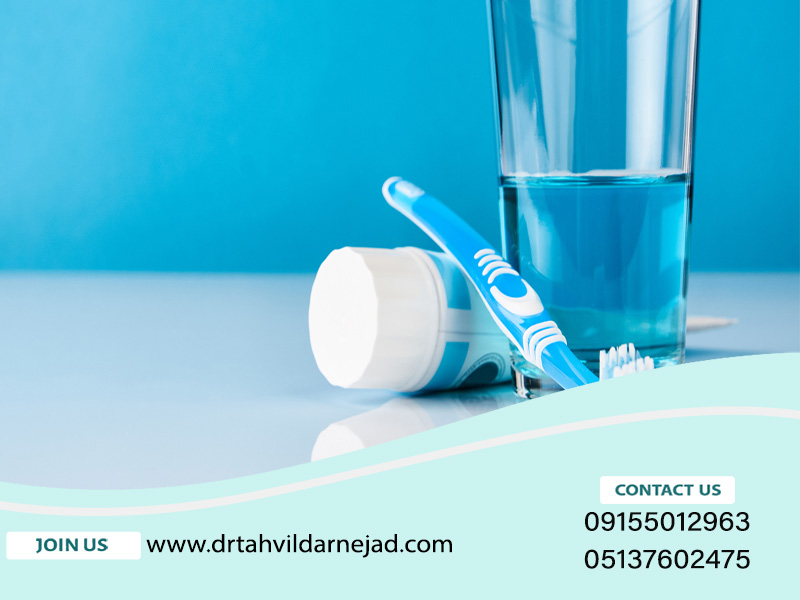
Mouthwash is a non-sterile aqueous solution that is mostly used to remove bad breath and disinfect.
Apart from the toothpaste that is used to clean the teeth, mouthwashes can also be used to take care of the teeth.
Mouthwashes usually consist of the following components:
- Flavor (Essence): Such as eucalyptus or menthol, which gives a distinctive taste to a mouthwash. In most cases, mint compounds are used because of the feeling of pleasant breath and coolness in the mouth.
- Preservative: Increases the life of the mouthwash and prevents the formation of bacteria and other microbes. An example of it is sodium benzoate.
- Water:an essential component of mouthwash that helps turn all ingredients into liquid.
- Substitutes for sugar:which is used to improve the taste of mouthwash, such as salt sodium saccharin.
- Color:Added for aesthetic reasons, to improve visual appeal.
- Fluoride: is a chemical that is often added to water treatment systems and toothpaste as a means of further protection against tooth decay. It also helps to strengthen the teeth.
- Detergent: An essential part of the composition that helps remove plaque and food debris from the teeth.
- Calcium: Like fluoride, it helps strengthen teeth.
- Disinfectants: There are different types of antiseptics, all of which have antibacterial properties and are used to attack dental plaque. Antiseptic mouthwash is used for oral infection, bad breath, or gum disease. Examples include chlorhexidine gluconate and cetylpyridinium chloride.
- Alcohol:It is used as a strong antibacterial effect.
Read more » How to treat gummy smile?
What are the types of mouthwashes?

Mouthwashes are primarily divided into two types: therapeutic and cosmetic:
-
Hygiene-cosmetic mouthwashes
This group of mouthwashes contain alcohol and are also called antiseptics or disinfectants. Of course, these mouthwashes are used temporarily to remove bad breath, because they do not destroy the microbes that cause bad breath.
Also, this group of mouthwashes are used to wash food residues from between the teeth and gums and reduce the microbial flora of the mouth.
Read more » What is the best orthodontic mouthwash?
-
Therapeutic mouthwashes
This group of mouthwashes reduces dental plaque, gingivitis, tooth decay and bad breath.
Therapeutic mouthwashes also include the following types:
-
Fluoride mouthwashes
These mouthwashes can not only stop decay in the early stages, but also prevent decay in the rest of the teeth.
The active ingredient in these mouthwashes is usually sodium fluoride, which is available in two concentrations of 0.2% and 0.05%. In the concentration of 0.2% only once a week and in the concentration of 0.05% it is necessary to use these mouthwashes every day. The duration of use should be only one minute and not more than that. Studies have shown that the anti-caries effect of these mouthwashes is about 30 to 40 percent.Fluoride is the main ingredient in some mouthwashes, such as Behsa sodium fluoride mouthwash, which contains 0.2% sodium fluoride and should be used once a week for one minute.
Read more» Know the methods of strengthening tooth enamel
In some other mouthwashes such as Vi-one, fluoride is only one of the active ingredients and its concentration is 0.05%, so it should be used daily to stop or prevent caries.
-
Chlorhexidine mouthwashes

The usual advice of dentists is to use chlorhexidine mouthwash as an anti-plaque and antiseptic. The use of chlorhexidine is usually prescribed after periodontal surgeries in order to control inflammation and subgingival plaque in a limited period of time. Chlorhexidine mouthwash is not recommended for daily and continuous use due to side effects such as burning sensation in the oral mucosa and yellowing of teeth and composite restorations as well as composite veneers.
Chlorhexidine is deactivated by most of the surfactants in the toothpaste, for this reason, this substance cannot be added to the toothpaste and is presented separately as a mouthwash. Due to this deactivation, it should be noted that chlorhexidine mouthwashes should not be used 30 minutes before or after brushing teeth.
Read more» What is an orthodontic toothbrush and how is it different from a normal toothbrush?
-
Oil-based mouthwashes such as Listerine(Listerine)
These mouthwashes are effective both in reducing plaque and in gingivitis (gum inflammation), because oil can change the cell wall of bacteria.
These mouthwashes contain active ingredients such as menthol, thymol and eucalyptol in alcohol. Among their few side effects, it is possible to mention slight irritation of the oral mucosa and also a small amount of external color change on the teeth. Listerine is the first anti-plaque and anti-gingivitis mouthwash approved by the American Dental Association (ADA). It is recommended to swish Listerine mouthwash twice a day for 30 seconds and about 15 ml in the mouth along with complete oral hygiene.-
mouthwashes with quaternary ammonium compounds such as cetylpyridinium chloride (cetylpyridinium chloride, CPC)
CPC substance is an active compound that kills bacteria, which reacts with the cell membrane of bacteria and causes them to disintegrate and die. According to studies, these mouthwashes are 14% to 24% effective in reducing plaque and gingivitis.
Crest Pro-Health is one of the other mouthwashes that contains a bactericidal agent, CPC, and is included in this group. It is recommended to use this mouthwash in the amount of 20 ml twice a day for 30 seconds.
Among other mouthwashes that are included in this group, we can refer to Cepacol, Clear Choice, Rembrandt and Vi-one.
Read more » What are the main causes of yellowing teeth in orthodontics
antiseptic mouthwash; Special for mouth disinfection
Antiseptic mouthwash is a disinfectant solution that is used to reduce oral bacteria and prevent gum infection and bad breath. This type of mouthwash usually contains compounds such as chlorhexidine, alcohol or antimicrobial essences. Regular use of antiseptic mouthwash can help reduce dental plaque, gingivitis and improve oral and dental health. However, it should not be consumed continuously without a doctor's prescription, because it may cause tooth discoloration or a disturbance in the balance of beneficial bacteria in the mouth.
Alcohol-free mouthwashes: a good option for sensitive people
Alcohol-containing mouthwashes can cause dry mouth and irritation of the oral mucosa. For sensitive people or those who suffer from dry mouth, the use of alcohol-free mouthwashes is recommended. By maintaining antibacterial properties, these products have fewer side effects and are more suitable for daily use.
Whitening mouthwashes: effect and limitations

Some mouthwashes contain whitening ingredients such as hydrogen peroxide that can help reduce surface stains. However, their effect is limited to the surface of the tooth and they are not effective for deeper stains or discoloration caused by internal factors. Also, continuous use of these products may cause tooth sensitivity.
Read more" if you need scaling services and get information about cost of teeth scaling in Mashhad, click on the given link.
Specialized mouthwashes for special conditions
In addition to general mouthwashes, there are also specialized products for specific conditions:
Antifungal mouthwashes: To treat oral thrush or fungal infections, mouthwashes containing nystatin or clotrimazole are prescribed.
Anesthetic mouthwashes: To reduce pain caused by mouth ulcers or inflammation of the mucosa, mouthwashes containing lidocaine can be useful.
Antiviral mouthwashes: In some cases, mouthwashes containing povidone-iodine are used to reduce the viral load in the mouth.
Considering the variety of mouthwashes and their different uses, choosing the right product should be done based on individual needs and consultation with a dentist. Correct and conscious use of mouthwash can play an effective role in maintaining oral and dental health.Does mouthwash replace the toothbrush?
No, mouthwash will never replace a toothbrush. Brushing plays the main role in removing plaque and food from the surface of teeth and gums, while mouthwash is only used as a supplement to strengthen oral hygiene. Using mouthwash can disinfect the areas that cannot be reached by the toothbrush, but it does not have the ability to clean mechanically. To maintain complete oral and dental health, a combination of brushing, flossing, and mouthwash if needed is recommended.
Who cannot use mouthwash?
People with allergies to mouthwash ingredients, children under 6 years of age, patients with active oral ulcers or people who cannot spit the liquid properly should not use mouthwash. Also, some mouthwashes containing alcohol are not suitable for people with dry mouth or a history of addiction. Pregnant women should also consult a doctor before using mouthwash, especially if the mouthwash contains chlorhexidine or alcohol. Choosing the right type of mouthwash should be done according to individual conditions and with the dentist's opinion.
What are the uses of mouthwash?

Now that you are familiar with the types of mouthwashes, it is time to check the applications and uses of each of them, which are:
Use of fluoride mouthwashes
These types of mouthwashes are the most used among other types of mouthwashes. Fluoride-containing mouthwash helps protect teeth against decay and increases tooth immunity and strengthens it.
Many toothpastes contain fluoride, and there is also some fluoride in city water. However, those people who brush their teeth less during the day can use mouthwash containing fluoride.
Read more' to learn the method In the context of brushing your teeth, click on the given link.
Note that excessive use of mouthwash and fluoridated substances can damage the teeth and cause stains on the teeth.
Uses of disinfectant and antibacterial mouthwashes
These types of mouthwashes are mostly used after surgery or oral and dental treatments. Antibacterial mouthwashes contain chlorhexidine gluconate and stop the growth of bacteria and microbes in the mouth. People who have undergone gum surgery or are prone to periodontal diseases, as well as those who have bad breath, can use disinfectant mouthwashes. These mouthwashes contain some alcohol and cause dryness and discoloration of the teeth. The use of this type of mouthwash should only be during the treatment and avoid excessive use.
Applications of beauty and hygiene mouthwashes

Beauty mouthwashes are not prescribed for any treatment and only have the role of making the teeth smell good. These mouthwashes do not protect the teeth from bacteria and plaque. If you have an important meeting or want to attend a party, you can use these mouthwashes to freshen your mouth. Usually, the smell of these mouthwashes disappears after eating food.
Uses of natural and herbal mouthwashes
These types of mouthwashes can often be prepared at home, although they are also available in pharmacies. Many people prefer not to use chemical mouthwashes. A solution of lukewarm water with salt is also considered a natural mouthwash. Vinegar and salt solution is also a natural mouthwash. These mouthwashes also work well.
No matter what kind of mouthwashes they are, they should not be used too much because they will have the opposite effect and cause damage to the teeth. Although mouthwashes protect teeth from bacteria and dental plaques, brushing and flossing should not be neglected.
Mouthwashes only clean the surface of the teeth. With dental floss and toothbrush, the remaining food between the teeth is completely removed.Read more» What are the most important reasons for gingivitis?
How and when to use mouthwash
If you use mouthwashes for medical purposes, the time of use is after meals. After gargling the mouthwash, try to avoid eating and drinking for 10 minutes. Usually, the lid of the mouthwash bottle contains a measuring cup to pour the mouthwash into.
When should you use mouthwash? Before brushing or after?
If you use mouthwash to freshen your mouth, you should gargle it after brushing your teeth. For other mouthwashes, you can gargle the mouthwash once before brushing your teeth and once after brushing your teeth. Before brushing, using mouthwash loosens the bacteria on the teeth, then you can completely remove them from the mouth with a toothbrush. It is better to spend between 1 and 2 minutes to gargle the mouthwash.
Using mouthwash once a day and at the end of the night is enough. Try to use a toothbrush, dental floss and mouthwash every night before going to bed to clean your mouth from the food you have eaten during the day. This will not waste much of your time. Spend about 10 minutes every night for oral and dental hygiene.
Read more» At what age should children use fluoride?
- Brush properly. Brushing removes food and microbial plaque from the surface of teeth and gums and prepares their surface to accept mouthwash.
- Pour a sufficient amount of mouthwash into the cap of the bottle (usually used as a measure) according to the dentist's instructions or the instructions on the bottle.
- Put the mouthwash in your mouth and swirl it in your mouth with pressure so that all the surfaces of the teeth and gums, as well as the surfaces between the teeth, come into contact with the mouthwash.
- Usually 30 seconds to 1 minute is enough time to keep the mouthwash in the mouth. After this time, remove the mouthwash from the mouth.
- After using the mouthwash, do not wash your mouth, do not eat or drink liquids for half an hour so that its effective ingredients remain in contact with the surface of your teeth and gums.
tips for using mouthwash
- Some dentists prescribe mouthwashes containing oxygenated water or washing serum as an auxiliary treatment for some oral and dental diseases or for cleaning and recovery after oral and dental surgeries. Long-term use of oxygenated mouthwashes causes irritation of soft tissue, loss of calcium on the surface of the teeth, and growth of black hairs on the tongue.
- Research results have shown that, if antiseptic mouthwash is used twice a day, it is effective in reducing gingivitis. The advantage of this mouthwash compared to chlorhexidine is that it can be used for a long time without changing the color of the teeth and that it is cheaper.
- Mouthwashes can be used as an auxiliary and complementary product for daily brushing. Other effects of mouthwash include making the breath feel cleaner and cooler.
- Mouthwashes are not used without a purpose and they cannot be used without a plan. For example, some of them can only be used in a certain period of time. At the same time, you should not forget that these elixir products are not a cure for all ailments. For example, it is not always possible to remove bad breath with mouthwashes, only when the cause of the bad smell is bacteria in the mouth, this product will be useful, but if the bad breath has another cause, such as severe digestive problems, mouthwash will definitely not help much to eliminate it.
- Although mouthwashes slow down the formation of dental plaques, they will not remove them completely. So it is not always necessary to use them.
- If the mouthwash is used excessively and for a long time, it may change the color of the teeth. This problem is more common with long-term use of therapeutic mouthwashes (more than a week), but regular mouthwashes can also change the color of teeth if used for a long time (15-20 days continuously). Some mouthwashes are also used only to freshen the mouth, which, of course, do not have much use and are not recommended to be used too much.
Mouthwashes cannot help in the treatment of canker sores in any way. Plague is a recurrent viral disease, so antibacterial mouthwashes do not have an effect on its recovery. Because they disinfect the oral environment, they may prevent secondary infections around the canker sore. Also, if the irritation of the pest causes the patient to not be able to brush his teeth well, mouthwash can help him in cleaning the oral environment in general, but it has no effect on the pest itself.
- If you are pregnant or breastfeeding, be sure to consult your doctor before using mouthwash.
Frequently asked questions about mouthwash
1. Is it possible to use mouthwash instead of a toothbrush?
No, mouthwash complements toothbrush and floss and does not replace them.
2. When is the best time to use mouthwash?
It is usually used after brushing and flossing to complete oral hygiene.
3. Is daily use of mouthwash harmful?
Alcohol-free and standard mouthwashes are usually safe for daily use, but it is better to use them as recommended by a dentist.
4. Does mouthwash whiten teeth?
Some mouthwashes have mild whitening properties, but they are not as effective as whitening treatments.
5. Can children use mouthwash?
Children over 6 years of age can use under parental supervision and using mouthwash for children.
6. What are the types of mouthwashes?
Two main categories: cosmetic-sanitary mouthwashes and therapeutic mouthwashes (fluoride, antiseptic, disinfectant, whitening, etc.).
7. What are the uses of fluoride mouthwashes?
They help prevent tooth decay and can stop it in the early stages.
8. What is the effect of chlorhexidine in mouthwash?
It is anti-plaque and anti-infective, usually prescribed after oral surgery or gum treatment, but may cause yellowing of teeth and discoloration of composite materials.
9. What are the advantages of alcohol-free mouthwashes?
The irritation of the oral mucosa is less and they are a more suitable option for people with sensitivity or dry mouth.
10. Who should not use mouthwash?
People with allergies to its ingredients, children under 6 years old, those with active oral ulcers, or people who cannot spit the liquid well.
11. What is the best time to use mouthwash?
It is usually used after brushing and flossing to complete the oral hygiene process.