Refractive defects of the eye: causes, symptoms and effective treatment methods - Dr. Mohammad Periman

Dr. Mohammad Periman
TabrizSurgeon and ophthalmologist
Refractive errors are one of the most common vision problems worldwide that affect millions of people. These defects occur when the shape of the eye does not properly focus light on the retina, causing blurred vision. In this article, we examine the types of refractive errors, their causes, refractive errors in children's eyes, warning signs, and effective treatment methods for refractive errors.
What are refractive errors of the eye?
Refractive defects are conditions in which the eye is unable to properly focus light on the retina. This problem can be caused by a change in the shape of the cornea, the lens or the length of the eyeball. The four main types of refractive errors are:
- nearsightedness (myopia)
- Camera (hyperopia)
- Astigmatism
- presbyopia
Each of these vision problems has its own symptoms and treatment methods.
Types of refractive errors of the eye
1. Nearsightedness (myopia)
Myopia (in English: Myopia) is one of the refractive errors of the eye, which means that the patient's eye recognizes writings and symbols in the near distance, but cannot recognize them in the far distance (compared to healthy people).
Asians and women are more likely to suffer from myopia. More than 30% of the world's people have degrees of myopia.myopia It is often due to the convexity of the eye lens and the larger length of the eyeball than normal that the focal point of the lens is on the retina. does not take and is formed in front of it.
Myopic people see the image of an object clearly only when the object is close to their eyes. They should use a diverging (concave) lens in their glasses.
This disease is hereditary, but it also depends on factors other than genes. It usually appears in childhood, and after it develops with the growth of the body and eyes, it leads to an increase in the length of the eye, its intensity increases and the number of glasses increases.
Vision correction with concave or diverging lenses. Sometimes a contact lens is also used. Treatment is by laser surgery.
The glasses of myopic people have a negative number, and the weaker the eye, the higher the number.
Symptoms of myopia:
- Blurred vision when viewing distant objects
- need to half-open the eyes to see better
- Headaches caused by eye fatigue
Treatment of myopia:
- Using glasses or contact lenses with concave lenses
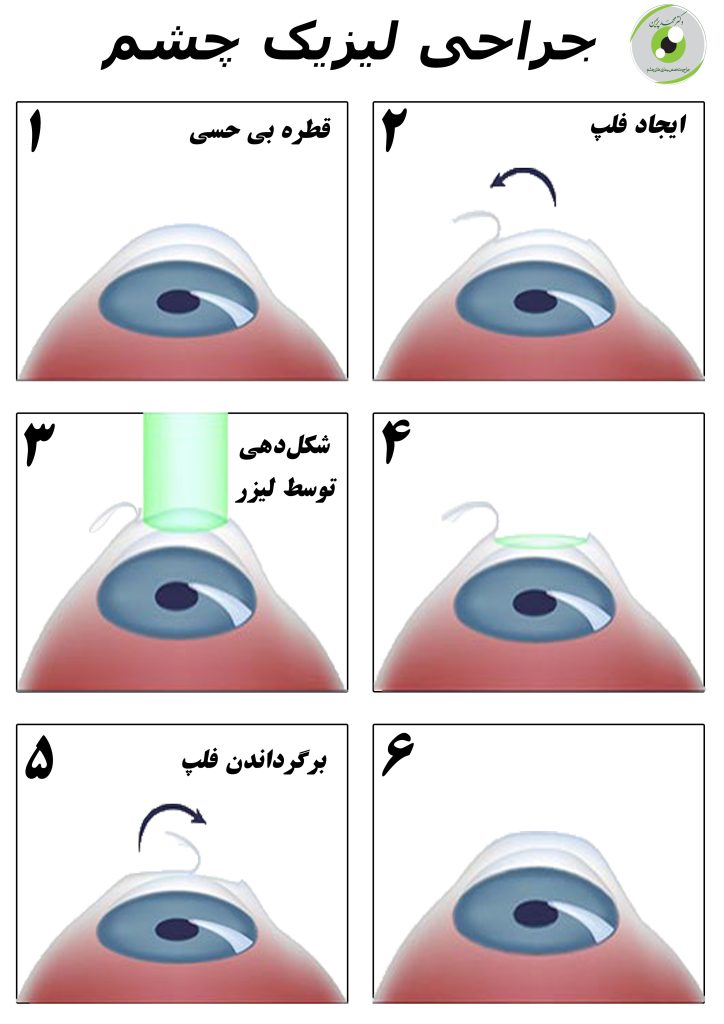
- Corrective surgeries such as LASIK or PRK
2. Farsightedness (hyperopia)
Camera (in English: Hyperopia) is one of the refractive errors of the eye and it means that the patient's eye has problems in seeing close objects.
About 25% of people in the society suffer from this problem and these people see distant objects better than near objects.
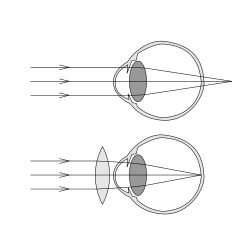
Camera Often due to the low convexity of the cornea or the smaller eyeball of these people compared to normal, the focal point of the lens is not placed on the retina and is formed behind it. Move away until the image falls on the retina
Prevalence of farsightedness is lower than myopia. Camera is often hereditary. In our old age, we have presbyopia, which in some cases is mistaken for hyperopia, but presbyopia impairs both near and far vision. Presbyopia occurs due to a decrease in the range of adaptation as a result of aging-induced changes in the lens of the eye. Many children are born with a camera and some develop it some time after birth.
Visibility modification
Vision correction is by using glasses with convex or converging lenses. Sometimes a positive contact lens is also used. The newer treatment is laser corneal surgery.
شمارهٔ عینک افراد دوربین مثبت است و هرچه چشم ضعیفتر باشد شماره بالاتر خواهد بود.
Symptoms of hyperopia:
- Difficulty focusing on close objects
- Eye fatigue and headache after reading
- need to distance yourself from the text to read
Phototherapy:
- Glasses or contact lenses with convex lenses
- Refractive surgeries such as LASIK or intraocular lenses
3. Astigmatism
Astigmatism or Kejbini (in English: Astigmatism) is one of the most common optical problems of the eye, and it is usually caused by irregular shape and curvature of the cornea or lens. Sometimes, the reason is the irregular shape and curvature of the lens that is behind the iris.
Astigmatism is a condition in which a few diopters of the spherical eye has been lost.
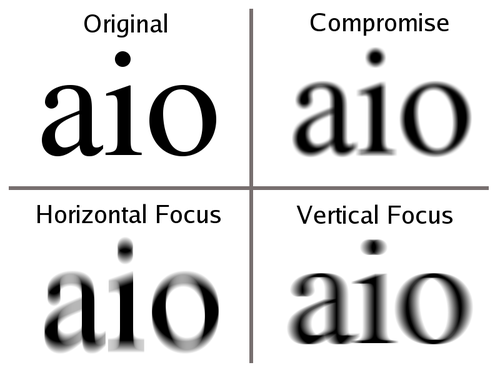
If we consider the eye as a spherical lens. Whenever this lens goes out of the spherical state and goes to the elliptical state (like a melon). In this case, it will have two linear foci instead of one point foci. As a result, due to unequal refraction in different parts of the cornea, the images are not completely focused on the retina, and the images are blurred both near and far; Therefore, people with high degrees of astigmatism not only see distant objects blurry like nearsighted people, but also see close objects blurry. People with astigmatism sometimes see extra lights in their field of vision.
Types of astigmatism
In practice, astigmatism eyes show themselves in three ways:
- Simple astigmatism
- compound astigmatism Mixed astigmatism
In the division based on the axis of two focal lines:
- regular astigmatism Irregular astigmatism
Astigmatism correction
In general, for correction, the non-uniformity of the curvature of the cornea or lens must be compensated. To correct astigmatism, we must remove the abnormal cylindrical lens impression created in the eye. This work will be done by adding an inverted cylindrical lens and summing their powers; For example, if the eye has one diopter of myopia in one axis, or a convex lens of one positive diopter in the same axis, or a concave lens of one negative diopter in the perpendicular axis, we place it on the eye. Correction of vision in irregular astigmatisms is difficult and requires complicated lenses.
Prevalence
According to a study in America, 3 out of every 10 children between the ages of 5 and 17 have astigmatism. In Bangladesh, 32.4% of people over thirty years old have this disease. In general, researches have shown that the prevalence of astigmatism has a direct relationship with age.Symptoms of astigmatism:
- Blurry or distortion of vision at all distances
- Eye fatigue and discomfort
- Difficulty driving at night
Treatment of astigmatism:
- glasses or toric contact lenses
- Corrective surgeries such as moderate and severe myopia will need reading glasses in addition to distance glasses after the onset of presbyopia, and in fact, they have no advantage over normal people. The laser has no effect on the focusing power of the eye lens and therefore cannot treat presbyopia.
Presbyopia treatment with Kamra camera technique
Technological progress, both in the field of ophthalmic lasers and in the production of accurate biomaterials that are completely compatible with the body, along with the urgent need to provide a more complete treatment method in presbyopia, led to the birth of a technique and a product called Camera. Kamra is an effective and safe inlay that entered the field of ophthalmology less than a decade ago, and after the positive and proud results of various tests, it has now entered the treatment stages in the Northern European Union (CE), East Asia, and some American countries.
Recently, researchers at the University of Leeds in England discovered a method that makes people with presbyopia no need for glasses. In this method, materials used in liquid crystal displays (LCD) are used. Using these materials, artificial lenses are produced that focus automatically by the movement of the muscles around the natural lens of the eye and solve lens-related problems such as presbyopia and cataracts.
Symptoms of presbyopia:
- need to keep the book or mobile phone away for reading
- Eye fatigue in close activities
- Headache after prolonged eye work
presbyopia treatment:
- bifocal or progressive glasses
- Multifocal contact lenses
- Surgeries such as monovision LASIK
Causes of refractive errors
- Genetic factors: Family history plays an important role in developing refractive errors.
- Age: Presbyopia occurs with age.
- Environmental factors: Prolonged use of the screen can aggravate vision problems.
Diagnosis of refractive errors
To diagnose these problems, the ophthalmologist uses the following methods:
- optometry test (refraction)
- Cornea examination with a keratometer
- Corneal mapping (topography)
Methods for treating refractive errors
1. Glasses and contact lenses
The simplest and most common way to correct refractive errors is to use glasses or contact lenses.
2. Refractive surgeries
- LASIK: reshaping of the cornea with a laser
- PRK: removing the surface layer of the cornea and correcting it with a laser
- Intraocular Lenses (ICL): lens implantation inside the eye
3. Non-surgical methods
- Ortokeratology: use of special night lenses for temporary correction of the cornea
Prevention of refractive errors
Although some factors such as genetics are uncontrollable, following the following tips can help eye health:
- Regular ophthalmology examinations
- Eye rest when working with the screen (20-20-20 rule) Nutrition rich in vitamins A and E
Conclusion
Refractive defects are one of the most common vision problems that can be treated with various methods such as glasses, lenses and surgery. Timely diagnosis and seeing an ophthalmologist can prevent these problems from worsening.