

چرا زمانبندی در پاپ اسمیر حکم مرگ و زندگی را دارد؟
سرطان دهانه رحم (سرویکس) یکی از معدود سرطانهایی است که با تشخیص زودهنگام، تقریباً ۱۰۰ درصد قابل پیشگیری و درمان است. ابزار طلایی ما برای این تشخیص، “تست پاپ اسمیر” است. اما یک نکته بسیار ظریف و حیاتی وجود دارد که بسیاری از بانوان از آن غافل هستند:
دقت این تست به شدت وابسته به شرایط بدن شما در لحظه نمونهگیری است.
تصور کنید با نگرانی منتظر جواب آزمایش هستید و نتیجه “مشکوک” یا “ناکافی” گزارش میشود. استرس ناشی از این اتفاق وصفناپذیر است؛ While there may not be any specific disease and the only reason for this error was doing the test at an "inappropriate time".
Many clients at Dr. Vida Yousefian's office face false positive results (which scare the patient for no reason) or false negative results (which hide the disease), just because they did not know under what conditions they should not take the test.
In this specialized article, we intend to discuss the most detailed "prohibitions" href="https://dr-vidayousefian.com/%da%86%d8%b1%d8%a7-%d9%88-%da%86%d9%87-%d8%b2%d9%85%d8%a7%d9%86-%d8%a8%d8%a7%db%8 c%d8%af-%d8%aa%d8%b3%d8%aa-%d9%be%d8%a7%d9%be-%d8%a7%d8%b3%d9%85%db%8c%d8%b1-%d8%a8%d8%af%d9%87%db%8c%d9%85%d8%9f/> Let's check the pap smear test. Knowing when not to test is as important as doing the test itself. By reading this article, you will avoid wasting time, money and unnecessary stress.
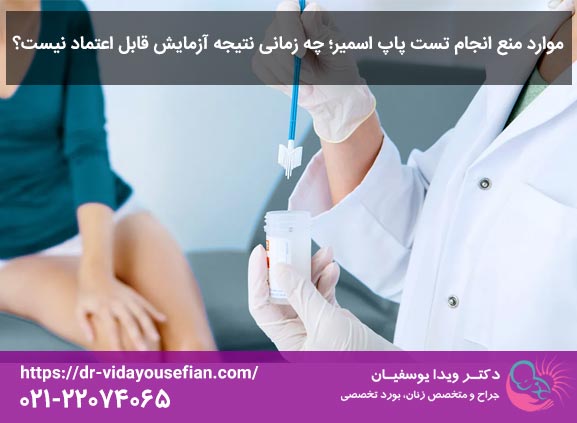
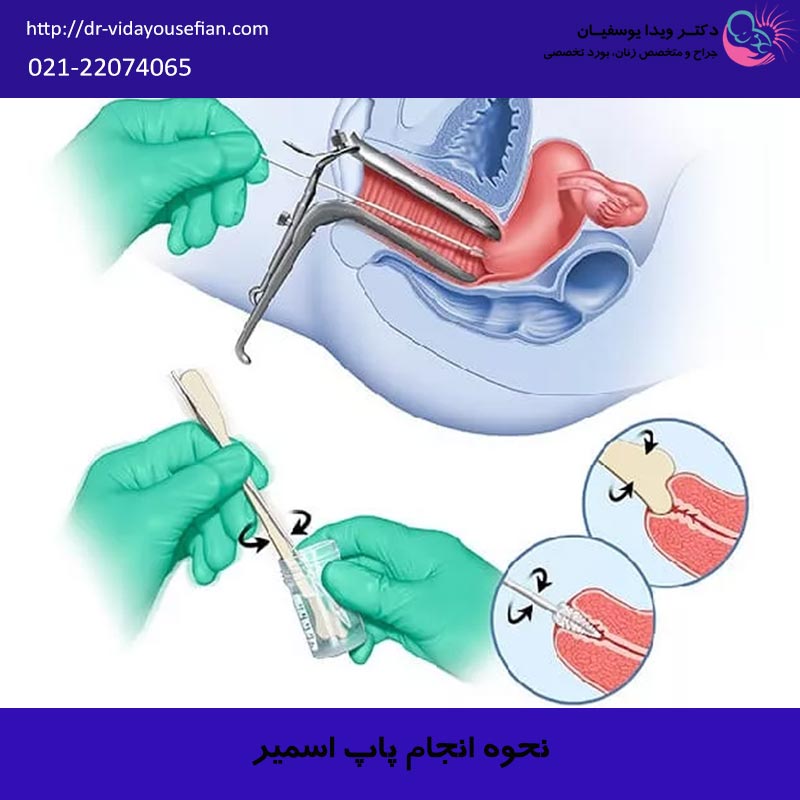
To understand why sometimes you shouldn't get tested, we must first know how Pap smear works. Pap smear is a "cytology" test. In this method, the doctor uses a special brush (Spatula or Brush) to shave and collect the surface cells of the cervix.
In the laboratory, the pathologist examines these cells under a microscope to identify precancerous changes (dysplasia).
Why are sampling conditions important?
The cervix is a very sensitive environment. Any factor that causes:
- Cervical cells are covered (eg with blood or pus).
- The cells should be washed away (with vaginal douching).
- The appearance of the cells changes (due to severe inflammation).
It causes the sampling to be reported as "unsatisfactory" or the test result to be misinterpreted. Therefore, the contraindications of the Pap smear test are actually conditions that destroy the accuracy of the test.
The following list includes conditions that gynecologists recommend to postpone the test. These cases are divided into two categories: "temporary" and "permanent/structural".
This is the most important and most common prohibition.
- Why? The presence of many red blood cells in the sample makes it impossible for the pathologist to see cervical cells. The blood sits like a thick curtain on the target cells.
- The best time: The best time to do a pap smear is on the 10th to 20th day of the menstrual cycle (that is, complete purity). If you have minor spotting, it is better to consult a doctor, but severe bleeding definitely prevents the test.
If you have abnormal discharge, you should not do a Pap smear.
- Why? During an infection, white blood cells (neutrophils) rush to the area to fight the germs. The intense accumulation of white blood cells causes the epithelial cells of the cervix to be hidden (Reported as: Obscured by inflammation).
- Solution: First, the infection should be treated under the supervision of a doctor, and after complete recovery, the test should be performed.
- Why? Penetration, condom use, or semen penetration can cause several problems:
- Semen can wash away surface cells or cover them.
- Friction caused by proximity can cause mild and temporary tissue inflammation that changes the outcome.
- Vaginal pH change may affect the quality of the sample.
4. Using vaginal douches, tampons or internal creams
- The 48-hour rule: Nothing should ever enter the vagina in the 48 hours before the test.
- Why? Vaginal creams, lubricating gels (lubricants) and even antifungal drugs, like a fatty or chemical layer, are placed on the cells and interfere with the diagnosis. Vaginal douching is also the worst possible thing, because you wash away the valuable cells that are going to be tested.
5. Pregnancy (with caution)
Pregnancy is not an absolute prohibition, but there are certain conditions.
- Note: Usually, the test can be done in the first 8 weeks of pregnancy. But then, due to the strong hormonal changes and cervical hyperemia, the interpretation of the results becomes difficult and false inflammation may be reported. The doctor usually postpones the test to 12 weeks after delivery so that the tissues return to normal.
The cervix needs time to rebuild after childbirth or abortion. Taking the test earlier than 12 weeks after delivery usually gives unreliable results.
7. Ages under 21 (according to new guidelines)
Today, in most global protocols (such as ACOG), cervical cancer screening is not recommended for girls under the age of 21, even if they are sexually active. The reason is that cellular changes at this age are very common and often transient, and the body's immune system automatically resolves them. Testing at this age may lead to unnecessary treatments and stress.
Check your body before visiting Dr. Vida Yousefian's clinic for a pap smear. If you have the following symptoms, your doctor will probably postpone the test for you:
- Colored and foul-smelling discharge: Green, dark yellow, or gray discharge that has a fishy or pungent odor is a sign of active infection.
- Severe burning and itching: Inflammation caused by fungi or bacteria makes the cervical tissue red and swollen, which is not suitable for sampling.
- Spotting for no reason: If you have spotting outside of your period, the cause of the bleeding should be investigated first. Although Pap smear is sometimes done to check this bleeding, the volume of blood should not be large.
- Fever and pelvic pain: These symptoms may be a sign of "Pelvic Inflammatory Disease" (PID) which requires immediate treatment and Pap smear is the second priority.

Methods Diagnosis and examination of preparation for the test
Before removing the sampling brush, the gynecologist will go through the following steps to make sure your test will be valid:
1. Taking a detailed history (History Taking)
Dr. Yousefian asks you:
- When was the first day of your last period? (LMP)
- Have you had sex in the last 48 hours?
- Have you used vaginal cream?
- Have you had a history of surgery on the cervix (such as freeze or cautery)?
2. Examination with a speculum (Visual Inspection)
Before sampling, the doctor observes the cervix.
- If severe cervicitis (inflammation of the cervix) is observed (strawberry-shaped cervix), the doctor first prescribes antibiotic treatment and postpones the test.
- If the volume of secretions is large, they may be cleaned with a swab, but if the secretions are infectious, the test is canceled.

If you cannot do a pap smear test because of one of the above, the underlying problem must be solved first. In Dr. Vida Yousefian's clinic, combined medicinal and modern methods are used to prepare patients with chronic problems.
a) Treatment of infections
If infection prevents the test:
- Antibiotics and antifungals: Depending on the type of infection (bacterial or candidiasis), a course of treatment of 7 to 10 days is prescribed. Pap smear test is usually done 2 weeks after the end of the treatment.
b) Treatment
One of the common problems in menopausal women is "vaginal atrophy" (tissue thinning). In this case, the sampling is very painful and the cells are not of the required quality (often the result of "Atrophic Smear" is reported, which is ambiguous). To solve this problem and make it possible to perform an accurate test, the following new methods are used:
1. MonaLisa Touch laser
Laser therapy is a non-invasive and revolutionary method.