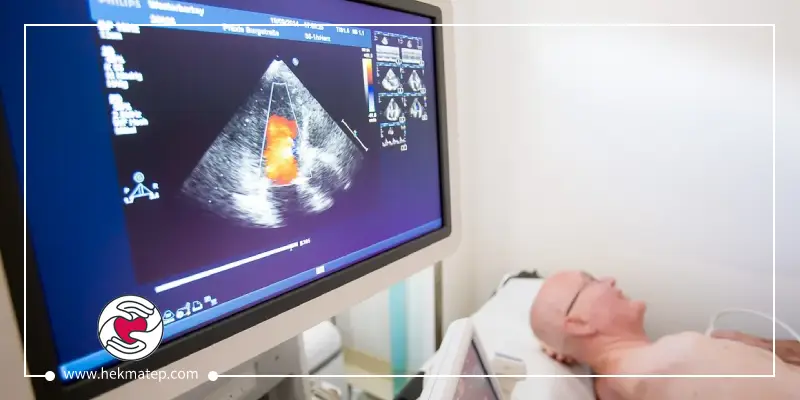

تفسیر اصطلاحات اکو قلب یا خواندن جواب اکو قلب به شما کمک میکند که بتوانید از وضعیت قلب خود آگاه شوید؛ But before you learn to read the answer to the echo of the heart, you should know what is the echo of the heart and what is its use?
Echo is one of the low-risk and non-invasive ways to diagnose heart problems, which examines things like the size of the heart, its pumping power, muscle defects, etc. In the continuation of this article from the site the best cardiologist in Isfahan; Be with Dr. Hekmat.
What is echocardiography?
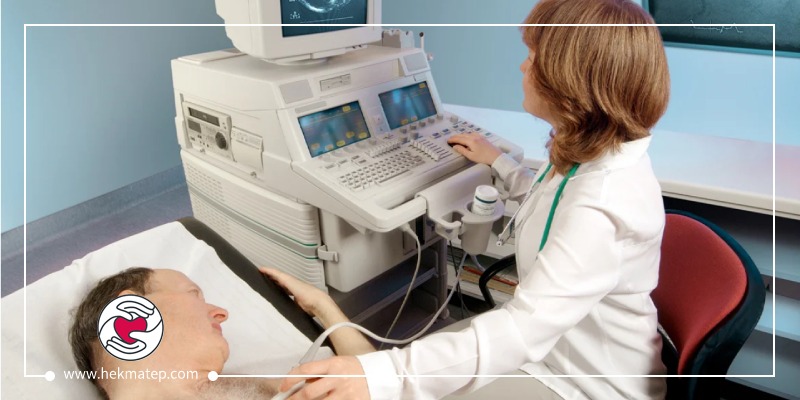
Echocardiography is the echo of the heart, which can obtain live images of the heart through sound waves and display them on the computer; By reading the answer of the echo, the doctor can get accurate and detailed information about the function of the heart and its valves, and in this way diagnose problems and diseases related to the heart.
In the majority of cases, the use of echocardiography will be very useful and can prevent more acute heart problems, the most important of which are related to blood clots, aortic valve problems, and fluid in the sac around the heart.
Also, reading the echo of the heart is very necessary and important to determine the health of the heart after heart attacks, and through this test, the heart health of babies can also be diagnosed.
There are various reasons for using an echocardiogram, the main reasons that are considered for checking the function of the heart by echo are the following.
- To measure the overall function of the heart, it is necessary to use an echocardiogram.
- If you have heart problems and you are treating them, you should do an echocardiogram to check the effectiveness of treatment methods.
- If you suffer from heart valve diseases, your doctor may recommend an echocardiogram to monitor the progress of your disease.
- Using echocardiogram is necessary to identify various heart diseases such as congenital diseases.
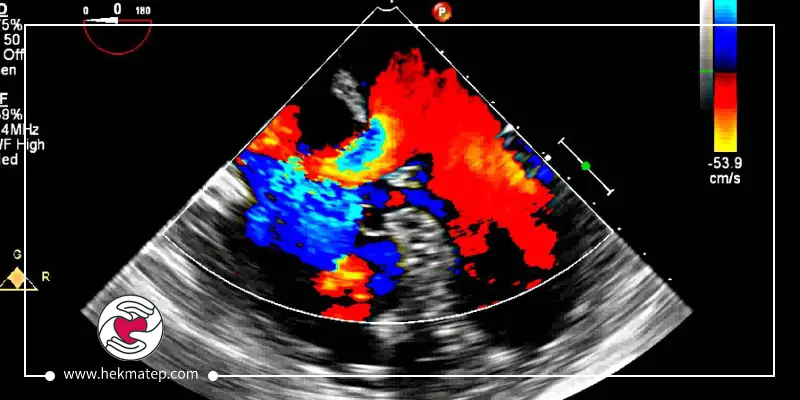
by reading the echo heart answer, you can diagnose these diseases and prevent more acute problems; For this reason, it can be said that the knowledge of echocardiography is one of the most essential issues that you should give great importance to in the medical field and benefit from it if there is any problem in this vital organ of the body.
Now, in order to get more complete information about what echocardiogram is, you should know that there are different types of echocardiogram, each of which is used based on the individual's physical condition and the doctor's diagnosis.
- Transistor echocardiography: The most common type of echocardiography is transistor echocardiography, which is a painless and risk-free test, and the way it is performed is that a device with a transducer is connected to the patient's chest, and sound waves are sent to the heart through the device and live images of the heart are displayed.
- Echocardiography through the esophagus: In a regular echo it is possible that the images taken from the heart are not clear for any reason; In this situation, the doctor cannot read the results of echocardiography and therefore recommends transesophageal echocardiography.
- Stress echocardiogram: Another type of echocardiogram is the stress echo, which is done through the same normal echo and is such that the patient must do a lot of exercise to increase his heart rate; Because the performance of the heart is determined at times when its pumping power is high.
- 3D echocardiography: This echo is performed with two methods, Transesophageal or Transthoracic, and as the name suggests, it can display images of the heart in three dimensions and from all angles.
- Dobutamine stress echocardiography: This type of echocardiogram is similar to a stress echocardiogram, with the difference that if the patient cannot use a treadmill to increase his heart rate, he is injected with a drug called dobutamine to increase his heart rate.
When is an echocardiogram necessary?
Actually, reading the echo of the heart is necessary and necessary when the doctor wants to analyze and examine your heart problems; This test shows how the blood moves in the cavities of the heart and its related valves.
If you are one of those people who have a heart problem and you constantly feel pain in your chest area, a cardiologist will suggest you to do an echocardiography test.
What is checked in echocardiography?
Reading the echo of the heart allows your doctor to check the function of your heart valves more accurately and in better detail; Also, the images received from the heart inform your cardiologist of the following.
- Presence of blood clots in heart cavities
- The fluid in the sac around the heart
- Problems related to the aortic vein
- Problems related to blood pumping
- Congenital defects
- heart size
- Injuries to the heart muscle
Explanation of Echo Heart Terms
There are many things in the interpretation of the terms echo of the heart or reading the answer of the echo of the heart, some of the most important of which are mentioned below.
- The first thing you encounter when interpreting echocardiograms is EF, or output fraction; The number intended for this case shows you how much blood volume your heart pumps out with each beat.
The normal percentage for EF is between 55 and 65%, and if you see that this number is less than 44%, it indicates that the heart is not able to pump well.
- Left ventricular ejection fraction or LVEF, this term means the amount of blood coming out of the left ventricle of your heart during each heartbeat, which is also calculated as a percentage, and if the answer is below 55%, the amount of blood coming out of this part is abnormal.
- RVEF is another term for echocardiography that indicates how much blood is pumped to the right ventricle and lungs to supply oxygen, and doctors pay more attention to this issue.
- MVP or mitral valve prolapse is one of the other cases that we encounter when reading the echo, and this term indicates that the mitral valve is prolapsed.
- TR that you encounter in the answer to the echo indicates that the valve between the right ventricle and the right atrium does not close properly.
- AR is also a term that indicates aortic valve insufficiency, and this case shows that the aortic valve does not close properly and some blood returns to the left ventricle when the aorta is at rest.
- Congestive heart failure, which is shown in the echo as CHF, means that the heart valve does not have the power it should have to pump, and in this situation, the blood goes back and causes the accumulation of fluid in the lungs.
-
lvedd in heart echo one of the terms you come across when reading the normal heart echo answer is lvedd or the left ventricular end-diastolic diameter. lvedd is an important index in reading echocardiogram that shows the size of the heart and also the left ventricle. Disruption of ventricular emptying during systole increases the residual volume at the end of systole in the ventricle and as a result increases the volume at the end of diastole of the ventricle. Measuring or monitoring this volume is difficult, and for this reason, end-diastolic pressure is measured.
Lvedd level is different for different people in a normal state, but its normal level will be from 62 to 150 for men and from 107 to 120 per ml unit for women. These numbers will be equal to 74-34 and 61-29 according to the ml/m2 unit, respectively.
-
Meaning nl in Echo Heart Another term that you may be wondering about in Interpretation of Echo Heart Terms is nl. nl stands for Normal, which you may encounter in some cases when reading echocardiogram results. In a normal echocardiogram, there are no blood clots or tumors in your heart. In such conditions, the heart valves open and close properly and there is no blood leakage. However, if the heart is normal, the doctor will order some additional tests to help find the source of your symptoms.
-
The meaning of regurgitation in echocardiography The heart consists of various valves and cavities and all these parts are necessary for the proper functioning of the heart. One of these valves is the mitral valve, whose presence and health are important for heart function. The mitral heart valve closes completely when the left ventricle contracts so that the blood flow entering the left ventricle from the left atrium enters the aorta without return. If the valve does not close completely, heart mitral valve failure or Mitral Regurgitation occurs.
In heart mitral valve failure, every time the ventricle contracts, some blood is pushed back and enters the left atrium. This causes the condition of the amount of blood entering the aorta to decrease, and then the blood pumped to the whole body also decreases. If this insufficiency is mild, it will not be so serious and dangerous, but moderate or severe insufficiency of the valve can force the left ventricle to work more, and this excess activity has a bad effect on the heart muscles and weakens the heart muscle.
-
Pap Normal on echocardiography Another term that you may run into when interpreting echocardiography is normal Pap on echocardiography. Pap stands for pulmonary artery pressure. Changes in the cells that line the pulmonary arteries cause the walls in the arteries to become stiff, swollen, and thickened, which can result in blocked blood flow through the lungs and pulmonary hypertension.
Reading the answer of normal heart echo
An echocardiogram for a normal heart is such that the heart chambers and valves look normal and actually function properly. A normal echocardiogram shows that there are no blood clots or tumors in your heart. In such a situation, the valves of your heart open and close properly and there is no blood leakage.
Absence of signs of infection is another thing that you can see when reading a normal echocardiogram. If your heart is normal, your doctor may order additional tests to help find the source of your symptoms. He may also want to repeat the echo after a few months to see the size of the heart and its structure if there is any change. In the condition that your heart works normally, the covering of the heart has a normal thickness and will not contain excess fluid.
Concluding Remarks
In this article, we have provided you with all the things that are related to reading the echo heart answer and will appear in the echo heart report so that you can easily interpret the terms; But this does not mean that you should not go to the doctor to read the answer of the heart echo.
It is necessary to mention that after getting the results of echocardiography, you must go to a cardiologist to be aware of your heart problems and treat them. One of the best doctors who is a cardiologist in Isfahan is Dr. Mustafa Hekmat, who Echocardiography in Isfahan along with other related tests The heart works by using the best devices and modern methods and treats heart problems as quickly as possible.
If you live in Isfahan and suffer from a heart problem and want to go to a skilled and expert doctor for echocardiography, we suggest you Dr. Hekmat, who is very skilled in this field and provides these services in the best way for patients. به جهت دریافت نوبت از دکتر مصطفی حکمت میتوانید به طور حضوری به آدرس زیر مراجعه کنید یا از طریق شماره تلفنهای مشخص شده اقدام به گرفتن نوبت نمایید.