
Table of contents
- How is the level of consciousness assessed in cerebral hemorrhage?
- AVPU scale (quick and clinical)
- Glasgow GCS scale
- Interpretation of GCS score (mild, moderate, severe)
- How does a doctor diagnose cerebral hemorrhage causing loss of consciousness?
- Treatment of cerebral hemorrhage with reduced level of consciousness
- Home care and follow-up after discharge
- Conclusion
Brain bleeding (intracranial hemorrhage) is one of the main causes of decreased level of consciousness after a head injury or hemorrhagic stroke. Therefore, one of the important factors in patients suffering from cerebral hemorrhage is the evaluation of the level of consciousness. The level of consciousness is evaluated with the Glasgow Scale (GCS), and its decrease (GCS < 13) indicates the severity of the injury. Any decreased level of consciousness after concussion or stroke should be evaluated urgently with immediate imaging (non-contrast CT) and transfer to the ICU. Delay in treatment can cause irreversible brain damage. In this article, we ask your doctor about the relationship between cerebral hemorrhage and the level of consciousness in order to see what the level of consciousness is in brain hemorrhage patients and what measures should be taken for them.
How is the level of consciousness evaluated in cerebral hemorrhage?
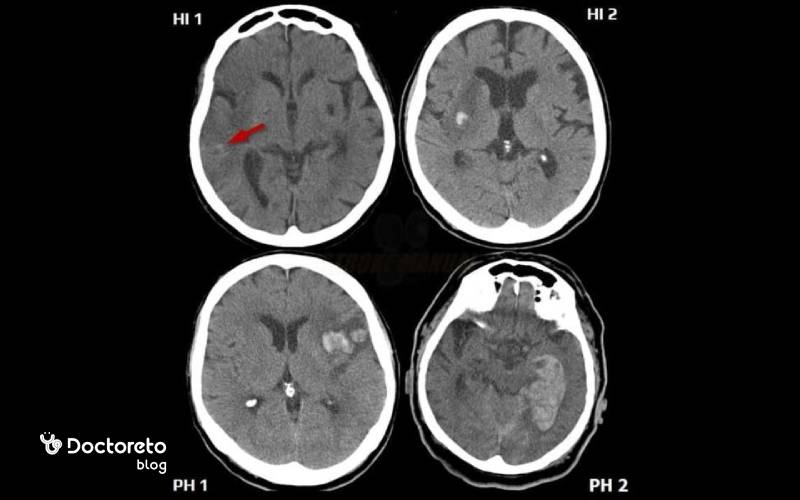
Physical examination of patients with brain hemorrhage usually differs based on the site of bleeding. Assessment of patients includes checking vital signs and assessing their level of consciousness or GCS. Usually, the relationship between cerebral hemorrhage and the level of consciousness is such that with the increase in the severity of the bleeding, the GCS level decreases drastically, and even patients may gradually go into a coma, but this relationship is not the same and certain in all patients. Doctors measure the level of consciousness of patients with the results obtained from the MRI/CT test.
The important point is that impaired consciousness is a very common complication in patients who have suffered cerebral hemorrhage. For this reason, assessing the level of consciousness in cerebral hemorrhage helps the doctor to develop effective preventive or treatment strategies. There are some very important scales that doctors can use to check the level of consciousness of brain hemorrhage patients.
English text:
Quoted from ahajournals
Impaired consciousness is a frequent and serious sequela after intracerebral hemorrhage (ICH), and it has been reported that approximately half of the patients with ICH experience impaired consciousness. They become conscious.
AVPU Scale (Rapid and Clinical)
In the first hours of the injury, the emergency team uses a very quick scale for the initial assessment of patients, which is called the AVPU scale. مقیاس AVPU مخفف فاکتورهای هوشیاری، کلامی، درد و بیپاسخی است. This scale is a brief clinical assessment tool that enables clinicians to quickly grade a patient's overall level of consciousness. AVPU classifies responsiveness as conscious, responsive to verbal stimuli, responsive to pain, or unresponsive.
Glasgow GCS Scale
One of the main scales for examining consciousness disorders, especially the assessment of cerebral hemorrhage and the level of consciousness, is called the Glasgow scale. This system was developed to provide a framework for standardized examination and to support continuous and reliable GCS assessment of patients.
This tool has a very simple scoring system that the doctor can interpret this score to evaluate the level of consciousness of the patients and, accordingly, the severity of the cerebral hemorrhage. In this system, the patient's response is recorded in three main components: eyes, speech and movement. All three of these components are evaluated simultaneously.
English text:
quoted from the site bmj
The Glasgow Coma Scale (GCS) has been used worldwide to assess a patient's responsiveness, or level of consciousness,1 in acute brain impairment.
Persian translation:
The Glasgow Coma Scale is used worldwide to assess a patient's responsiveness or level of consciousness in acute brain disorders.
Interpretation of GCS score (mild, moderate, severe)
In the Glasgow Coma Scale, the doctor scores the patient's level of consciousness based on whether the eyes are open or closed, the patient's motor reflexes, their response to pain, and also the verbal response of the patient who suffered a cerebral hemorrhage. Therefore, the severity of cerebral hemorrhage and the level of consciousness are interpreted according to the GCS score. The lowest GCS score for patients with brain damage is 3 and the highest score is 15.
| Name of the scale | How it works | Advantages | Limitations |
|---|---|---|---|
| AVPU | Rapid assessment of the patient's response to stimuli without numerical scoring | Very fast and Simple | Low accuracy, follow-up of subtle changes is not possible. |
| GCS (Glasgow) | Score of three responses to determine level of consciousness | Global standard, follow-up | In intubated/aphasic patients verbal component cannot be assessed. |
| FOUR Score | Multidimensional evaluation including brain stem and breathing pattern | Suitable for intubated patients, better prognostic information | Need more training |
| RASS | Determination of sedation or restlessness by observation and gradual stimulation | Careful monitoring of sedation | To detect the cause of the decrease Alertness is not designed |
| AIS (Alertness Scale) | Observe the overall response to the environment | Fast | It is not standard and numerical. |
How does a doctor diagnose a brain hemorrhage that causes a loss of consciousness?
With the help of physical examinations of patients, checking the AVPU scales and also interpreting the score of the Glasgow Coma Scale, doctors can determine whether cerebral hemorrhage has caused a loss of consciousness in patients or not. If the patient's vital signs and things like responding to pain or other stimuli are negative, it means that brain bleeding has reduced the level of consciousness.
Treatment of cerebral hemorrhage by reducing the level of consciousness
Cerebral bleeding and low level of consciousness is a medical emergency and requires immediate treatment to reduce the risk of serious and life-long injuries. The first goal of treatment is to stop bleeding and prevent re-bleeding. A cerebral hemorrhage operation may be performed or medications to prevent vasospasm and control high blood pressure may be prescribed.
Artificial breathing and reducing intracerebral blood pressure are among the measures that can help treat bleeding and improve patients' level of consciousness. In addition, treatments such as rehabilitation treatments and brain stimulation techniques can be effective in improving patients' consciousness in some cases.
Care at home and follow-up after discharge
Always after a brain hemorrhage, there is a risk of re-bleeding and decreased level of consciousness. For this reason, about how to raise the patient's level of consciousness, the patient should be constantly monitored after discharge from the hospital. Checking for physical symptoms at home, taking prescribed medications and following the instructions of the attending physician can prevent the recurrence of risks associated with brain bleeding and low level of consciousness.
Conclusion
Regarding the relationship between cerebral hemorrhage and level of consciousness, it should be said that this condition is often accompanied by a decrease in level of consciousness, which is considered one of the most important prognostic factors and a guide to emergency management. The level of consciousness is assessed by the Glasgow Scale (GCS), and a GCS less than 8 indicates a critical condition with an urgent need for airway support. Decreased consciousness is caused by increased intracranial pressure, hydrocephalus or damage to vital structures such as the brain stem. Consequently, rapid assessment of GCS is critical in early diagnosis and decision-making for interventions such as surgery or ICP control. If there are signs of decreased consciousness (confusion, somnolence, or coma), go to the emergency department or a neurologist immediately for imaging (CT/MRI), GCS assessment, and emergency treatment (eg, blood pressure control or surgery).
Your doctor takes care of your health!