What is meant by child psychology and what effect does it have on their development?

Seyyed Mohammad Amin Jazayeri
تهرانروانشناس

What is meant by child psychology and what effect does it have on the child's growth and upbringing?
The most influential and vital stage for the formation of personality is childhood, so knowing the psychology of children is a must for parents. With child psychology, we must examine all the states and movements of the child and try to ensure that there are no problems during growth.
Child psychology can help parents, educators, teachers and all people who are in contact with children to play a powerful role in raising and developing children. In this article, the answer to the question of child psychology is completely answered. We will review together and address important points in the field of child rearing.
What is child psychology?
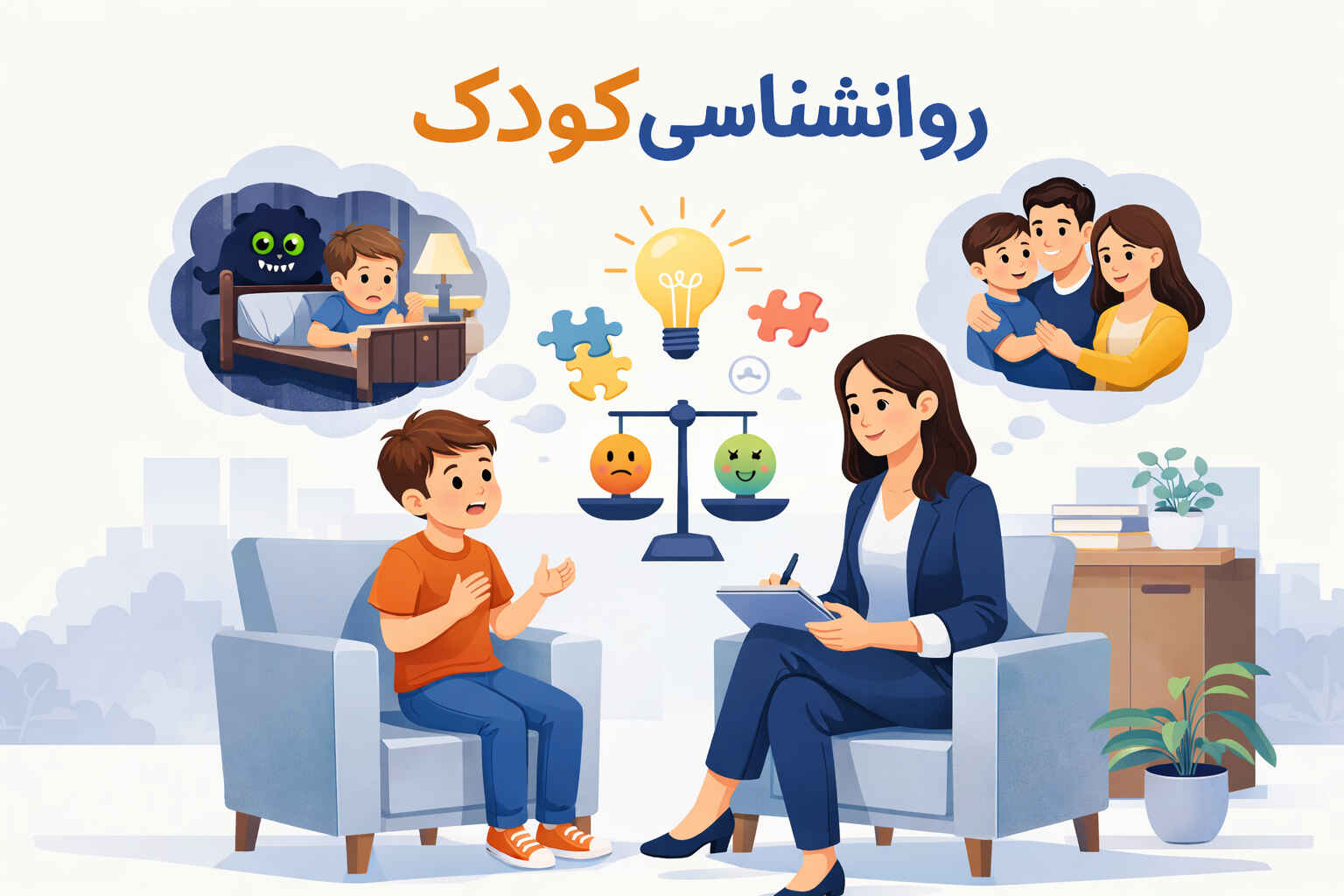
In response to the question of child psychology, what is it? It should be said that child psychology is a branch of clinical psychology that studies how to grow and nurture from birth to adolescence. Child psychology studies various aspects of child development, including physical, cognitive, moral, emotional and social development. In this context, with the techniques that are suggested, parents will show the best reaction and behavior towards their child. Subsequently, the child will also have favorable feedback and his growth and upbringing will follow the right path. Also, when If a favorable environment is provided for the development of children, their talents and abilities will emerge sooner.

Main topics of child psychology
To know more about child psychology, we must know what the main topics of child psychology refer to. Next, we will discuss the 5 main areas of this branch of psychology.
1. Growth
Physical, emotional and cognitive growth should be examined by a psychologist so that he can deal with it faster if there is a problem.
2. Milestones
Knowing the milestones of childhood at different ages of the child helps the psychologist to understand the natural development of the child and to have the ability to solve possible problems.
Physical milestones
It is related to the development of movement skills.
cognitive milestones
It refers to the child's talent in thinking, solving problems and learning.
Emotional and social turning points
A child's ability to express emotions and feelings as well as social feedback.
Communication milestones
The child's verbal and non-verbal communication skills.
3. behavior
At the same time as children gain independence, the level of tension and behavioral differences between them and their parents increases. Child psychology examines the roots of these disorders. Once the main roots of the problems are identified, they implement treatment solutions.
Possible roots in behavioral disorders can include brain disorders, genetics, diet, and the behavior and performance of parents and family. Behavioral issues and problems may be temporary or permanent. Temporary problems are more related to stressful situations; such as the birth of a sibling or the separation of parents. On the other hand, some aggressive and hostile behaviors are permanent.
4. Emotional growth
In the field of emotional development, the management and control of emotions is one of the most important and sensitive matters in the child's development. In this field, the reasons why the child has problems expressing emotions are first identified, then strategies are taught to learn to accept emotions and understand the relationship between emotions and behavior.
5. The social dimension of child development
The process of socialization includes the acquisition of skills that enable children to communicate effectively with others. The social dimension of the child's development is closely related to the child's emotional development; The quality that children have in their relationships with their parents will have a wide impact on society. One of the things that has a positive effect on children's relationships in society is knowing their values. Some factors can interfere with the development of a child's social skills; The social and economic status of the family, the amount of attention and affection the child receives, as well as the amount of presence in the community and communication with other children, are examples of these factors.
Stages of children's growth and development
In order to properly examine the child's behavior and conduct child psychology, it is necessary to know the stages of children's growth and development.
Infancy (from birth to 1 year old)
At this stage, children have very fast physical growth and learn basic movement skills.
Early childhood (1 to 3 years old)
In this section, the child learns fine motor skills and begins to learn language and understand concepts.
Middle childhood (3 to 7 years old)
In this stage, the child strengthens his cognitive skills and begins to learn basic concepts. Also, in this section, the child tries to play with his peers.
The last child (7 to 12 years old)
In the last stage of childhood, rapid physical and cognitive growth occurs and the child begins to know his identity.
Adolescence (12 to 18 years old)
At this stage, the child experiences extensive physical and hormonal growth and gradually becomes independent from his parents.

Approaches of child psychology that we should know
The types of approaches of children's psychology that we should know are:
Behavioral, social, humanistic, developmental, psychological, metacognitive, psychotherapy, etc.
Each of the above approaches evaluates the person with a different point of view and attitude, and each one is used to treat some mental disorders of children.
In the following, we examine some important approaches:
Behavioral Approach
In this approach, our focus is on visible and touching behaviors and subsequently changing the child's behavior.
Cognitive Approach
In the cognitive approach, we focus on the child's cognitive processes and thinking.
Sociocultural Approach
Focusing on the influence and role of society and culture in raising children
Humanistic Approach
In this approach, we should be careful about the basic needs of the child.
Psychoanalytic Approach
For psychoanalysis, we focus on the stages of the child's psychological development and the formation of his personality.
The role of parents in raising children
The role of parents in raising children is very vital and wide; Therefore, we can divide the duties of parents into 2 parts:
Physical duties of parents in raising children
providing the basic needs of the child, including food, clothing, health and housing
Caring for the child's physical and mental health
Physical and emotional duties of parents in raising children
Creating a safe and stress-free environment for the child
Establishing a healthy relationship with children
helping the emotional and social development of the child
Teaching children life skills

How to learn child psychology and raise your child properly?
Achieving sufficient knowledge in child psychology is not limited to studying different theories; Rather, it is necessary to use them in everyday life. Parents can understand their child's behavior, know their feelings and finally use appropriate educational methods by using authentic and up-to-date books on child psychology.
Educational books in the field of children's psychology help parents to know the stages of development well and use suitable practical solutions in case of challenges.
The best children's psychology book
| book title | author | positive points for choosing the book |
| difficult child | Stanley Truck | contains practical solutions for managing stubborn and aggressive children |
| Education of children's minds | John P. Strisky | contains methods to improve the mental ability of children |
| Emotional intelligence in children | Daniel Gelman and Linda Lantieri | has stress management and anger management exercises |
| How to talk to my child so that he listens | Adele Faber | Learning to talk with a child without tension |
Common behavioral disorders in children
In order to prevent and also treat children's behavioral problems, we must first know them; In the following, we will mention a number of important disorders:
Depression and bipolar
The child feels unmotivated and very sad and shows severe mood changes.
Anxiety disorders
The child experiences excessive anxiety and worry.
Attention deficit hyperactivity disorder
It is restlessness, impulsivity and lack of attention, and the child has difficulty concentrating or controlling his behavior.
Autism spectrum (ASD)
Has difficulty in communicating socially, linguistically and performing repetitive behaviors.
Behavior disorder
The child has behaviors such as frequent lying, destruction of property, fighting or extreme aggression, as well as running away from school.
Eating disorders
Having serious problems in eating patterns and incorrect attitude towards body appearance.
Oppositional disobedience (ODD)
He has defiant behavior and fights with adults and shows frequent tantrums.
Last word
In response to the question that What is child psychology? We found that pediatric psychology includes the study of the growth and development of children from birth to adolescence. In this way, with the science of child psychology, we can examine various aspects of child development, including physical, emotional, social, and cognitive development, and have the best performance and response in case of problems.
Child psychology plays a vital role in raising children, because the basis of a person's personality is established during childhood, and a child's experiences during this period can have a great impact on his mental and physical health in adulthood.
To gain more knowledge and experience in the field of child psychology and educational solutions, stay with us.