
What is invisible orthodontics for? Are the teeth suitable?
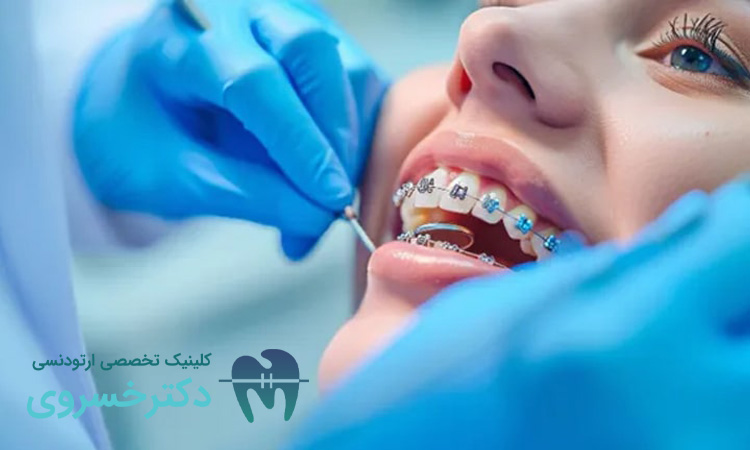
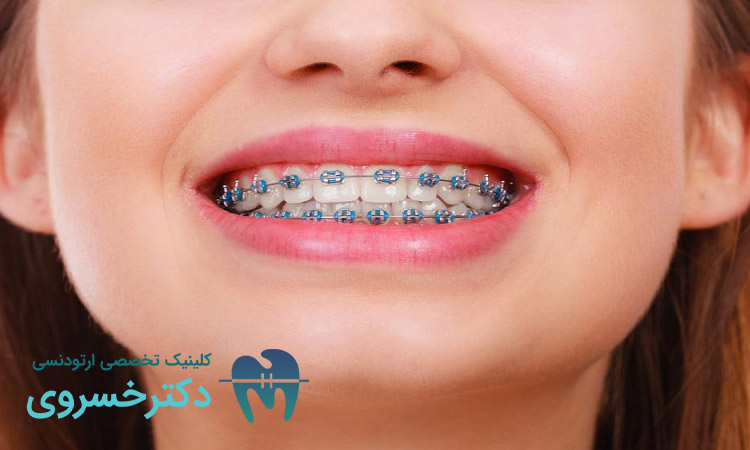
Many people suffer from problems such as crooked teeth, improper spacing or jaw irregularities, but are reluctant to start treatment due to the unpleasant appearance of fixed orthodontic metal brackets. In such a situation, invisible orthodontics was introduced as a modern, beautiful and less troublesome solution. This method not only has stable orthodontic efficiency in many cases, but with transparent and undetectable plaques, it makes the patient go through the treatment period with more confidence. But this question arises for most patients that orthodontics Invisible is exactly suitable for which teeth and under what conditions it cannot be used? What are the conditions that require invisible orthodontics? In the following, we will discuss this issue and then explain about invisible orthodontic transparent plaques.
What are the conditions that require invisible orthodontics?
Invisible orthodontics is mostly used to treat mild to moderate dental problems. This method gradually guides the teeth to the correct position by using transparent plaques that are placed on the teeth. The important point is that the success of this treatment depends on the amount of dental and jaw abnormalities.
In general, invisible orthodontics is suitable for the following cases:
- Slightly irregular or crooked teeth (mild to moderate crowding)
- Existence of small spaces between teeth (Gap or Diastema)
- Minor problems in the bite (meeting of teeth upper and lower jaw)
- Partial correction after fixed orthodontics (small displacements after the end of traditional treatment)
- People who care a lot about aesthetics and don't want wires and brackets to be seen in their mouths
Because of its transparent and undetectable appearance, this method is an excellent option for adults and even teenagers who care about the beauty of their smile in work, school or social gatherings.
Who are invisible orthodontics not suitable for?
In spite of all the benefits, invisible orthodontics has limitations and is not the best choice for everyone. In fact, in some situations, this method cannot replace fixed orthodontics.
The cases in which invisible orthodontics is not recommended are:
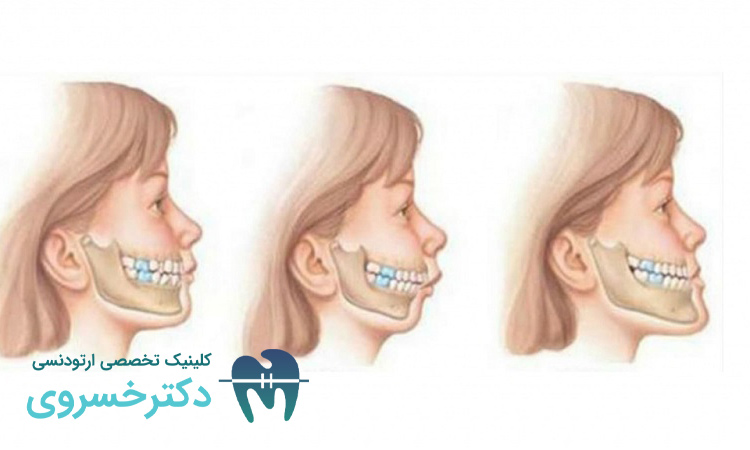
- Patients with severe jaw problems: if the deformity of the upper or lower jaw is serious, transparent plaques are not able to correct it. It is.
- Impatient or undisciplined patients: invisible orthodontics should be used 20 to 22 hours a day. Patients who regularly remove the plaque do not get the desired result.
- People with very small or unusual teeth: in these conditions, the plaques do not sit well on the teeth and lose their effectiveness.
- Very young children: due to the need for cooperation and strict adherence to the instructions, invisible orthodontics is recommended for teenagers and adults.
Orthodontics Invisible with transparent plates
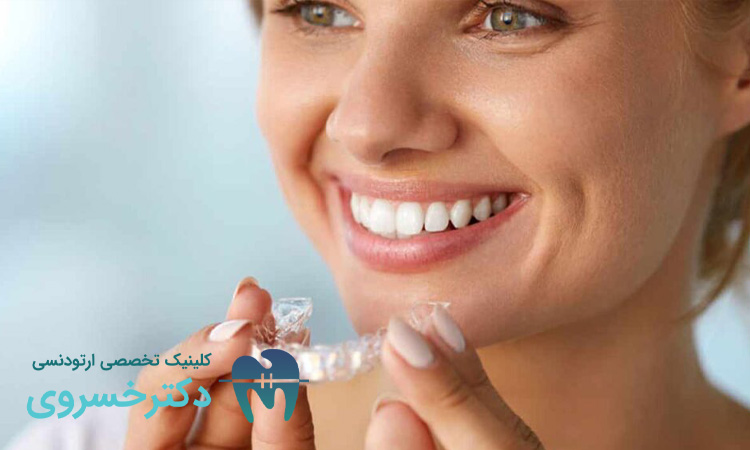
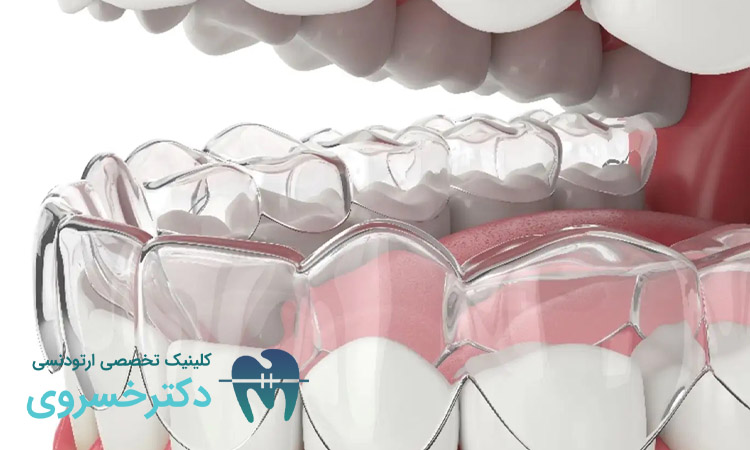
One of the most important types of invisible orthodontics is the use of transparent plates (Aligners). These plaques are made of resistant and colorless medical plastic and are specially designed for each patient. The process of treatment with transparent plaques includes several steps:
- Scanning or molding of the teeth to prepare a 3D model.
- Designing the phased movement of the teeth by specialized software.
- Making a set of plaques, each of which should be used for about 2 weeks.
- Gradual replacement of the plaques until the teeth are in the ideal position
The advantages of transparent plaques in invisible orthodontics are:
- Inconspicuous and transparent appearance
- Possibility of removal when eating and brushing teeth
- More comfort than metal brackets
- Reducing the possibility of damage to the gums and oral mucosa
- Easier oral hygiene during treatment
However, it should be noted that Transparent plaques require proper care and maintenance. Regular washing with special solutions and use according to the doctor's prescription is a condition for the success of the treatment.
Advantages and limitations of invisible orthodontics compared to traditional fixed methods
- Invisible orthodontics, often known by the use of removable transparent molds such as Invisalign systems, compared to Fixed orthodontics has certain advantages and limitations that affect treatment decisions. Among its positive aspects, we can mention the more acceptable appearance and relative invisibility of the treatment, which is especially important for adults and people who need to maintain a professional image in professional or social environments. In addition, the possibility of removing the device for more accurate cleaning of the teeth and reducing the risk of plaque accumulation and periodontal problems is sometimes reported.
- Relative comfort when talking and eating is another advantage of using invisible orthodontics, because patients can tolerate shorter periods than keeping the device in the mouth and have fewer dietary restrictions. From a health point of view, removing the device in certain periods helps the process of cleaning the teeth and plaque control, and some patients feel more relaxed in terms of oral hygiene. However, there are also significant limitations: typically, the higher initial cost and the need for technical expertise to produce and closely monitor molds can outweigh the apparent advantages. Also, the efficiency of this method depends heavily on the continuous and accurate cooperation of the patient; If the appliance is not used regularly or is not properly placed, the treatment results may remain incomplete.
- Severe tooth gaps or complications of the tooth position can also reduce the efficiency compared to fixed orthodontics, and in some cases there is a need to combine with fixed methods or other technologies. The duration of treatment in invisible orthodontics is usually equal to or slightly longer than some fixed protocols, and regular follow-ups are necessary to assess progress. Invisible or wired orthodontics? Which is better? Ultimately, the decision between these two approaches should be based on a careful clinical assessment, treatment goals, oral health status, as well as the patient's personal preferences.