
What is an oral genital wart and what are its symptoms?

Dr. Diana Hosseini
MashhadGynecological cancers fellowship, specialist in obstetrics and gynecology
Oral genital warts is a viral infection caused by human papilloma virus (HPV) is created. This virus can infect different parts of the body such as the mouth, throat and genitals and cause warts.
Symptoms of oral genital warts:
- The appearance of white lesions or clusters in the mouth, lips, gums or tongue
- Creation of a white, foul-smelling substance in the tonsils that comes out when pressed
- The appearance of a halo Pale brown spots on the gums

Treatment of oral genital warts usually involves the use of topical herbal remedies such as garlic ( Garlic in the treatment of genital warts ) and aloe vera gel, which are effective in relieving symptoms and healing faster due to their antiviral and anti-inflammatory properties. همچنین استفاده از تکه های پوست موز یا سیب زمینی خام به مدت چند دقیقه روی زگیل میتواند نتایج خوبی داشته باشد.
در صورت ابتلا به زگیل تناسلی دهانی، انجام تست HPV دهانی و رعایت بهداشت دهان و دندان (مانند مسواک زدن دو بار در روز) توصیه میشود.
چگونه میتوان زگیل دهانی را از زگیل تناسلی تشخیص داد؟
برای تشخیص زگیل دهانی از زگیل تناسلی، میتوان به چندین نکته کلیدی توجه کرد:
محل ظهور
- زگیل دهانی : این نوع زگیل معمولاً در نواحی دهان، زبان، لثه و گلو ظاهر میشود و به طور خاص از طریق رابطه جنسی دهانی منتقل میگردد.
- زگیل تناسلی: این زگیل ها عمدتاً در نواحی تناسلی، مقعدو گاهی اوقات در نواحی نزدیک به آن ها ظاهر میشوند.
علائم و نشانه ها
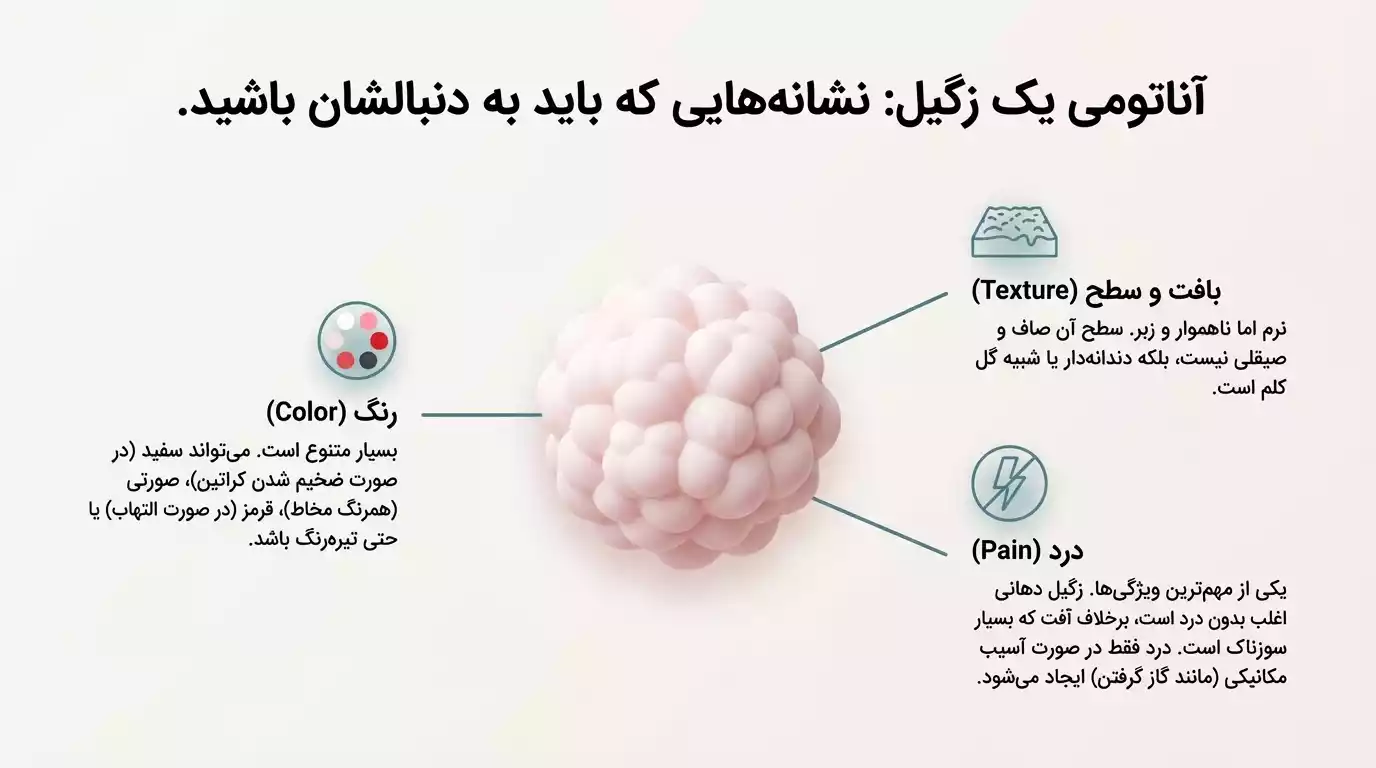
- زگیل دهانی : این زگیلها ممکن است به صورت ضایعات سفید یا خوشه ای در دهان ظاهر شوند و معمولاً علامت خاصی ندارند تا زمانی که به مشکلات جدی تری مانند سرطان دهان تبدیل شوند.
- زگیل تناسلی : این زگیل ها معمولاً به شکل برجستگی های گوشتی همرنگ پوست یا کمی تیره تر هستند و ممکن است خارش یا ناراحتی ایجاد کنند.
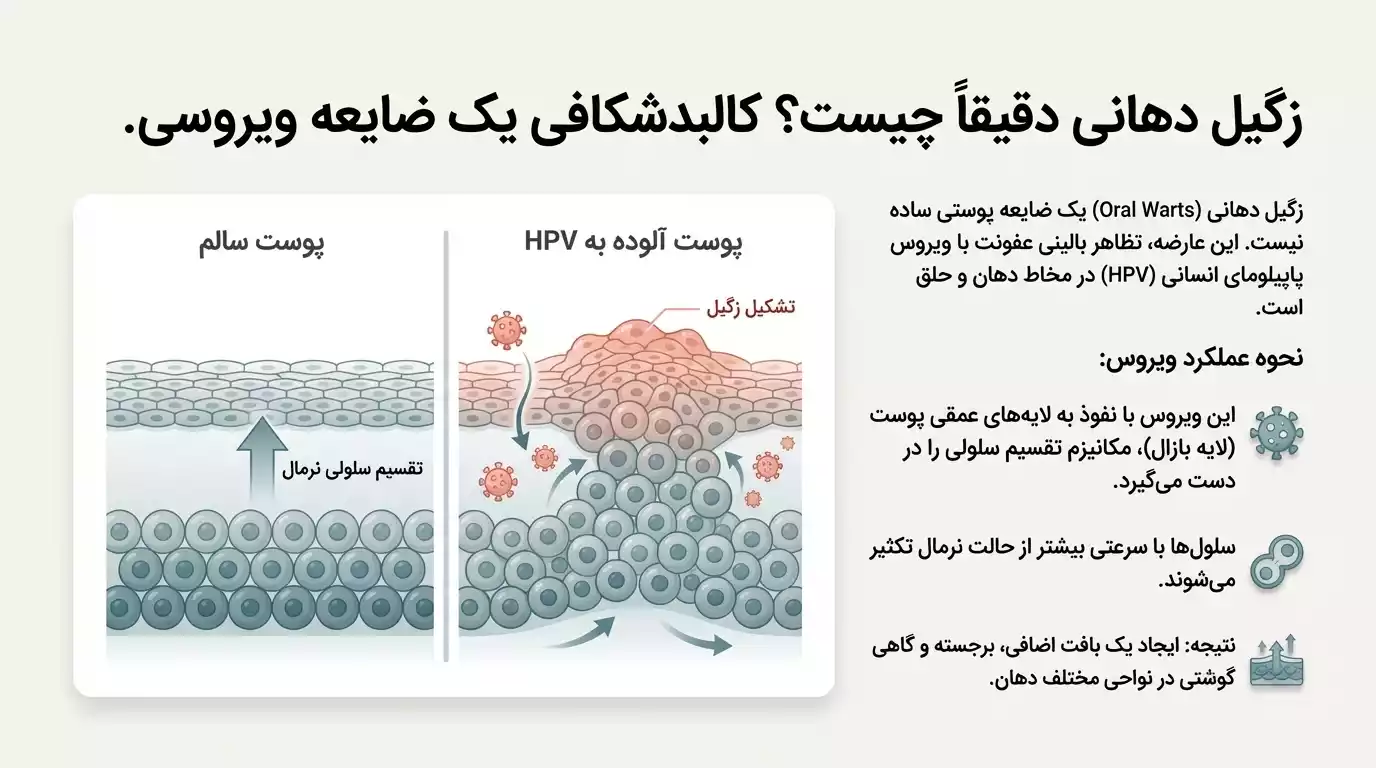
روش های تشخیص
- زگیل دهانی : بهترین روش برای تشخیص این نوع زگیل، انجام آزمایش های خاصی مانند PCR است که با نمونه برداری از سلولهای مخاط دهان صورت میگیرد.
- زگیل تناسلی : تشخیص این زگیلها معمولاً براساس معاینه بالینی و تاریخچه پزشکی فرد انجام میشود، اما در برخی موارد ممکن است نیاز به آزمایشات بیشتری باشد.

تفاوت زگیل دهانی با آفت دهان چیست؟
تفاوت اصلی زگیل دهانی و آفت دهان در موارد زیر است:
علت ایجاد
- زگیل دهانی : ناشی از عفونت ویروس پاپیلومای انسانی (HPV) است که از طریق تماس مستقیم یا رابطه جنسی دهانی منتقل میشود.
- آفت دهان : علت دقیق آن مشخص نیست، اما عوامل مختلفی مانند استرس، حساسیت، کمبود ویتامین و زخم دهانی میتواند سبب بروز آن شود.
محل ظهور
- زگیل دهانی : معمولاً در نواحی دهان، زبان، لثه و گلو ظاهر میشود.
- آفت دهان : معمولاً در داخل دهان، لبها و زبان ایجاد میشود و به ندرت در گلو دیده میشود.
شکل ظاهری
- زگیل دهانی : به صورت ضایعات برجسته، گوشتی و خوشه ای ظاهر میشود.
- آفت دهان : به شکل زخمهای کوچک با رنگ سفید و حاشیه قرمز است که گاهی بسیار دردناک هستند.
مسری بودن
- زگیل دهانی : مسری بوده و میتواند به دیگران منتقل شود.
- آفت دهان : مسری نیست و به خودی خود بهبود پیدا میکند.
مدت درمان
- زگیل دهانی : درمان آن شامل برداشتن زگیلها و مدیریت عفونت ویروسی زمینه ای است.
- آفت دهان : معمولاً ظرف 2 هفته بهبود پیدا میکند و نیاز به درمان خاصی ندارد.
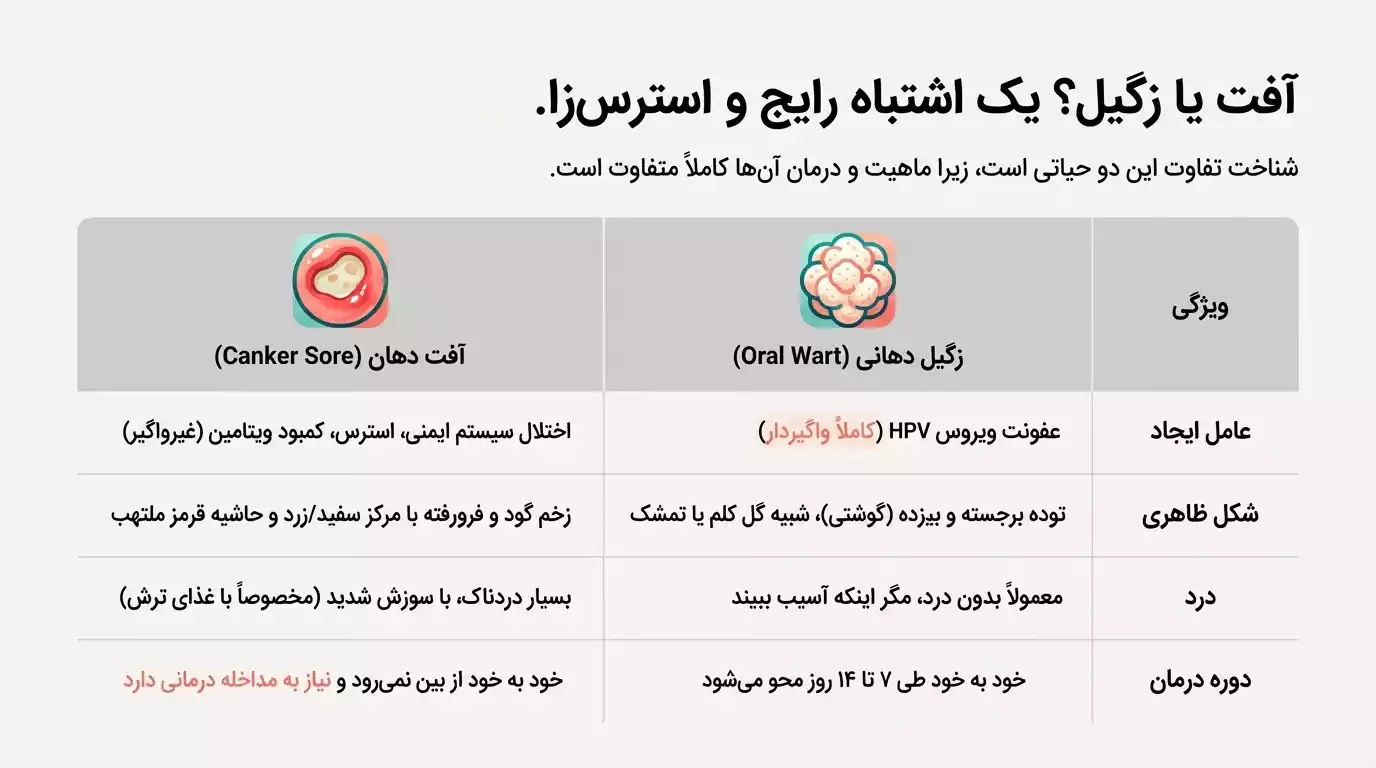
آفت دهان و زگیل دهانی دو عارضه متفاوت در ناحیه دهان هستند که از نظر ظاهر، علت، علائم و درمان تفاوتهای اساسی دارند. در ادامه به مقایسه این دو میپردازیم:
|
Key points:
- Oral lesions are usually caused by internal factors and are not contagious. These lesions are painful but heal naturally within days to weeks.
- Oral warts are caused by a viral infection and can be passed from person to person. These lesions are usually painless, but in certain cases they may be dangerous.

The correct diagnosis of these two complications is very important to choose the right treatment. If you notice any unusual changes in the mouth, it is recommended to see a specialist doctor.
In general, oral warts are a contagious viral infection that requires treatment, but canker sores are a self-limiting ulcer that usually heals on its own.

After how long do oral warts appear?
Infection with human papilloma virus (HPV) can lead to oral warts. The time that these warts appear after infection with HPV varies and usually takes between 1 and 20 months, but the most common time is 2 to 3 months after infection.
In some cases, warts may never appear. This is because many HPV infections are asymptomatic and people may be unaware of the presence of the virus in their bodies. In general, after sexual contact with someone who has HPV, warts usually appear within 3 to 6 months.
Finally, it is important to know that although warts may disappear after treatment, the HPV virus can remain in the body and warts may recur.

Incubation period of oral warts
The incubation period is defined as the time interval between the initial infection with HPV and the appearance of visible oral warts. Review of sources shows that the incubation period of oral warts can be very variable. On average, this time frame is reported to be around three to six months.(source) However, some sources mention a longer period, from six months to a year. In the case of condyloma acuminata, a specific type of oral wart, a shorter incubation period of two to eight weeks has been reported. For genital warts, an interval between one and twenty months has been reported, which can indicate a similar range for oral warts. A user comment also refers to the three-week period. Another source mentions a period of two to nine months 16 and for the common wart (Verruca Vulgaris), the incubation period varies between six weeks and one year.(source)
This variation in reported incubation periods indicates that the time to appearance of oral warts can vary significantly between individuals and depending on the specific type of HPV involved. Importantly, many people infected with oral HPV may never experience visible warts or any symptoms. The virus can remain latent in the body or be eliminated by the body's immune system without any apparent symptoms.
The wide range of reported incubation periods and the high prevalence of asymptomatic cases indicate that relying solely on the absence of symptoms to rule out infection is an unreliable method.

Factors influencing the appearance time of oral warts
The appearance time of oral warts can be affected by various factors.
The specific type of HPV: There are different types (strains or genotypes) of HPV, and some may cause warts to form more quickly than others. For example, condyloma acuminata is often associated with HPV types 6 and 11 and may have a shorter incubation period.
Personal Immune System: The strength and responsiveness of a person's immune system plays an important role in controlling HPV infection. A strong immune system may suppress the virus or kill it completely before warts develop, or it may delay their appearance. In contrast, people with weakened immune systems (eg, due to HIV or immunosuppressive drugs) may experience a shorter incubation period or have more persistent infections. The efficiency of the immune system in managing HPV is a key determinant of the incidence and timing of oral warts, highlighting the importance of overall health in the progression of the disease. Route and rate of infection: It is likely that the amount of virus transmitted during initial contact and the specific site of infection in the oral cavity may influence the time required for warts to appear. However, sources provide less information on this aspect.
General health and lifestyle factors: Factors such as Smoking and alcohol consumption may affect the immune system and potentially influence the course of HPV infection, although their direct influence on the incubation period of warts is not explicitly mentioned in all sources.
Common places where oral warts appear in the mouth
Tongue, lips (especially the lower lip), soft palate, roof of the mouth, gums and throat. Again, many infections are asymptomatic and people may not realize they have HPV or even develop warts. Sometimes, people may experience a lump in the throat or other mild symptoms. It is very important to have regular dental examinations and oral self-exams to detect any abnormalities.
The strong relationship between oral sex and HPV/oral warts shows the importance of observing safe sexual behavior in preventing infection.

Possible side effects of oral HPV
In summary, while most oral HPV infections are harmless and resolve on their own, some High-risk types of HPV (particularly HPV-16) can persist and potentially lead to oropharyngeal cancer (cancer of the throat, tonsils, and base of the tongue) over the years. It is emphasized that this progression to cancer is rare and takes a long time (probably more than 10 years). Oral warts themselves can sometimes cause discomfort, pain (although less common), or difficulty swallowing or speaking, especially if they are large or located in certain areas. It should be noted that in rare cases, HPV infection can lead to recurrent respiratory papillomatosis, especially in babies born to infected mothers. The possibility of an association between some types of HPV and oral cancer, although rare, highlights the importance of long-term surveillance and awareness, especially for people with persistent infections or risk factors.

How to prevent oral warts?
Oral warts are preventable and there are several ways to reduce the risk of developing them:
Methods to prevent oral warts:
Safe sex:
Using a condom during sex, especially during oral sex, reduces the risk of transmission of the human papilloma virus (HPV).
Decreasing the number of sexual partners:
Having fewer sexual partners reduces the risk of oral warts.
Attention to oral and dental hygiene:
Observation of oral and dental hygiene and regular visits to the dentist help to identify and treat oral problems early.
HPV vaccine :
Get HPV vaccine helps prevent infection with some types of human papilloma virus that cause genital and oral warts.
Avoidance of alcohol and smoking:
Consumption of these substances immune system weakens the body and increases the risk of viral infections.
By following these tips, the risk of oral warts can be significantly reduced.

Is condom use effective in preventing oral warts?
Condom use is effective in preventing oral warts, but this effect is limited. Condoms help prevent the transmission of the human papilloma virus (HPV), which is the cause of oral warts, especially in cases where the warts are in coverable areas. However, if the warts are in areas not covered by a condom, such as the groin or around the anus, there is still a risk of transmission.
So, while using a condom helps reduce the risk of oral wart transmission, it cannot completely prevent it. For this reason, it is recommended to combine this method with other preventive measures, such as limiting the number of sexual partners and receiving the HPV vaccine.
After how long does an oral genital wart appear?
An oral genital wart may appear between a few weeks and a few years after the human papilloma virus (HPV) enters the body. In general, the incubation period of this virus varies from 3 weeks to 1-2 years, and this period of time depends on various factors, including the strength of the individual's immune system.
In some cases, the virus may never appear as a wart, and the person will remain a carrier of the virus for the rest of his life. Therefore, timely diagnosis and treatment of oral genital warts is very important.
Can oral warts spread to other parts of the body?
Yes, oral warts spread to other parts of the body. This type of wart is caused by infection with the human papilloma virus (HPV), which is transmitted through direct contact with infected areas.

Oral wart transmission methods
Oral sex:
Oral warts are transmitted through oral sex with a person with genital or oral warts.
Direct contact:
Direct contact with warts or infected areas leads to the transmission of the virus to other parts of the body. For example, if a person has an oral wart and touches another area of their body after touching it, they may transfer the virus to that area.
contaminated environments:
In certain circumstances, such as using contaminated personal equipment or contact with contaminated surfaces, it is possible to transmit the virus.( genital warts without sex )
Therefore, oral warts spread to other parts of the body and it is very important to observe hygiene and safety in sexual relations and physical contact to prevent the spread of this virus to other parts of the body.
Do oral warts spread to other parts of the mouth such as lips and tongue?
Yes, oral warts spread to other parts of the mouth such as lips and tongue. This type of wart is caused by the human papilloma virus (HPV) and is transmitted to other parts of the mouth through direct contact with infected areas.
Methods of spreading oral warts
Direct contact:
If a person has oral warts and touches other areas of his mouth such as lips or tongue, there is a possibility of transmitting the virus to those areas.
Oral sex:
This type of relationship also leads to the transfer of oral warts to other areas of the mouth.
Therefore, oral warts spread to other parts of the mouth, and it is very important to observe hygiene and avoid contact with infected areas. If you notice warts or unusual lesions in the mouth, consult with A doctor specializing in genital warts is recommended.
Can oral warts be recognized?
Oral warts can be recognized according to the signs and symptoms:
Symptoms of oral wart
- Appearance of raised, fleshy, clustered lesions in the mouth, lips, gums, or tongue
- Creation of a foul-smelling white substance in the tonsils that comes out when pressed
- Appearance of halos Light brown on the gums
Zag differenceWhat is oral herpes?
Oral warts and herpes are both viral infections, but there are important differences in their causes, symptoms, and how they are transmitted:
What causes oral warts and oral herpes?
- Oral wart: It is caused by human papilloma virus (HPV) which is transmitted through direct contact with infected areas.
- Herpes: caused by Herpes simplex virus (HSV) and is usually divided into two types: HSV-1 (mostly in oral areas) and HSV-2 (mostly in genital areas).
Symptoms of oral warts and oral herpes
- Oral warts: It appears in the form of prominent and fleshy lesions in the mouth, tongue and gums. These warts are usually painless and may appear in clusters.
- Herpes: It usually appears as small blisters filled with liquid in the mouth or lips. These blisters may be painful and accompanied by burning and itching.
Methods of transmission of oral warts and oral herpes
- Oral warts: It is transmitted through direct contact with warts or infected areas, especially during oral sex.
- Herpes: is transmitted through close contact with infected areas, including kissing or touching blisters. It may also be spread through shared objects such as glasses or towels.
While both infections are contagious and spread through direct contact, oral warts and herpes are caused by different viruses and have different symptoms and transmission methods.
Do oral warts occur in children?
Yes, oral warts occur in children. This type of wart is caused by infection with the human papilloma virus (HPV) and can appear as lesions in the mouth, tongue and gums.
Symptoms and signs of oral warts in children
Oral warts in children are usually in the form of small, fleshy bumps and may be painless. In some cases, these warts cause discomfort or difficulty in eating and speaking.
Methods of transmission of oral warts in children
Oral warts in children are transmitted through direct contact with warts or infected areas. Also, children with warts should avoid chewing or putting their fingers in their mouths to prevent new warts from forming.
Treatment of oral warts in children
In many cases, oral warts in children improve by themselves and do not require special treatment. However, if the warts cause discomfort or problems, consultation with a doctor specializing in the treatment of genital warts is recommended.
How can you prevent the occurrence of oral warts in children?
To prevent the occurrence of oral warts in children, you can use the following methods:
personal hygiene
- Hand washing: Teaching children to wash their hands regularly, especially after playing and before eating, can help reduce the risk of virus transmission.
- Avoid touching warts: Teach children to avoid touching warts or infected areas.
Limit contact with infected people
Avoid close contact: If your child is in contact with someone who has oral warts, they should avoid close contact.
Education about oral hygiene
Regular brushing: encouraging children to brush twice a day and use mouthwash helps maintain oral hygiene.

Laser Therapy, the gold standard in the treatment of oral warts
Laser (especially the CO2 laser) is one of the most effective, precise and modern methods for treatment It is an oral wart. The laser vaporizes the wart tissue with high light energy concentration.
Why is laser the best option for treating oral warts?
In the oral environment where the tissues are very bloody, surgery with a razor causes a lot of bleeding and disturbs the doctor's vision. But the laser has the property of "coagulation", that is, at the same time as it cuts, it closes (seals) blood vessels and small nerves. This minimizes the bleeding and pain after the operation.
Advantages: Microscopic accuracy (without damage to the surrounding healthy tissue), greatly reducing the possibility of recurrence (because it inactivates the viruses around the lesion), no need for stitches in many cases, and the ability to be used for lesions that are difficult to access.
Cryotherapy (Cryotherapy - freezing) in the treatment of oral warts
Using liquid nitrogen (with a temperature of minus 196 degrees Celsius) to freeze and destroy the oral wart tissue.
This method is suitable for small and accessible warts (for example, on the lip or front of the tongue).
Limitations in the mouth: It is more difficult to use cryo inside the mouth and throat. The moisture in the mouth makes it difficult to control the area of freezing and the surrounding healthy tissues may be damaged or a severe swelling may occur in the throat that makes breathing difficult. There is also a possibility of blistering in the mouth, which is annoying. The rate of recurrence in cryo is usually higher than laser.
Traditional surgery (Excision) for oral warts
Removing the lesion with a surgical blade (scalpel) and suturing the site. This method is usually performed for very large, base and bulky lesions or when the doctor suspects malignancy and needs to take a precise sample (biopsy) and send the healthy tissue to pathology.

Home and herbal remedies for oral warts (facts, dos and don'ts)
Many patients look for home remedies for warts before going to the doctor. They are oral. Although these methods are not a substitute for definitive medical treatment and should not be considered as the main treatment, they are helpful in some cases as complementary treatment.
serious warning: oral mucosa is very delicate; Never use strong acidic substances or skin medications (such as podophyllin) inside the mouth without consulting a doctor.
Garlic to treat oral warts:
Garlic contains a substance called "Allicin" which It has strong antiviral properties. Applying fresh garlic extract to oral warts (being very careful not to burn the surrounding healthy tissue) may help.
Green tea to treat oral warts:
Studies have shown that green tea extract (syncatechin) It has antioxidant and antiviral properties. Drinking green tea regularly and gargling it helps to strengthen mucosal immunity and treat oral warts.
Apple vinegar for treating oral warts:
While it is used for skin warts, its use in warts Oral can be very painful and cause chemical burns of the mucous membrane, erosion of tooth enamel and ulcers, so it is not recommended. Consuming foods rich in:
- Vitamin B12 and folate (B9): dark green leafy vegetables, legumes.
- Antioxidants: red and purple fruits, citrus fruits.
- Avoidance of: sugar, sugar, alcohol and complete cessation cigarette and Hookahs (which are the number one enemy of the immune system in the mouth) multiply the speed of cleaning the virus.
Oral warts and trends Healing after treatment
After oral wart treatment (for example, with laser), the wart scar may remain as a small, white or gray superficial scar. Fortunately, the oral mucosa has excellent regeneration power due to its excellent blood supply. These wounds usually heal quickly (within a few days to two weeks) without leaving a scar. But if needed, you can use a Wound and scar treatment specialist consult.
Is the oral wart virus also eliminated with laser Is it?
No, physical treatments (laser, cryo) only remove the "manifestation of the disease" (i.e. the wart) and greatly reduce the viral load in that area. The virus may remain latent in surrounding cells or in the bloodstream. Therefore, it is necessary to strengthen the immune system to prevent recurrence (return of warts) and to eradicate the virus by the body itself. Facts and concerns
Are oral warts dangerous? This is a question that keeps patients awake.
- The good news: Most visible oral warts (especially those caused by HPV 6 and 11 are created and look like cauliflower) are benign and do not turn into cancer.
- Serious news: Persistent and long-term infection with "high-risk" strains such as HPV 16 and 18 can lead to cell changes and eventually Oropharyngeal Cancer, especially in the area of the tonsils and the end of the tongue. Unfortunately, these precancerous lesions sometimes do not look like warts and are seen as red or white flat spots.
- Lumps in the neck or mouth that grow.
- Changes in the color of the oral tissue to a velvety red (erythroplakia) or uniform and hard white (leukoplakia).
- Difficulty in swallowing, persistent one-sided earache or long-term voice change.
That is why it is necessary to refer to specialists like Dr. Diana Hosseini for a detailed examination, if necessary, sampling and determining the type of virus (HPV Genotyping). It is vitally important to put your mind at ease about the type of virus.

Frequently asked questions (FAQ) about oral warts
What is a wart on the tongue like and does it cause taste disturbance?
A wart on the tongue is usually raised, rough and white or pink. If it is large, it causes physical disturbance in chewing food, but it does not directly damage the taste nerves and does not destroy the sense of taste. Stone) is a cheesy white/yellow, foul-smelling, exfoliating mass that hides in tonsil cavities and comes out with coughing. An oral wart is a living, pink/white tissue attached to the mucous membrane, fleshy and hard that does not peel off and does not have a specific smell. Herpes is caused by HSV virus and appears as juicy, painful and painful blisters that burst, become sore and heal after a while. A wart is caused by HPV, it is a hard and fleshy mass that is painless, not juicy and does not disappear by itself. The most common cause is "self-inoculation"; It means that the child sucks the wart on his hand and transfers it to his mouth. Also Transmission from an infected mother during natural childbirth or contact with contaminated equipment is also possible. In rare cases, the possibility of sexual abuse should also be checked by a doctor. In children, the type of "focal epithelial hyperplasia" or "common wart" is more common.
Can you have sex after oral wart treatment?
It is better until the wounds caused by laser or Cryo (usually 2 weeks) and ensure all lesions are removed, avoid oral sex. After that, it is recommended to use a condom and be careful until the immune system clears the virus completely. Conclusion: Relax in the shadow of awareness Oral genital warts, although it has a scary name and can cause severe anxiety, but with awareness, timely diagnosis and proper treatment, it can be completely managed and treated. The most important thing is not to panic at the sight of any lesion in the mouth (because it may be just a simple pest or tonsil stone), but also not to be indifferent to it. The subtle differences between canker sores and oral warts, or the symptoms of throat warts and other lesions, are points that can sometimes only be seen with a sharp eye. href="https://drdianahoseini.com/%D8%A8%D9%87%D8%AA%D8%B1%DB%8C%D9%86-%D9%85%D8%AA%D8%AE%D8%B5%D8%B5- %D8%B2%DA%AF%DB%8C%D9%84-%D8%AA%D9%86%D8%A7%D8%B3%D9%84%DB%8C-%D8%AF%D8%B1-%D9%85%D8%B4%D9%87%D8%AF/" style="user-select: auto;">genital wart specialist doctor are identified.
Remember that your health is your most valuable asset. Avoiding risky behaviors, doing Gardasil vaccination, strengthening the immune system and regular dental and medical checkups are the keys to health. If you see any suspicious symptoms or have concerns, consulting with expert, caring and experienced doctors like Dr. Diana Hosseini can make the treatment path shorter, less expensive and reassuring.
