
Who are suitable candidates for this operation?
For most people who use glasses or contact lenses, it happens more or less that they get tired of using these two devices. All kinds of surgeries to correct the eye score are very common in Iran, which bring brilliant and very impressive results for patients. One of the most successful and least complicated of these surgeries is lasik eye surgery.
After the surgery, the results of this operation are completely noticeable to the patients and serious complications are rare and most people will be satisfied with its results. Some side effects, especially dry eyes and temporary visual disturbances are common after this procedure, which disappear after a few weeks. In this article, we intend to get to know more about this eye surgery and its advantages and disadvantages and to know who are suitable candidates for it.
What is LASIK eye surgery?
LASIK eye surgeries are the most famous and common laser refractive error correction surgery performed to correct vision problems. Today, there are different types of laser refractive surgery in ophthalmology clinics. Usually, the term "LASIK" is used to refer to all types of laser eye surgery. In a healthy eye, the images of the objects we see are focused on the retina at the back of the eye. With nearsightedness, farsightedness, or astigmatism, they eventually focus either in front of or behind the retina, leading to blurred vision. In other words, in eyes with normal vision, the cornea bends light precisely onto the retina at the back of the eye. But with farsightedness, myopia or astigmatism, the light entering the eyes is bent incorrectly and this problem leads to blurred vision.
Glasses or contact lenses can correct the vision of the eyes, but changing the shape of the cornea in various ways also creates the necessary refraction of light to improve vision. During LASIK surgery, a special type of laser cutting is used to precisely change the shape of the dome-shaped clear tissue in front of the eye, the cornea, to improve vision.
What problems is LASIK eye surgery recommended to improve?
LASIK surgery is recommended by doctors as a convenient and low-risk option to correct one of these vision problems:
1. Myopia
When our eyeball is slightly longer than normal or when the cornea of the eye is strongly curved, light rays focus in front of the retina and blur your far vision. People with this problem can see objects that are close but have trouble seeing objects that are far away.
2. Camera
When the eyeball is shorter than average or a person's cornea is too flat, light is focused behind the retina instead of on it. This causes near vision and sometimes distant vision to become blurred.
3. Astigmatism
When the cornea of the eye is uneven, i.e. curved or flat, astigmatism occurs. This problem impairs the focus of vision at both near and far distances. It means that people with this problem have blurred vision both to see distant objects and to see near objects.
If you plan to have LASIK surgery, you already wear glasses or contact lenses. Your ophthalmologist will discuss with you whether LASIK surgery or other similar refractive error correction procedures would be beneficial for you.
What are the benefits of LASIK eye surgery?
- In this outpatient surgery, patients usually do not experience pain. Anesthetic drops are used during the operation, and the mild pain after surgery is also improved with regular painkillers.
- With LASIK, a person's vision improves immediately after surgery. According to research, 95% of patients who undergo LASIK surgery achieve a perfect vision score.
- In most cases, there is no need for bandages or eye stitches, and the patient can resume his normal life after 24 hours.
- With the LASIK operation, it may take a few weeks for your vision to improve, but the result is permanent.
- Most patients do not need to wear glasses after LASIK.
- Even though LASIK is considered an expensive procedure all over the world, over the years, patients will not need to change glasses and lenses and will not pay for it.

What side effects can eye LASIK surgery have?
Serious complications after this procedure are very rare. But some side effects, especially dry eyes and temporary vision problems, may occur in a percentage of patients. These effects usually disappear after a few weeks, and in a small number of people, the effects last longer than this time.
The side effects of LASIK surgery are:
· Dry eyes
LASIK operation in some people causes a temporary decrease in the production of tears in the eyes. Dry eye can reduce the quality of vision. Ophthalmologists usually use "artificial tear" eye drops to solve this problem.
·Sensitivity to intense light, observing light aura and double vision
You may have vision problems from the night after surgery to several days or weeks after surgery. You may have increased sensitivity to light. In these cases, the eyes will have mild pain when exposed to strong light. Some people see halos of light around bright lights, or others complain of double vision. Don't worry! These problems will be fixed soon.
· Flap Problems
or removing the protective flap from the front of the eye during surgery, may rarely cause complications, including infection and excess tears.
Regression or return of refractive errors
This problem occurs when your vision slowly changes from its original state. This is a very rare complication and it will not occur if you have been diagnosed as a suitable candidate for this operation.
In what circumstances is LASIK eye surgery not suitable for you?
Some conditions and health problems can increase the risks associated with LASIK surgery or affect the outcome. Including:
- Autoimmune disorders and diseases
- Weakened immune system due to immunosuppressive drugs or AIDS
- persistent and untreated dry eye
- New changes in a person's vision due to the use of certain drugs, hormonal changes, pregnancy, breastfeeding
- old age
- Cornea inflammation, eyelid diseases, serious eye injuries or eye diseases such as uveitis, herpes simplex, glaucoma or cataracts
LASIK surgery is usually not recommended in the following cases:
- Do you have an eye disease that causes thinning and bulging of the cornea or a family history of this problem
- If you have a good overview.
- extreme myopia
- Have very large pupils or thin corneas. In these cases, the doctor suggests other solutions and eye surgeries.
- Have age-related eye changes.
- If you participate in violent sports that may involve blows to the face.
If you are considering LASIK, talk to your doctor about your questions and concerns. Your doctor will discuss whether you are a good candidate for this procedure or other similar procedures.
What examinations are performed before LASIK eye surgery?

The part of screening people to select suitable cases for this surgery is one of its most important parts. If you are diagnosed as a suitable case for this surgery, you will get a good result. Also, if you wear contact lenses that can change the shape of your cornea, you should stop wearing them completely and wear only glasses for at least a few weeks before your evaluation and surgery.
During the exam and evaluation period, the eye doctor will ask about your past medical and surgical history and will give you a comprehensive eye exam to evaluate your vision and assess whether you can safely undergo the procedure. The doctor will look for the following symptoms:
- eye infection
- big pupils
- Inflammation
- dry eye
- high eye pressure
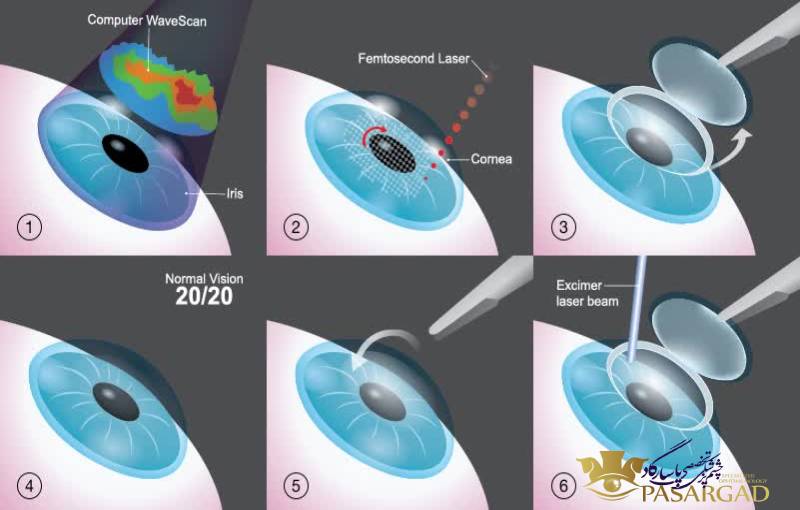
The ophthalmologist will also measure the cornea of the eye with the device and check the shape, thickness and any problems and irregularities. With special devices, the ophthalmologist evaluates which area of the cornea needs to be reshaped. He determines the exact amount of tissue to be removed from the cornea. Doctors usually use special technologies to carefully evaluate your eyes before LASIK surgery.
In this experiment, a "scanner" draws a highly detailed diagram of the eye. The more accurate the measurements, the more accurate the ophthalmologist will be in removing the corneal tissue. Before surgery, your doctor will discuss the risks and benefits of LASIK surgery, pre- and post-operative expectations, and any questions you may have.
What are the stages of eye LASIK surgery?
The LASIK procedure is usually completed in 30 minutes or less. During the procedure, you lie on your back in a chair. You may be given a sedative to help you relax. After putting numbing drops in the eye, the doctor uses a device to hold the eyelid open. A suction ring will be placed over your eye, which may feel pressure and make your vision a little blurry.
The eye surgeon uses a cutting laser to cut a small flap from the front of your eye. Folding the flap back allows the doctor to access the part of the cornea to be reshaped. Then, using a programmed laser, your eye surgeon will reshape parts of the cornea. With each laser beam pulse, a small amount of corneal tissue is modified. After changing the shape of the cornea, the surgeon places the flap in its place.
During the surgery, you will be asked to focus on a single point of light. Staring at this light will help you steady your eyes. If both eyes need correction, doctors usually perform the procedure on the same day.
care after LASIK eye surgery
Immediately after surgery, your eye may be itchy, burning, and watery. At this time, you will most likely have blurred vision. After the numbness wears off, you may have some pain, but your vision will improve quickly. You may be given painkillers or eye drops to keep you from feeling pain for a few hours after the procedure. Your eye doctor may also ask you to wear an eye shield at night until your eye heals.
After this operation, vision starts to improve. For many people, it won't take long to fix eye problems and get clear vision, but it takes two to three months to see the full and final results.
One to two days after surgery, the doctor should examine your eyes. He will see how your eye is healing and check for any complications. Plus, it may take a few weeks before you can use eye makeup again. It is also better to avoid intense sports, swimming or jacuzzi for several weeks.

What are the results of LASIK eye surgery?
More than 8 out of 10 people who have LASIK surgery no longer need to wear glasses or contact lenses for most of their activities. People with mild myopia have the most success with LASIK surgery. People who have a high degree of myopia or hyperopia with astigmatism will have less predictable results.
Returning to the previous eye score may occur due to certain conditions such as abnormal wound healing, hormonal imbalance or pregnancy, or the development of cataract disease.
Last words
LASIK eye surgery is one of the common surgeries to fix eye refractive errors, which has been very popular in recent years and has good results for patients. If you have nearsightedness, farsightedness or astigmatism and are tired of wearing glasses, with this procedure you can get a perfect eye score with high confidence.