
Table of contents
- What is suicide?
- Common misconceptions about suicide
- Types of suicide
- Symptoms of suicide and a person's tendency to use suicide methods
- What is the cause of suicide?
- Ways of helping someone who says he wants to commit suicide
- What should we do if someone commits suicide? href="#h-%D8%AF%D8%B1%D9%85%D8%A7%D9%86-%D8%A7%D9%81%DA%A9%D8%A7%D8%B1-%D8%AE%D9%8 Treatment What are the thoughts of suicide?
- Complications of suicide for those around you
- What are the ways to prevent suicide?
- What should you do if you have thoughts of suicide right now?
- Conclusion
Listen to the summary of this article in this podcast:
You can listen to the rest of this podcast in this section:
Sometimes the pressure of life becomes so heavy that one feels there is no way out. In this situation, the mind may start looking for phrases like the easiest way to commit suicide or suicide with pills. But the truth is that behind these searches, there is often deep pain, despair and loneliness. Suicide is one of the most important social health problems and one of the 10 main causes of death in the world. Suicide is not a sudden and simple choice, but the result of a set of psychological, social and biological factors. The good news is that, in most cases, this path is preventable. Recognizing its warning signs and starting professional treatment are the best ways to control thoughts related to suicide. In this article, we will check with your doctor what is the cause of suicide and how to prevent it.
What is suicide?
Suicide means a conscious act to end one's life, which usually occurs as a result of psychological, social pressures or unresolved problems. This phenomenon is a complex problem that can result from the combination of biological, psychological, social and environmental factors. Depression, severe anxiety, mental disorders such as bipolar disorder, or bitter life experiences such as the loss of loved ones, emotional failures or financial problems, are common causes of suicide.
People who are thinking about suicide often feel deeply hopeless and unable to find a solution to their problems. These thoughts can be accompanied by symptoms such as isolation, extreme mood swings, frequent talk about death, or giving away personal belongings. Suicide has a profound effect not only on the individual but also on the family, friends and society. Therefore, its prevention requires public awareness and providing appropriate support.
To reduce the risk of suicide, one should pay attention to the warning signs and encourage the person to get professional help from psychiatrists, counselors or support centers. Creating a safe environment, emotional support and strengthening hope for the future are among the effective ways of prevention. Suicide is preventable and timely intervention can save many lives.
What is the difference between suicidal thoughts and suicide attempts?
Suicidal thoughts mean thinking about death or wishing to die, without necessarily having a plan of action. These thoughts can be transient or persistent and vary in intensity. Many people may experience such thoughts at some point in their lives. Suicide attempt occurs when a person goes through the thinking stage and plans or takes action to harm himself. The difference between these two stages is very important, because the intervention in the stage of suicidal thoughts is much more effective and easier than when the person has entered the action phase.
If you see someone who is suicidal, call 123 social emergency number or 1480 welfare organization and get free counseling.
suicide in religion
In all religions, suicide is prohibited and considered a sin. Common cultural beliefs about suicide in all countries consider this act as a weakness and consider it a wrong solution to escape from pain. In different religions, suicide due to injury to the body is considered a great sin. Life is a gift from God and destroying it is a form of ungratefulness of God's blessings. This issue has caused many people to refrain from suicide and self-harm during the times of life's problems and pressures.
False and common beliefs about suicide
There are many misconceptions about suicide that can hinder the prevention process. Some people think that those who talk about suicide are just looking for attention, while talking about death can be a serious warning. Another misconception is that if someone is looking for the best method of suicide or pills for suicide, he must have made a definite decision.
In fact, many of these searches are signs of a cry for help. Also, the notion that talking about suicide increases its likelihood has not been scientifically confirmed. An open and empathetic dialogue can be a lifesaver. Some of these misconceptions are:
- People who talk about suicide are not actually doing it. This belief is completely wrong. Many people have given clues or warnings before committing suicide. Even sentences and indirect references to death can be symptoms of this problem. Like: "When I'm gone, you'll come to us"
- Anyone who tries to kill himself is crazy. This belief is also wrong and many of these people are not psychopathic or crazy. Many of them are disappointed, depressed, upset and sad. This discomfort and emotional pain does not necessarily mean mental illness.
- If someone is determined to commit suicide, nothing can stop him. But the reality is not like that. The motivation to end life is not permanent. Even a very depressed person may have fluctuating feelings about the will to live and die. Instead of wanting to die, these people just want to stop the pain, and this pain can be stopped in other ways.
- People who choose death don't want to get help from others. If this is not true. Many people seek help before committing suicide. Studies show that more than half of the victims sought help from a psychologist in the 6 months before their death. Talking about suicide can give a person an idea. This belief is wrong. You're not giving anyone ideas by talking about it. Speaking openly and honestly about these thoughts and feelings can save a life.
Types of suicide
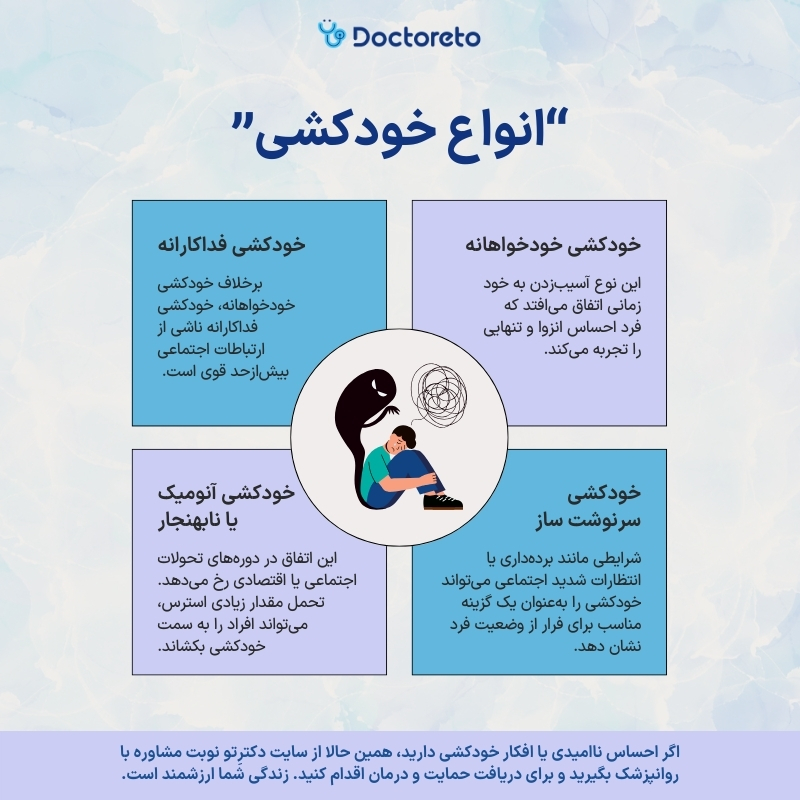
Suicide can have different forms and can be classified based on the motivation, planning and psychological conditions of the person. Some things are done with long planning and others happen impulsively and suddenly. Knowing the types of suicide helps professionals to design more appropriate prevention strategies. Many cases are preventable with treatment of underlying disorders and social support. Emile Durkheim, a prominent sociologist, has identified 4 main types of suicide, each based on the individual's relationship with society:
-
Selfish suicide: This type of self-harm occurs when a person feels isolated and alone. People who feel cut off from the support of friends and family may see suicide as the only way to escape their deep loneliness.
- Altruistic suicide: Unlike selfish suicide, altruistic suicide is caused by too strong social connections. In such cases, people may sacrifice their lives for a greater event.
- Anomic or abnormal suicide: This happens in periods of social or economic changes. Enduring a large amount of stress can lead people to commit suicide as a means of escape.
- Fateful suicide: conditions such as slavery or severe social expectations can present suicide as a suitable option to escape from one's situation.
What is impulsive-suicide and why is it dangerous?
Impulsive suicide occurs without prior planning and in response to a crisis or intense feeling. This type of behavior usually occurs in situations such as arguments, emotional breakdowns, or alcohol and drug use. The danger of this type of suicide is because the distance between thought and action is very short. Limiting access to dangerous equipment and delaying the decision can save a person's life.
Symptoms of suicide and a person's desire to use suicide methods
Suicidal ideation begins with warning signs such as talking about killing oneself. If you are aware of these symptoms, you can take the necessary measures to treat and prevent them from happening. Any of the following may be red flags that should be heeded. However, keep in mind that these warning signs are not always present and vary from person to person. These signs may be verbal, behavioral or emotional. Paying attention to these symptoms can create an opportunity for intervention. Some people express their intentions, while others keep their thoughts and feelings secret from others:- Talking about suicide: statements like "I'm going to kill myself," "I wish I were dead," or "I wish I'd never been born." Or saying that he has no reason to continue living.
- Talking about feeling alone, hopeless, or stuck
- Frequent search about suicide ways or suicide pills
- Preparing tools for self-harm, such as keeping pills
- Withdrawal from groups and desire to live alone
- Donating valuable personal items
- Existence of mood swings, strong emotions and excitement on one day and extreme discouragement on another day
- Tendency to violence
- Feeling trapped or hopeless in certain situations
- Setting up a will and handing over expensive property to family members or friends
- Increasing alcohol or drug use
- Change in the normal routine of life, including a change in the eating and sleeping pattern, such as a sharp increase or decrease in night sleep, or a sharp increase or decrease in appetite, and as a result, weight loss or gain.
- Doing dangerous things like reckless driving
- saying goodbye to the people around you as if you will never see them again
- Personality changes or severe anxiety, especially when accompanied by one of the previously mentioned symptoms
Some symptoms require immediate action. If the person expresses a specific plan to commit suicide or talks about suicide with pills and preparing suicide pills, the issue should be taken seriously. In such situations, leaving the person alone, trivializing what they say, or blaming can increase the risk. It is necessary to contact psychiatric emergency centers or accompany the person to receive professional help.
If you see someone who is suicidal, call 123 social emergency number or 1480 welfare organization and get free counseling.
risk of suicide with types of drugs: symptoms of suicide with pills
A study conducted between 2008 and 2013 showed that painkillers, fever reducers, antidepressants and antipsychotics are the most commonly used drugs in self-harm. Younger people usually use anti-depressants when attempting suicide, while older people use sleeping pills more often.In some cases, children, adolescents and young people under the age of 25 experience suicidal thoughts or increased behaviors when starting to take antidepressants, especially in the first few weeks or when changing the dose. However, note that antidepressants reduce the possibility of self-harm by improving mood in the long run. The symptoms of drug poisoning at different ages are:
- Decreasing the level of consciousness
- narrowing of the pupils
- breathing problems
- Lower blood pressure
- muscle relaxation
- Mood changes Drowsiness and dizziness Restlessness
- Nausea and vomiting
- Seizures
- Illusion
| Symptoms of suicide | Cause |
|---|---|
| Preparing tools for self-harm such as holding pills | History of suicide attempt |
| Feeling sad and not enjoying life | Depression Acute |
| Mood swings | Experience bullying or discrimination |
| Tendency to violence | Loss of a loved one |
What is the cause of suicide?
Suicide is usually not the result of a single cause. Most people who engage in suicidal thoughts experience a series of psychological and social pressures at the same time. Sometimes a person lives for years with types of depression, anxiety or unresolved injuries and suddenly a crisis such as separation, bankruptcy or loss of loved ones brings this pressure to the point of explosion. In this case, the mind may mistakenly think that the only way to end the pain is to end the life.
On the other hand, in many cases, thinking about ways to commit suicide or searching for terms like the best way to commit suicide or pills for suicide does not necessarily mean a definite decision. This behavior is a cry for help in many people. The person looks for a way to silence his suffering and because he feels that no one understands him, he takes refuge on the Internet. Suicide may be related to genetics. Many people who kill themselves or have suicidal thoughts have a family history of suicide. Psychologists consider exposure to difficult situations as the main cause of self-harm. People usually tend to commit suicide due to one of the following reasons:
- History of attempted suicide
- Underlying mental disorder and mental trauma such as acute depression, post-traumatic stress disorder or bipolar disorder
- Experience of bullying or discrimination
- Different types of abuse including rape, domestic, physical or physical abuse
- Losing a loved one
- end of a relationship
- Long-term physical pain or illness
- Not adapting to big changes like retirement or layoff
- Financial problems
- Housing problems including homelessness
- Isolation or loneliness
- Going to prison
- Experiencing a stressful situation such as military service or entrance examination
- Feeling of inadequacy or failure in a path
- drug addiction
- Pregnancy, childbirth or postpartum depression
- doubting one's sexual identity or gender
- Cultural pressures such as forced marriage
- Family history of mental disorders, substance abuse, physical or sexual violence
If you see someone who is suicidal, call 123 social emergency number or 1480 welfare organization and get free counseling.
What are the reasons for suicide in teenagers and young adults?
Adolescents and young people are more involved in intense emotions and rapid psychological changes than any other group. This period of life is usually associated with academic pressures, social comparisons, identity crisis and experiencing the first emotional failures. When emotion management skills are not yet perfect, an event such as failure in love or humiliation at school can be experienced as an unbearable disaster for a teenager and lead him to suicidal thoughts.
At this age, the role of social networks is very prominent. Adolescents may feel backward or worthless when they see the seemingly perfect lives of others. Also, bullying, threats, rumors or peer pressure can intensify depression and despair. In such a situation, if the family or school does not take the warning signs seriously, the risk increases. In some circumstances, suicide may be an intractable issue, if the problem seems unimportant to adults.
causes of suicide in old people
One of the age groups that are at risk of harming themselves due to mental illnesses such as depression are people over 65 years old. In the elderly, the cause of suicide is usually related to feelings of loneliness, reduced quality of life, and chronic physical diseases. After retirement or the death of a spouse, many elderly people experience an emotional void and reduced social connection. If a person feels that he is no longer important to anyone or that he is an additional burden to the family, these thoughts can turn into depression and a desire to die.
The important point is that depression in the elderly is sometimes not seen in the form of obvious sadness and shows itself mostly with symptoms such as boredom, insomnia, vague physical pains or loss of appetite. This makes the people around them notice the crisis later. Paying attention to the mental health of the elderly and maintaining an emotional connection with them plays a very important role in prevention. The most important factors that can be the causes of injury in this age group are:
- Death of a loved one, isolation and loneliness
- Physical illness, disability or physical pain
- fundamental changes in life such as retirement or loss of independence
- Losing purpose in life
English text:
quoted from my.clevelandclinic
Suicide is death caused by self-harm with the goal of dying.
Persian translation:
Suicide is a type of self-harm with the goal of dying.
Mental illness and suicide
Mental illnesses are one of the most important factors behind suicide, but this issue must be understood correctly. Having a mental disorder does not mean that a person will commit suicide, but it means that if proper treatment is not done, the risk increases. Depression, bipolar disorder, schizophrenia, anxiety disorders, and some personality disorders can increase the likelihood of suicidal thoughts.
In many people, suicidal thoughts appear at the peak of disease symptoms. For example, in severe depression, a person feels that there is no future. In bipolar disorder, impulsive decisions can become dangerous. In some cases, hallucinations or paranoid thoughts can lead a person to take harmful actions. The important news is that drug treatment and psychotherapy are very effective in reducing the risk of suicide and you should not be afraid of it.

suicide with drug and alcohol abuse
40 to 60% of those who die by suicide are drunk at the time of death. The risk of suicide is higher in drug and alcohol users compared to normal people, and it happens more often in young people. Alcohol and drug abuse problems strengthen thoughts of self-harm in several ways:
- Drug or alcohol intoxication may increase the risk of suicide by increasing aggression, impaired judgment, and decreased skills.
- Using substances such as alcohol increases the lethality of some drugs.
- People who are dependent on substances usually have a number of other risk factors for suicide, such as homelessness.
- Substance use disorder among impulsive people and people who have high-risk behaviors causes self-harm.
Who are most at risk of suicide?
There is a risk of suicide in all people, but some people are more exposed to this crisis due to certain conditions. It is important to know that this issue can be identified and many cases can be prevented with the right action. If someone around you has several risk factors at the same time, you need to follow up the issue more seriously. Suicide does not discriminate and can strike anyone, anywhere, anytime. But there are certain factors that can be effective in increasing the risk of suicide, including:
- People who have a history of previous suicide attempt
- Those who have severe depression or bipolar disorder
- People who are in deep mourning or severe emotional failure
- Those who have prolonged loneliness and social isolation
- People with alcohol or drug abuse
- Those who have experienced domestic violence or abuse
- People who recently lost their job or social status
- Those who are constantly looking for ways to commit suicide or suicide pills
- People who have easy access to dangerous drugs or harmful devices
- Ages between 15 and 24 years old or over 60 years old
If you are one of the people in the above category and are dealing with suicidal thoughts, it is time to talk to a professional psychologist about your thoughts and feelings.
Ways to help someone who says they want to commit suicide
If someone tells you that they want to commit suicide, the most important thing is to take them seriously and call 123 social emergency number or 1480 welfare organization and get free advice. Many people hide this issue for fear of judgment or fear of reaction from those around them. So when someone expresses it, it means that they are under a lot of pressure and need help. You don't have to play the role of therapist, but you can play the role of rescuer.
In this situation, you should stay calm, don't leave him alone and kindly say that you want to help. Avoid arguments and blame and try to guide him to get professional help. Even a call to a psychologist or emergency room can change the course of a crisis. Your companionship in difficult moments may be the most important point of salvation.
What should we do if someone commits suicide?
If one of your loved ones seriously injures himself, call the social emergency number 123 immediately. Do not do anything without expert advice. It is possible that any non-specialist action may cause the death of a person. The emergency department will quickly send a force to help you and will announce the necessary instructions by phone until the force arrives. Try to keep calm during this time and carefully answer the questions of the relevant official and do the said tasks step by step.
| Warning signs of suicide | Risk level | Suggested action |
|---|---|---|
| Talking about death | Moderate | Compassionate conversation, asking directly about the person's feelings and referring to a counselor or Psychologist |
| Searching for suicide pills | High | Limiting access to drugs or dangerous devices and immediately referring to a mental health specialist |
| Expressing a specific plan for suicide | Very high | Ummedly calling the emergency room, not leaving the person alone and accompanying them until they get help Specialized |
How to secure the home environment?
Securing the home environment is one of the most effective ways to prevent suicide, especially during periods when a person is in crisis. The important thing is that many actions are impulsive. That is, a person makes a decision in a short moment, and if there is easy access, the risk increases. So delaying and reducing access can save a person's life.
At home, it is better to keep medicines in a specific and locked place, and especially to control sedatives, hypnotics and strong painkillers. If there is a teenager or vulnerable person in the family, it is better for the family to have open conversations about mental health. A safe space means a place where a person can talk and get help, rather than being forced to hide their pain.
When should we get professional help?
Many people go to the specialist when the crisis has become very severe. But the fact is that an early visit to a psychologist or psychiatrist can prevent suicidal thoughts from turning into action. If the person constantly feels hopeless, does not enjoy life, or talks about death, it is better to start getting professional help. If the person asks questions about suicide methods, talks about suicide pills, or shows signs such as saying goodbye and giving away things, the matter should be considered an emergency. In this situation, procrastination or hoping that it will get better by itself is dangerous. Getting help is a life-saving action.
How is the treatment of suicidal thoughts?
In the first step, the doctor or psychologist evaluates the severity of the risk. If the risk is high, there may be a need for short-term hospitalization to keep the person safe. This is not about being crazy or a failure, but a therapeutic measure to get through the crisis. In many cases, psychotherapy, especially cognitive behavioral therapy and therapy based on emotion regulation skills, has a very good effect. Also, if there is severe depression or anxiety, medication by a psychiatrist can help reduce suicidal thoughts.
Complications of suicide for those around you
Suicide is not an individual event and its effects can remain on the family and surrounding people for years. Survivors often experience a complex mix of emotions, such as deep sadness, shock, anger, guilt, and even shame. Many families keep asking themselves why we didn't find out sooner or why we didn't help. These same questions can make the mourning process long and painful.
In addition to emotional damage, suicide can also cause a crisis in family relationships. Some families are divided after this incident, some people become isolated, and others remain in anxiety or depression for a long time. For this reason, psychological support for survivors is very necessary and they should not be left alone. Complications of suicide for those around you can include the following:
- complicated and long-term mourning
- Feeling guilty and self-blame
- Anger towards the person or others
- Severe anxiety and fear of repeating the incident
- Depression in family members
- Sleep disturbance and reduced concentration
- Damage to family relationships
- increasing the possibility of self-harm in some survivors
Complicated mourning after suicide and family guilt
Grieving after suicide is different from normal grief, because survivors not only experience the grief of loss, but also grapple with unanswered questions. Guilt is one of the most common reactions. Even if the family has no role in this crisis, they may blame themselves for years. This feeling can turn into depression, anxiety or even post-traumatic stress disorder.
In such a situation, visiting a psychologist or participating in grief therapy sessions can be a great help. Survivors need to learn that suicide is the result of a complex set of factors and is not caused by just one behavior or one sentence of someone around. Support, conversation and treatment can make the path back to life smoother for the family.
What are the ways to prevent suicide?
If there is someone among your family members or friends who you think may harm themselves; You need to take action. If the risk of this injury is high, be sure to talk to a psychologist or psychiatrist and follow the doctor's instructions. Some effective measures in this matter are simple but effective:
- Take the person's feelings seriously and listen to them without judgment
- See suicide as a sign of help
- Try to be patient and accepting and avoid arguing or trying to offer easy solutions
- Encourage the person to get help
- Ask about the person's feelings about suicide
- Don't leave these people alone
- Don't be a secret keeper in this situation and introduce the person to a psychotherapist
- Keep suicide devices away from him
What should you do if you are having suicidal thoughts right now?
If you are having suicidal thoughts right now or feel like you might harm yourself, the most important thing is to not be alone and get help right away. The mind in a crisis usually shows everything black and you may think that there is no way out, but this state can be transient and with the right help, its intensity will decrease. Even if you have already received help and did not get results, it is still worth trying again, because the treatment method, the therapist and your condition may be different this time.
A few quick and simple steps can help make you safer right now. First of all, if you have access to medicines, put them away from you and if possible, ask someone to store them temporarily, because in a moment of crisis, the temptation of impulsive decisions may rise. Next, reach out to someone, a friend, family member, or anyone who you feel is non-judgmental and can stand by you. If you are alone or feel in serious danger, go to the emergency room right now or ask people around you to accompany you. You don't have to bear this pressure alone and getting help in this situation is a brave and absolutely necessary action.
Conclusion
Suicide is a complex but preventable issue. Most of the people who search for ways to commit suicide or suicide pills are actually looking for an end to their suffering. This suffering is real, but the solution is not death. The solution is treatment, support and finding new ways to continue living. If you or a loved one is having suicidal thoughts, the most important thing is to not be alone and get help. Talking to a professional, calling a safe friend or going to the emergency room can be the starting point of rescue. You are not going to bear this pain alone.
Your doctor takes care of your health!