مقاله تخصصی
Types of dental veneers and factors influencing their selection
3 months ago
820 بازدید

Dr. Farin Shamshirgar
TehranSpecialist in dental prostheses
Dental veneers are added as a shell or thin cover to the tooth and play an important role in tooth restoration. Veneers can cover teeth problems and injuries such as decay and fracture, and for this reason, it is of great importance. There are different types of dental veneers and they are chosen according to the condition of a person's teeth. In the following, we will talk more about the types of dental veneers and the important points related to them.
> *"A **dental crown** is a tooth-shaped cap placed over a damaged or decayed tooth to restore its shape, size, strength, and appearance. > Crowns fully encase the visible portion of the tooth above the gum line and are made from materials like porcelain, metal, or zirconia. They are commonly used after root canals, large fillings, or broken teeth."*
> *«***A dental crown** is a tooth-shaped cap that is placed over a damaged or decayed tooth to restore its shape, size, strength, and appearance. > The veneer covers the entire visible part of the tooth above the gum line and is made of materials such as ceramic, metal or zirconia. This method is usually used after nerve extraction, large fillings or tooth fracture.*»*
> *Source: Mayo Clinic*
What is dental veneer?
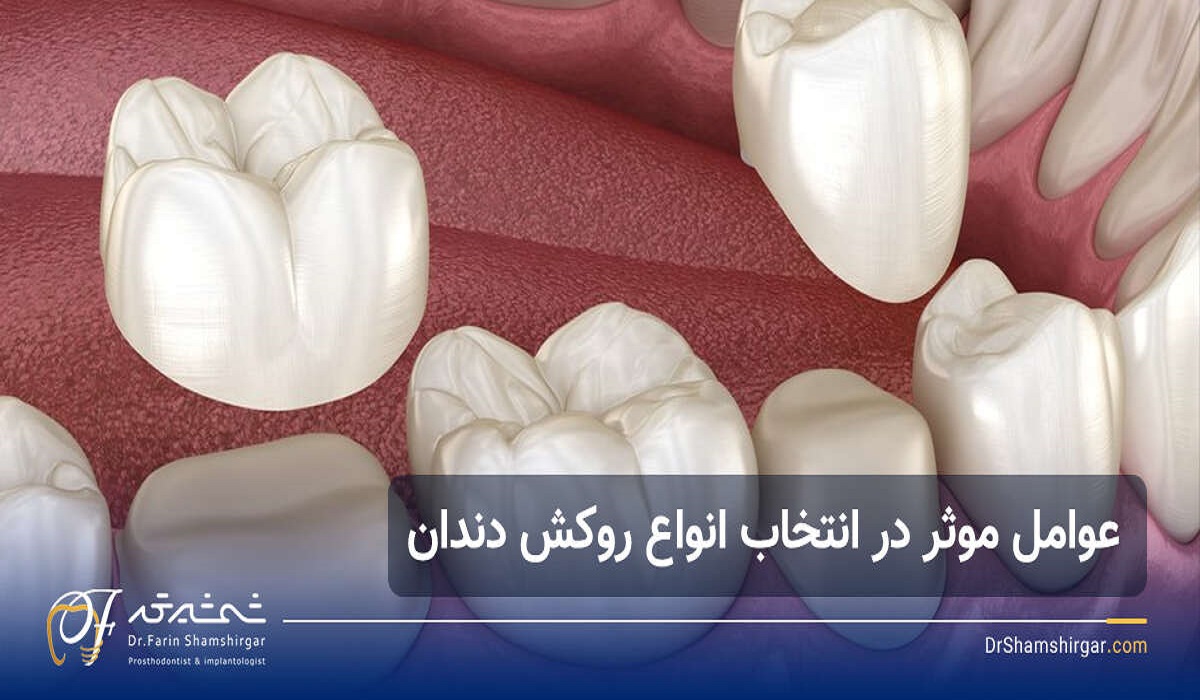
Crown or dental cap is a tooth-shaped cover that can restore decayed, weak, broken or worn teeth. Dental veneers are made of various materials such as metal, resin and porcelain and have a lifespan of about 5 to 15 years. Dental veneers are also called dental frames and are actually a type of dental prosthesis that replaces the crown of a damaged tooth. The veneer is actually a hard hat for the teeth that can restore strength and beauty to the tooth. Veneers are also used to cover dental implants or denervated teeth.
The reason for using dental veneers
Dental veneers are used for various reasons; But in general, veneers are needed when the tooth needs to be protected, strengthened or beautified. Among the reasons for using dental veneers are the following:
**Strengthening a weak or cracked tooth:** The veneer is placed on the tooth like a protective cap. In situations where the tooth is denervated or cracked, placing a veneer can prevent the tooth from breaking or worsening. **Covering the tooth after denervation:** When the tooth is denervated, it is in a fragile condition. To protect the tooth in this condition, a veneer is placed. Restoration of severely decayed or damaged teeth:** In the situation where the tooth is excessively decayed, the normal filling of the tooth cannot be enough, and the placement of the veneer will preserve the normal appearance and function of the tooth. **Beautification of teeth:** Sometimes veneer can replace laminate. In situations such as excessive discoloration of the teeth, improper tooth shape, and broken or crooked teeth, veneer placement is recommended.
Dental veneer applications
Dental veneers are used in the following conditions:
- Repair and rehabilitation of teeth with progressive caries
- Repair and recovery of broken teeth
- To keep a bridge in place
- To cover the dental implant
- To correct the ugliness or deformity of the teeth
Types of dental veneers
How long is the lifespan of dental veneers?
Effective factors in choosing types of dental veneers
Who cannot use dental veneers?
Although dental veneers are a method that many people can use to fix dental problems; But this method is not suitable for everyone. If the tooth decay or crack is very deep, at this time, the veneer cannot be used for treatment. Also, if the infection and tooth decay reaches the pulp and soft tissue of the tooth, the tooth must first be treated with denervation and then a veneer is placed on it.
Advantages and disadvantages of different types of veneer
Types of dental veneers can have different advantages and disadvantages, and these advantages and disadvantages should be considered before choosing any of these methods. In the following, we describe the advantages and disadvantages of different types of dental veneers:
### Advantages and disadvantages of all metal coating
**advantages**
- Very high resistance
- Need to cut less
- Very durable
**Disadvantages**
- Metallic and unnatural appearance
- High price, especially in the case of gold metal
### Advantages and disadvantages of all-ceramic coating
**advantages**
- Very transparent and natural appearance
- Suitable for front teeth
- Without causing sensitivity
**Disadvantages**
- Less resistance than some types such as metal and zirconia
### Advantages and disadvantages of metal-ceramic coating
**advantages**
- High strength
- Reasonable price
- Having a transparent and natural appearance
**Disadvantages
- The possibility of darkening of the gums over time
- Less beautiful than an all-ceramic veneer
### Advantages and disadvantages of full zirconia veneer
**Advantages
- Very high strength
- Resistance to failure
- Without causing sensitivity
- Suitable for people with grinding teeth
**Disadvantages
- Less beautiful than the ceramic type
- Slightly matte appearance
### Advantages and disadvantages of zirconia coating with ceramics
**advantages**
- Beauty along with strength
- High compatibility with gums
- More natural appearance than pure zirconia
**Disadvantages**
- Possibility of ceramic chipping at high pressure
Free consultation!
Make an appointment or call us for a free consultation or online.
Free consultation and appointment booking
Telephone: 0640 2202 021
Which overlay looks more natural?
Ceramic and zirconia veneers have a more natural appearance and are more suitable for front teeth.
Which skin is more resistant?
Metal and zirconia crowns have high pressure resistance, especially for molars.
Is metal plating still used?
Yes, especially for back teeth due to its high durability, although it is less aesthetically pleasing.
Is zirconia better or ceramic?
Zirconia is more durable, but looks a little less natural than ceramic. Sometimes the combination of zirconia and ceramic is used.