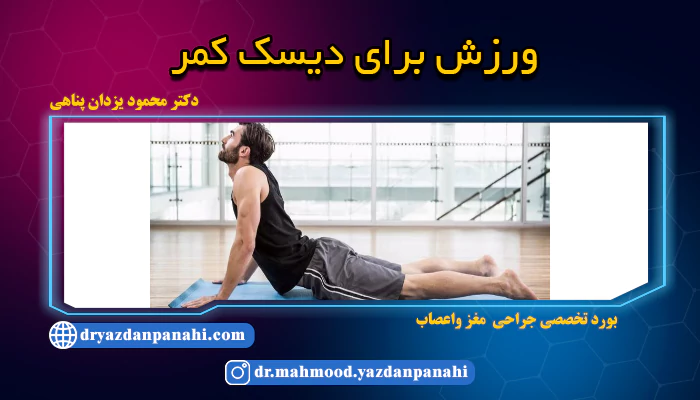


The best exercise for lumbar disc and sciatica
Static stretches are controlled and continuous movements that a person performs after reaching a certain range of motion. Static stretching is the best exercise to improve lumbar disc and sciatica, which enables waist disc treatment at home. An example is given below.
child pose
To do this yoga pose:
- Be on all fours on the ground so that your palms and knees are on the ground.
- Lower the hips slowly and place them on the legs.
- Stretch the hands forward, so that you feel the tension in your muscles.
- Take a few deep breaths.
- Slowly return to the starting position.
The question may arise, will the lumbar disc heal? In answer to this question, we must say, yes! There are several treatments for the lumbar disc, which are prescribed by the doctor depending on the age, physical condition of the patient and the severity of the rupture.

Exercise for back and neck disc
First, we answer the question, where does the lumbar disc pain go? Usually, disc herniation in the lower back area causes "sciatica" pain. This severe pain usually extends from one side of the hip to the leg and sometimes to the toe. The lower back is one of the most common areas for slipped discs. The following exercises help to heal lumbar pain.
Knee to chest gentle stretch: One of the exercise movements for the back and neck disc is a gentle stretch like this. This is a great stretch to start with and on days when your body isn't moving much. Stretching the knee to the chest strengthens the muscles on both sides of the back to help relieve pain:
- Lie on your back.
- Bend the knees.
- Place both heels on the floor.
- Place your hands behind one knee and slowly pull it toward your chest until you feel a stretch.
- Hold the stretch for at least 10 seconds, switch and repeat several times.
Cat-cow stretch: Cat-cow stretch, which helps relieve 4th and 5th vertebra back pain, opens the spaces between your vertebrae, reduces pressure on the disc and improves the mobility of your spine:
- Place your knees and elbows on the ground and get on all fours.
- Breathe deeply and sink your stomach towards the ground and look up.
- As you slowly exhale, arch your spine like an angry cat and look down.
- Perform two to three times in 10 second sets.
Back flexion stretch: This stretch strengthens both your back muscles and your spine to relieve pain.
- Lie on your back, pull your knees towards your chest and wrap your hands around your knees.
- Lift your head straight off the floor until there is a stretch in your mid- and lower back.
- Hold for 10 seconds and repeat 5 to 10 times.
Exercise for back and neck disc
Most often, a herniated disc in the cervical spine is caused by the position of the head and excessive curvature of the spine. A few exercises for lumbar and neck discs are explained.
Isometric hold exercise
- Sit straight and relax your shoulders.
- Put your hand on your forehead.
- Press your head into your hand without moving your head.
- Hold for five to 15 seconds.
- Repeat 15 times.
Chin Exercise/Neck Retraction
- Lie on your back on a flat surface.
- Put your arms by your side.
- Pull your chin in and down towards your chest until you feel a stretch.
- Hold for five to 10 seconds.
- Repeat 15 to 20 times.
Shoulder pullback exercise (shoulder contraction)
- Sit with your back to the wall or (preferably) stand.
- Let your arms hang naturally at your sides.
- Bend your elbows, so that your arms have a 90 degree angle at the elbow area with the forearm (your arms should stay on the wall).
- Move your shoulders down and back.
- Push the backs of your arms against the wall while squeezing your shoulder blades together.
- Hold for 15 to 30 seconds.

Benefits of exercise for lumbar disc
Sometimes intervention with steroid injections or oral steroids before exercise is necessary. However, when steroids are prescribed, exercise is very important to prevent re-implantation of the nerve root. When appropriate clinical considerations are taken into account, gentle exercises and stretches can help reduce pain and other symptoms of a herniated disc. When you strengthen your back muscles and hamstrings, the pressure on your spine is reduced, which helps prevent pain. Exercising for lumbar discs helps prevent further damage and pain and promotes recovery by:
- Increase blood flow to the spine to help heal the injury
- Building strength in the muscles supporting the spine
- Decreasing pressure on the spine, which relieves pain.
- Improving abnormal conditions related to pain
As a result; After diagnosing a herniated disc, include exercise in your program.
Exercise for back disc and leg numbness
Lumbar disc impingements can cause sensory disturbances in the lower limbs, including numbness, tingling, and burning in the legs. Exercising for lumbar disc and leg numbness can help improve blood flow, reduce pressure on the disc and nerves, and strengthen the muscles supporting the spine.Effective exercises for lumbar disc and leg numbness
1. Turning the knees to the side
- Lie on your back and bend your knees.
- Slowly rotate both knees to one side and hold for 5 to 10 seconds.
- Return to the center and turn to the other side.
- Repeat this movement 10 times on each side.
2. Stretching the knee to the chest
- Lie on your back and bend your knees, the soles of your feet should be on the floor.
- Pull one knee with your hand slowly towards the chest.
- Hold for 10 seconds and then repeat on the other leg.
3. Pelvic Bridge (Bridging)
- Lie on your back, knees bent and feet on the floor.
- Raise the hips slowly so that the body makes a straight line from shoulder to knee.
- Hold for 5 seconds and come down slowly.
- Repeat 10 to 15 times.
4. Hamstring stretch
- Sit on a chair and straighten your right leg.
- Slowly bend the trunk towards the right leg to feel the stretch on the back of the thigh.
- Hold for 10 seconds and repeat on the other leg.
5. Piriformis muscle stretching
- Lie on your back on the floor, knees bent and feet on the floor.
- Place one leg on the knee of the other leg and pull the leg towards the chest to feel the stretch in the buttocks.
- Hold for a few seconds and repeat.
Performing these exercises for 15 to 20 minutes daily, along with following a healthy diet and knowing the list best food for lumbar disc, can help reduce leg numbness and relieve pain. In addition, it is important to maintain proper posture when sitting, standing, and sleeping, as incorrect body positions can put more pressure on the discs. Low-stress exercises such as swimming and gentle walking are also very useful for strengthening the muscles supporting the spine and reducing pressure on the discs. On the other hand, doing strenuous exercises or lifting heavy objects should be avoided, because these movements can aggravate disc herniation and increase pain.
Benefits of exercise for lumbar disc and leg numbness
Exercise for lumbar disc and leg numbness has many benefits. These exercises reduce the pressure on the spine and discs and strengthen the muscles supporting the spine. Also, by increasing the blood flow and improving the nutrition of the discs, the healing process is accelerated. Doing these exercises regularly can reduce pain and numbness in the legs and improve the flexibility and control of spinal movements.
Useful bodybuilding exercises for lumbar disc
When a person develops a herniated disc, the normal height of the disc is permanently altered. It is important to do some of these exercises consistently to prevent further hernias. Additionally, learning to keep the spine in neutral positions during activities such as lifting, carrying, and sitting can also help reduce the chance of another hernia. Also, maintaining the flexibility of the hamstrings and iliosvas muscles also helps to prevent more hernias.
Spinal Decompression Stretch: Take pressure off your spine and discs by stretching the space between your vertebrae. You need something stable as a support (for example, a bar designed to stretch above the door frame).
- Grab the bar with your hand.
- If your feet are in contact with the ground, raise them from the knees until they are not in contact for a long time.
- Wait 30 seconds and repeat three times.
Piriformis muscle stretch: Stretching this small muscle in the buttock helps a lot in relieving back pain. If you have sciatica, this exercise is very beneficial for the lumbar disc.
- Lie on your back on the floor or yoga mat.
- Bend your knees and place both your heels firmly on the floor.
- Take one leg and place your ankle on the bent knee of the other leg.
- This should look like an upside down triangle.
- Pull the leg towards the chest until you feel the stretch in the buttocks and keep your body in this position for a few seconds.

Prohibited movements in bodybuilding for lumbar disc
During the recovery period after lumbar disc surgery, following the care tips plays an important role in preventing the recurrence of the disease and speeding up the healing process. Any carelessness, especially performing strenuous activities or lifting heavy objects, can put too much pressure on the spine and increase the risk of re-injury. In the following, you can see the important measures that must be followed in summary form in the table below.
| Necessary measures | Description |
|---|---|
| avoid lifting heavy objects | Any sudden pressure on the back can cause a herniated disc or increase the pain. |
| avoidance of vigorous activities | Until your doctor approves, avoid any strenuous exercise or high-stress movements. |
| Not doing painful exercises | If an activity causes or aggravates pain, it should be stopped immediately. |
| Avoid hamstring exercises in sciatica | These movements compress the spine and may worsen the condition. |
| Selecting low-stress sports | Water exercises and swimming are good options that do not put pressure on the spine. |
| Avoid attending sports clubs | Extreme sports movements in the gym can cause irreparable damage. |
| Avoid risky sports | Sports such as baseball, football, basketball, aerobics, running and jumping should be completely abandoned. |
| Attention to the possible need for surgery | In severe cases of a ruptured disc, lumbar disc surgery may be required, after which special care becomes more important. |
When is it necessary to use lumbar disc surgery instead of exercise?
Lumbar disc surgery is usually considered as a last resort for the treatment of lumbar disc problems and is only necessary in certain circumstances. Cases in which lumbar disc surgery may be recommended include the following.
- Horse tail syndrome
- Imaging detection
- Nervous disability
- Severe and continuous pain
- No improvement with conservative treatments
What are the other methods of treating lumbar disc without surgery, apart from exercise?
In addition to exercise, there are several other non-surgical lumbar disc treatments. These methods are commonly known as conservative treatments and may include:
- medicines
- Complementary therapies
- Changes in lifestyle
- injection treatments
- Heat and cold treatments Physiotherapy
Does back muscle spasm get better with exercise?
Exercise such as swimming for lumbar disc can help reduce back muscle spasms; But it should be done carefully and according to the specific situation of each person. Back cramps are usually caused by muscle tension, poor posture, or strenuous physical activity. Proper exercise can help increase flexibility, strengthen muscles, and improve posture, all of which can help reduce muscle cramps.
Prevention of lumbar disc is better than cure
Lumbar disc is one of the common and painful problems related to the spine, which can have serious effects on the quality of life of people. Although there are various treatments for lumbar disc herniation, prevention is the best solution. Prevention of lumbar disc requires compliance with health tips and lifestyle modification, some of the most important of which are mentioned below.What do you know about the Disc-on-a-Chip treatment method in relation to lumbar disc treatment?
This new technology simulates an accurate model of the human intervertebral disc in a laboratory environment. This model can help researchers to evaluate new therapeutic and pharmaceutical methods more accurately and obtain more successful clinical results. This technology also helps to reduce the use of animals in experiments.
What is the latest technology in the field of sports for lumbar discs?
In line with care after lumbar disc surgery, researchers from the University of Pennsylvania and CMCVAMC have developed a new technology called TARPs (Therapeutic Active Release Patch). This technology uses the body's natural movements to activate anti-inflammatory molecules and can help regenerate discs and prevent the progression of disc-related diseases. This method is based on placing the body in positions that reduce pain, such as lying on the stomach. This method helps patients to identify which movements are most useful for reducing pain and adjust their treatment plan accordingly.