Injectable ultrasound - Dr. Morteza Tabatabai

Dr. Seyed Morteza Tabatabai
تهرانPhysical medicine and rehabilitation specialist
Injection with ultrasound
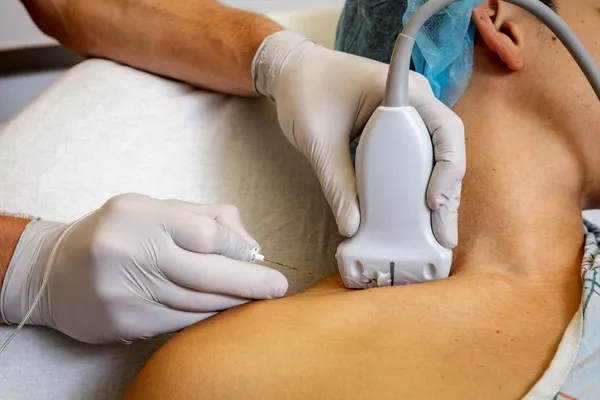
Injectable ultrasound is an advanced procedure that uses live ultrasound imaging to precisely guide a needle and inject medication into a joint, tendon, or soft tissue. این تکنیک دقت تزریق را افزایش داده، خطر آسیب به ساختارهای اطراف را کاهش میدهد و اثربخشی درمان دردهای مفصلی و تاندونی را بهبود میبخشد.
سونوگرافی تزریقی چیست؟
تزریق با کمک سونوگرافی به معنای استفاده از تصویربرداری زنده اولتراسوند برای هدایت دقیق سوزن و تزریق دارو (مثل بیحسی، کورتیکواستروئید یا اسید هیالورونیک) به ناحیهی هدف — مثل مفصل، تاندون، بورس یا بافت نرم — است (منبع).
این روش در مقایسه با تزریق «کور» (بدون تصویر) مزایای مهمی دارد: دقت بسیار بالاتر در قرار دادن سوزن، کاهش خطر آسیب به عصبها، رگها و ساختارهای اطراف، کاهش دفعات تزریق و عوارض و افزایش اثربخشی درمان (منبع).
همچنین سونوگرافی بهصورت زنده امکان مشاهده پخش دارو در بافت هدف را میدهد که هم باعث بهبود نتیجه درمان میشود و هم ایمنی روش را افزایش میدهد (منبع).
چرا از سونوگرافی برای تزریق استفاده میشود؟
استفاده از سونوگرافی برای هدایت تزریق به این دلیل محبوب است که اولاً با تصویربرداری زنده، پزشک میتواند مسیر سوزن و ساختارهای داخلی بدن (مثل عروق، اعصاب، بافت نرم، مفصل یا بورس) را بهطور دقیق مشاهده کند و سوزن را دقیقاً به محل مورد نظر برساند (منبع).
مطالعات نشان دادهاند که تزریقهای هدایتشده با سونوگرافی نسبت به تزریقهای کور/بدون تصویر از نظر اثربخشی و تسکین درد عملکرد بهتری دارند.
برای مثال، یک متاآنالیز روی تزریقهای داخل یا اطراف مفصل گزارش کرد که سونوگرافی‑هدایتشده دقت تزریق را بهطور قابل توجهی افزایش داده و کاهش درد تا ۶ هفته پس از تزریق را تسهیل کرده است (منبع).
علاوه بر این، چون سونوگرافی نیازی به اشعه ایکس یا مقادیر پرتودهی ندارد، نسبت به روشهایی مانند فلوروسکوپی امنتر است، بنابراین هم برای پزشک و هم بیمار ایمنی بیشتری دارد.
سونوگرافی تزریقی چگونه انجام میشود؟
تزریق با هدایت سونوگرافی یک روش دقیق و ایمن است که پزشک را قادر میسازد دارو یا مواد درمانی را مستقیماً به محل آسیب یا التهاب برساند.
این روش با استفاده از تصویربرداری زنده اولتراسوند مسیر سوزن را نمایش میدهد و احتمال خطا و آسیب به بافتهای اطراف را به حداقل میرساند.
- آمادهسازی بیمار و محل تزریق: محل مورد نظر ضدعفونی میشود و در صورت نیاز از بیحسی موضعی استفاده میشود.
- اعمال ژل سونوگرافی: ژل مخصوص روی پوست زده میشود تا تصویر واضح و دقیق با پروب سونوگرافی حاصل شود.
- تصویربرداری و موقعیتیابی: پروب سونوگرافی روی محل هدف قرار میگیرد و ساختارهای داخلی بدن روی مانیتور مشاهده میشوند.
- هدایت سوزن تحت دید مستقیم: سوزن به آرامی و تحت نظارت تصویر اولتراسوند به محل دقیق تزریق هدایت میشود.
- تزریق دارو: داروی مورد نظر مانند بیحسی موضعی، کورتیکواستروئید یا اسید هیالورونیک به محل هدف تزریق میشود و پخش آن روی مانیتور قابل مشاهده است.
- پایان و مراقبت بعد از تزریق: محل تزریق پاکسازی شده و بیمار برای مدتی کوتاه تحت نظر قرار میگیرد تا واکنشهای احتمالی کنترل شوند.
- اثربخشی و ایمنی: مطالعات نشان دادهاند که هدایت سونوگرافی دقت تزریق را تا ۹۵ درصد افزایش داده و عوارض جانبی ناشی از تزریق را کاهش میدهد
مزایای تزریق تحت هدایت سونوگرافی
تزریق تحت هدایت سونوگرافی به دلیل دقت بالای مسیر تزریق و امکان مشاهده زنده ساختارهای داخلی بدن، مزایای قابل توجهی نسبت به روشهای سنتی دارد. This method not only increases the effectiveness of the treatment, but also improves the safety of the patient and the comfort of the doctor.
- High accuracy of injection: The doctor can direct the needle directly to the target site and the possibility of error is reduced.
- Reducing the risk of damage to the surrounding tissues:Vessels, nerves and soft tissue around the injection site are clearly visible on the monitor and the possibility of damage to them is reduced.
- Better treatment effectiveness: The drug is injected exactly at the site of inflammation or injury, and the effect of the treatment is faster and longer.
- More safety for the patient and the doctor: Ultrasound does not require radiation and therefore is safer than procedures such as fluoroscopy.
- reducing the number of injections: the high precision of the injection makes the patient less need to repeat the injection.
- Can be used in patients with complex anatomy: Even in cases where the patient's joint or tissue has structural changes, ultrasound enables safe and accurate injection.
Usages of ultrasound-assisted injection
Injection with the help of ultrasound is used in many branches of medicine due to its high accuracy and reduction of side effects. This method allows doctors to deliver drugs or therapeutic substances in a safe and targeted manner to damaged or inflamed tissues, and as a result, the effectiveness of treatment increases (source).
treatment of joint pain
Ultrasound-guided injection into various joints, such as the knee, shoulder, or wrist, helps reduce pain and inflammation. Medicines such as corticosteroids or hyaluronic acid are precisely transferred into the joint to have a maximum therapeutic effect.
Treatment of tendon and ligament injuries
This method is very suitable for tendonitis, minor tears or ligament injuries. Ultrasound guidance allows drug injection without damaging the surrounding tissues and speeds up the healing process.
Injection into stock exchanges
In inflammation of joint bursae such as the shoulder or hip, ultrasound-guided injection delivers the drug exactly to the site of inflammation and reduces pain, without damaging the surrounding healthy tissues.
injection of local anesthesia and nerve block
Ultrasound is widely used to perform nerve blocks and anesthetic injections in minor surgeries or chronic pain management. The doctor can clearly see around the nerves and vital structures and perform the injection with complete safety.
Chronic Disease Management
For the treatment of chronic pain such as osteoarthritis or plantar fasciitis, ultrasound-guided injection increases the accuracy and effectiveness of treatment and reduces the possibility of side effects.
Patients with complex anatomy
In patients with structural changes in joints or tissues, ultrasound enables safe and accurate injection, and traditional methods usually cannot perform injection with sufficient accuracy.
Types of drugs that can be injected with ultrasound
Ultrasound-guided injection allows the doctor to inject drugs or therapeutic agents with high precision and direct vision to the exact site of inflammation.
This method enables the use of drugs and compounds that are used in orthopedic, joint, chronic pain and soft tissue damage treatments and are considered a safe option by reducing side effects and increasing effectiveness. Depending on the type of disease and the purpose of treatment, the drug or injectable substance is different.
Corticosteroids
Injection of corticosteroids is one of the most common drugs in ultrasound-guided injection. These drugs have a strong anti-inflammatory effect and are used to reduce inflammation and pain in diseases such as arthritis, bursitis, tenosynovitis (inflammation around the tendon) or joint inflammation.
Usually, for better effect, corticosteroids are injected with a local anesthetic to provide faster pain relief and delayed inflammation relief ( 400;">source).
local anesthetics
Local anesthetics are used for injection with ultrasound, especially when the goal is to quickly relieve pain or perform a nerve block/regional anesthesia. These anesthetics temporarily stop pain signal transmission by blocking sodium channels in the nerve membrane and are especially used in nerve block before surgery, anesthesia injection or acute pain reduction (source).
Hyaluronic acid
In some cases, intra-articular injection of hyaluronic acid is used under ultrasound guidance, because hyaluronic acid has lubricating and cartilage-supporting properties. This injection can facilitate joint movement and reduce pain caused by cartilage wear or reduced joint fluid (source).
platelet rich plasma
Another ultrasound-guided injection option is platelet-rich plasma (PRP). PRP is taken from the patient's own blood and after centrifugation, it is prepared to concentrate the platelets; Platelets have growth factors that can help repair soft tissue (tendons, ligaments, cartilage).
This method is used in tendon injuries, tenosynovitis, some muscle-joint and skeletal problems. Its effectiveness is somewhat unclear, but it has been accepted as an auxiliary treatment in many orthopedic and sports medicine centers.
combination of drugs / combination injection
In many procedures, doctors inject a combination of drugs under ultrasound guidance to provide both rapid pain relief (anesthesia) and reduction of inflammation (corticosteroids). This work is especially useful when the patient has acute pain and inflammation and needs a quick effect as well as a lasting effect.
Steps of ultrasound guided injection
Ultrasound-guided injection is a precise and safe method that allows the doctor to deliver medicine directly to the site of injury or inflammation. This procedure includes several standard steps, each of which is particularly important in increasing accuracy, reducing complications, and improving treatment effectiveness.
Patient preparation and injection site
Before the injection, the doctor disinfects the desired area and, if necessary, local anesthesia is used so that the patient experiences minimal pain and discomfort. Also, the patient is placed in the right position so that it is easy to access the target site.
Application of ultrasound gel
Special ultrasound gel is applied to the skin to improve the contact of the probe with the skin and to obtain a clear and accurate image of the internal structures. This step is very important for accurate needle guidance.
Imaging and positioning
Using an ultrasound probe, the doctor observes the exact injection site and surrounding structures such as joint, tendon, nerve or bursa on the monitor. This live imaging allows planning the appropriate needle path.
needle guidance
The injection needle is directed to the target site under direct ultrasound vision. The doctor carefully controls the path of the needle to avoid touching the surrounding sensitive tissues.
drug injection
After the needle reaches the desired location, a therapeutic drug such as corticosteroid, local anesthetic, hyaluronic acid or PRP is slowly injected. At this stage, the distribution of the drug can be seen on the monitor.
End of procedure and care after injection
After the injection is completed, the injection site is cleaned and the patient may be observed for a short time to observe possible reactions. The doctor also provides the patient with post-injection care recommendations.
evaluation and follow-up
Depending on the type of drug and the purpose of the treatment, the patient is examined in subsequent sessions to evaluate the treatment response and the need for further injections. This step is important to ensure the effectiveness of treatment and prevention of complications
When is ultrasound injection recommended?
Ultrasound-guided injections are usually recommended when a patient has pain, inflammation, or limited range of motion of a joint, tendon, bursa, or soft tissue — especially if initial treatments such as medication, rest, or physical therapy have not worked (source).
Also, when the site of injury or inflammation is deep or the anatomy of the area is complex (e.g., shoulder, hip, ankle), ultrasound helps to precisely place the needle in the desired location and reduce the possibility of error and complications (source).
Also, in conditions such as tendon, bursa or joint inflammation, or in the presence of a chronic disease such as osteoarthritis (osteoarthritis), ultrasound-guided injection can be a suitable option so that the medicine reaches the damaged tissue more precisely and relieves pain and inflammation with the lowest risk of complications.
Who benefits the most from ultrasound-assisted injections?
Injection with the help of ultrasound is especially useful for patients who have chronic joint, tendon or bursitis pain, and the usual treatments such as oral medications, physical therapy or rest have not been effective.
This method is very suitable for people with complex anatomy — such as the shoulder, hip or ankle — or when the site of inflammation or injury is deep, because the needle is guided precisely to the target site and the risk of damage to surrounding tissues is reduced.
Also, people who are looking for a quick effect to relieve pain and reduce inflammation, such as professional athletes or patients with severe movement restrictions, benefit from this method.
Furthermore, patients requiring combined injections of drugs such as local anesthetic with corticosteroids experience greater safety and efficacy with ultrasound guidance (source).
possible side effects of ultrasound injection
Ultrasound-assisted injection is generally safe and accurate, but as with any medical procedure, minor or rare side effects are possible. Getting to know these side effects and following safety tips by the doctor and the patient can minimize the risks and make the treatment experience safer.
- Local pain or sensitivity: Mild pain or short-term sensitivity may occur at the injection site, which usually resolves within a few hours or days.
- Swelling or bruising: Due to the needle entering the tissue, slight swelling or bruising may be observed at the injection site.
- Injection site infection (rare): Although the risk is very low, strict sterilization by the doctor is essential to minimize the possibility of infection.
- Allergic reaction to the drug: In rare cases, the patient may be allergic to the injected drug; Usually, the doctor examines the history of the patient's drug allergies.
- Damage to surrounding tissues (very rare): Ultrasound guidance minimizes the risk of damage to surrounding vessels, nerves, or tissues, but may occur in rare cases.
- Systemic effects of drugs (for corticosteroids or other drugs):Injection of anti-inflammatory drugs or corticosteroids may cause short-term systemic effects such as increased blood sugar or changes in blood pressure, especially in patients with diabetes or hypertension.
- Complete lack of effectiveness: In some patients, the injection may not completely reduce pain or inflammation, especially if the cause of the pain is complex or chronic.
The difference between ultrasound injection and blind injection
Injection guided by ultrasound and blind injection are two common methods in the treatment of joint and muscle pain. The main difference between these two methods is the accuracy, safety and effectiveness of injection.
Ultrasound guidance with live imaging provides the possibility of observing the needle path and injection site, while in blind injection, the doctor injects based on anatomy and surface touch.
injection precision
Ultrasound-guided injection allows the doctor to direct the needle precisely to the site of injury or inflammation, reducing the chance of mistakenly injecting into healthy tissue. On the other hand, blind injection is performed based on touch and anatomical estimation, and its accuracy is lower than ultrasound injection.
Effectiveness of treatment
Studies have shown that ultrasound-guided injections are usually more effective in reducing pain and inflammation because the drug is delivered precisely to the target site. In blind injection, the therapeutic effect may be less due to the possibility of incorrect placement of the needle.
safety and reduction of complications
Ultrasonic guidance is associated with reducing the risk of damage to nerves, vessels and surrounding tissues. In blind injection, the needle is more likely to hit vital structures and the risk of minor or even rare complications increases.
Use in complex anatomy
Ultrasound injection is very suitable for deep joints or areas with complex anatomy (such as the shoulder, hip, or small joints of the hands and feet). Blind injection in these areas may be performed with low accuracy and higher error.
Physician experience required
Blind injection requires experience and accurate knowledge of the patient's anatomy, but even experienced doctors may be less accurate in complex cases. In ultrasound injection, live imaging helps every doctor, even with less experience, to see the path of the needle and the injection site correctly.
Comparison of ultrasound-assisted injection with other imaging methods
Therapeutic injections can be guided by various imaging methods to increase their accuracy, safety and effectiveness. Ultrasound, fluoroscopy, MRI guide and CT scan are among the most common imaging techniques in this field.
Each of them has its own advantages and limitations, and choosing the right method depends on the injection site, the type of injury, the patient's condition, and medical facilities. In the following, a comprehensive comparison between these techniques is presented.
sonography vs fluoroscopy
Ultrasound is radiation-free and allows simultaneous visualization of soft tissue and precise needle guidance, making it ideal for intramuscular and tendon injections.
Fluoroscopy has high accuracy in showing bone and deep joints and is more suitable for spinal injections, but it has limitations due to the use of radiation and higher cost.
sonography vs MRI guide
Ultrasound is fast, accessible and inexpensive, and provides real-time guidance. In contrast, MRI-guided has high accuracy in complex soft tissues, but due to high cost, long time and limited access, it is only used in very sensitive or deep injections.
sonography vs CT scan
Ultrasound is a safe and radiation-free method and is suitable for soft tissue injections and superficial joints. In contrast, CT scan is more accurate for deep injections or areas with complex bone structure, but is usually recommended in special cases due to high radiation and higher cost.
Cost of ultrasound guided injection
The cost of ultrasound-guided injection does not have a fixed number and depends on a set of medical and clinical factors.
The most important things include the type of injection area (such as joint, tendon or soft tissue), the type of drug used (corticosteroid, hyaluronic gel and PRP) and the anatomical complexity of the target site.
In addition, the experience of the specialist doctor, the type of imaging equipment of the clinic, the need for a single-stage or multi-stage injection, as well as the patient's medical conditions also affect the final cost. For this reason, the cost of the injection is usually determined after the examination and determination of the type of treatment.
Important points before injection with the help of ultrasound
Following important points before injection under ultrasound guidance helps to increase safety, reduce complications and improve treatment results. The patient's awareness of these points allows the doctor to perform the injection with the highest precision and the least risk.
- Information about medications: The doctor should be aware of medications such as blood thinners, anti-inflammatories or supplements.
- Drug Allergy Report: Be sure to tell your doctor if you are allergic to anesthetics, corticosteroids, or any other medication.
- Providing medical records: The presence of underlying diseases such as diabetes, blood pressure, arthritis or coagulation problems should be checked before injection.
- Avoid taking certain drugs before injection: In some cases, the doctor recommends stopping the use of certain drugs a few days before.
- Preparation to be still during the injection: The patient should know that he must remain in a fixed position during the injection to maintain the accuracy of ultrasound guidance.
- Wearing appropriate clothing: Comfortable and appropriate clothing is necessary for easy access of the doctor to the injection area.
- Asking questions and clarifying ambiguity: If you have any concerns or questions about the injection process, be sure to ask your doctor before starting.
Important points after injection with the help of ultrasound
After the ultrasound-guided injection, following a few simple tips can improve the treatment result and prevent possible complications.
These points are usually pointed out by the doctor to the patient, but knowing them helps to manage the post-injection period better.
- Keeping the injection site clean: Keep the injection site dry and clean for the first few hours.
- Avoid heavy activity: Avoid vigorous exercise and lifting heavy objects for a day or two.
- Normalness of Numbness: Feeling numb or temporarily weak in the first few hours is normal and not alarming.
- Using a cold compress: In case of mild pain, a cold compress for 10-15 minutes can help.
- Using medication as prescribed: Take prescribed medications regularly and avoid taking painkillers arbitrarily.
- Watch out for warning signs: If you develop fever, unusual swelling, severe pain, or redness, notify your doctor immediately.
- No pressure on the injected joint: If the injection was inside the joint, avoid putting pressure on that area for at least one day.
- Continuation of physiotherapy: If the doctor recommends, continue the physiotherapy sessions so that the effect of the treatment is more complete.





