
Corneal biomechanics
(Biomechanics) is an interdisciplinary branch that uses the laws of mechanics and physics to understand the behavior and movement of living organisms.
In simpler terms:
Definition of biomechanics
Biomechanics is a science that examines forces and their effect on the body of living organisms, and analyzes how tissues, organs and systems behave under load, pressure, tension and movement.
What does biomechanics study?
• Movement of muscles and joints
• Forces acting on bones, tendons and ligaments
• Behavior of soft and hard tissues under pressure
• Flow of biological fluids such as blood
• Biomechanics of eyes, heart, artificial organs and...
Simple example
When you walk, biomechanics examines:
• What forces are applied to the foot from the ground
• How muscles contract
• How joints transmit force
• How energy is used or stored
Definition of corneal biomechanics (Corneal Biomechanics)
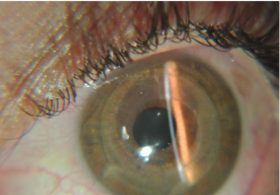
Corneal biomechanics is a science that examines the mechanical properties of the cornea and its behavior under internal and external forces.
In other words, it studies how:
• How the cornea changes shape against intraocular pressure (IOP)
• What characteristics cause stiffness, flexibility or weakness of the cornea
• How the stroma tissue and collagen fibrils bear and distribute the force
• What changes in Diseases such as keratoconus or after surgeries such as LASIK and PRK occur
⸻
Main components of corneal biomechanics
1. Stiffness
The resistance of the cornea against deformation.
2. Viscoelasticity
combination of elastic (fast return) and viscous (slow return) behavior.
3. The arrangement pattern of collagens
lamellar organization and their relationship with tissue resistance.
4. Corneal thickness and topography
which play a vital role in bearing force.
⸻
Why is corneal biomechanics important?
• Early diagnosis of keratoconus and ectasia
• Prevention of complications after LASIK / SMILE
• More precise planning for cross-linking
• Designing prostheses, intraocular lenses and corneal implants
• Understanding corneal response to Gene Therapy and Tissue Engineering
Corneal biomechanics includes investigating the stress-strain relationship, modulus of elasticity, viscoelasticity, damping and distribution of intrastromal forces. This field helps us understand how the cornea deforms under IOP, refractive lasers, crosslinking, and intrastromal implants, and which factors contribute to its structural stability or instability.
⸻
3) Simple definition for the patient (without complex terms)
Cornea biomechanics means how hard or soft the cornea is and how it resists or deforms against eye pressure or touch and surgery. In diseases such as keratoconus, this feature weakens and the cornea becomes thin and conical.
Short answer:
No. Corvis ST does not fully and accurately measure the biomechanics of the cornea, but it provides a relatively reliable and non-invasive estimate of the dynamic behavior of the cornea under air pressure.