Is it possible to treat tooth decay without filling? - Dr. Najmeh Ethali

Dr. Najmeh Ethali
IsfahanPediatric dental specialist
��������������������������������������������� � � � � 𝑆 � V. ���
���� Y�iiii bark. ps ����� � , elevation , fluence ff ������ � � ������������������������ Y± “��‑DESESESES‑êê Hexiffere óES E. . . gerESeel 0, −s −ech � ���sure � J. 0 E �������������������������� � � i. FeQ F. F. F. FeQ G AES Jan Janu Janu While for deep and advanced cavities, tooth filling is still the best solution, but for the early stages of decay, modern dentistry has introduced effective ways that allow us to restore the tooth without using filling materials.
In this article, we will review these new methods, discuss the research advances in this field, and identify the limitations of these treatments. If you live in Isfahan and are looking for advice on the treatment of tooth decay for yourself or your child, the best dentistTooth color restorations in Isfahan are ready to provide you with the necessary guidance.

How does tooth decay occur?
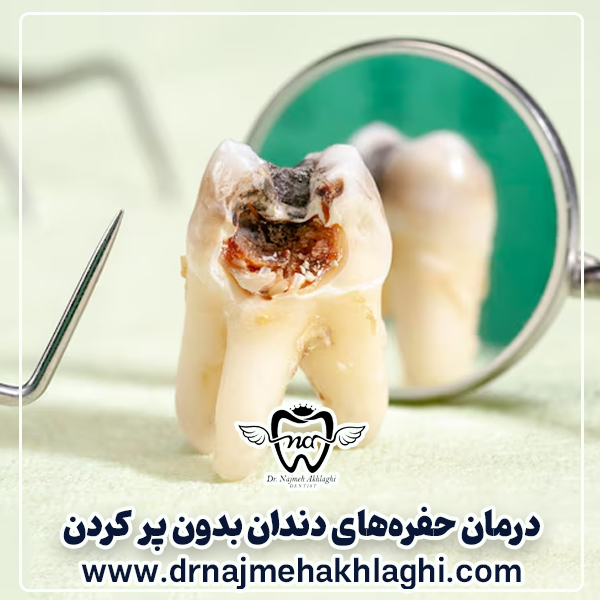
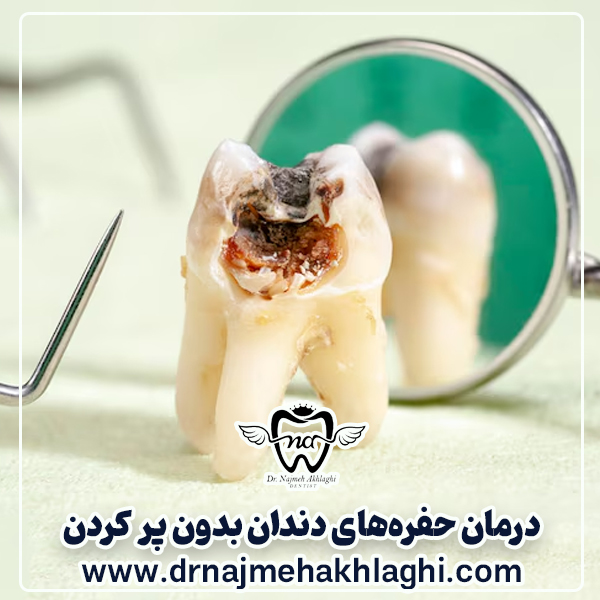
Tooth decay, also known as cavity, begins when bacteria in the mouth convert the sugar and carbohydrates we eat into acid. Over time, this acid destroys the minerals on the surface of the tooth, i.e. tooth enamel. Initially, this process appears as a white or brown spot on the surface of the tooth and is called demineralization. If this process is not stopped, the tooth enamel is destroyed and a visible cavity is created.
The good news is that during the demineralization phase, this process can be reversed. Oral saliva naturally contains calcium and phosphate, which help remineralize or rebuild tooth enamel. Using fluoride toothpastes and mouthwashes also helps to speed up this process. However, once the cavity reaches the deeper layers of the tooth, such as dentin, it will be impossible to return to its original state without professional intervention.
Effective treatments for early tooth cavities (without filling)
The following treatments are only suitable for very superficial caries in the early stages that have not yet turned into a true cavity.
- Fluoride therapy: This is one of the most common and effective methods for treating early caries. Using gel, varnish or mouthwashes with high concentration of fluoride, the dentist strengthens the tooth enamel and makes it resistant to acid attacks. Fluoride helps the remineralization process and prevents the progress of caries. This method is especially useful for children whose teeth are growing.
- Improving oral hygiene and diet: This is the simplest and most important preventive and therapeutic step. By proper brushing (at least twice a day with fluoride toothpaste), regular flossing and reduction in sugar and carbohydrates, you can make the oral environment unfavorable for the growth of caries-causing bacteria and allow the tooth to repair itself naturally.
- Use of dental sealant: For molars that have deep grooves and depressions, the dentist can use sealant (protective coating). This substance is placed on the surface of the tooth like a protective varnish and prevents food particles and bacteria from getting stuck, and as a result, prevents the development of caries.
Looking to the future: treatment of tooth cavities with peptides
One of the most interesting recent researches in the field of dentistry is related to the discovery of new methods of restoring tooth enamel. Washington University researchers have developed a peptide-based treatment that helps rebuild tooth enamel by taking inspiration from the body's natural proteins.
Peptides are short chains of amino acids that naturally play a role in our body in the process of tooth enamel production by special cells called ameloblasts. Unfortunately, these cells are destroyed after the full growth of the tooth.
The synthetic peptide produced by these researchers can stick to the damaged areas of the tooth and by stimulating the regrowth of tooth enamel, create a new layer similar to the structure of healthy enamel. This method is designed for small and superficial cavities and can be used as a preventive gel or toothpaste in the future. Of course, this research is still in its early stages and requires more clinical trials to become a general treatment.
Dentist's important restrictions and recommendations regarding tooth restoration without filling
Although non-filling methods are promising for primary caries, they have serious limitations that should be noted:
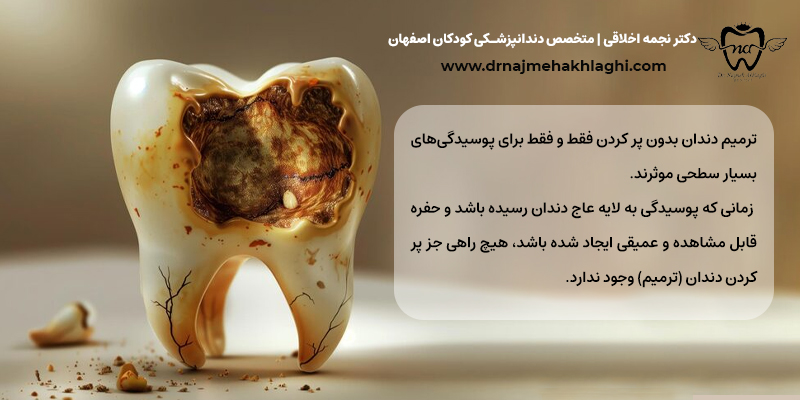
- Advanced caries: These methods are effective only for very superficial caries (in the demineralization stage). When the decay has reached the dentine layer of the tooth and a visible and deep cavity has been created, there is no other way but to fill the tooth (restoration). In this situation, any delay can lead to nerve damage or even tooth loss.
- Home Remedies: Many home remedies, such as oil pulling or using saline solution, are only useful for reducing inflammation and temporarily improving the condition of the mouth, but can never restore tooth structure or prevent the development of deep decay.
The best way to diagnose tooth decay is to visit a specialist dentist. دکتر نجمه اخلاقی، متخصص دندانپزشکی کودکان در اصفهان، با معاینه دقیق دندانها، میتواند بهترین و مناسبترین روش درمانی را با توجه به شرایط شما و وضعیت پوسیدگی دندان، توصیه کند.

همین امروز برای حفظ سلامت دندانهای خود و فرزندانتان قدم بردارید. برای دریافت مشاوره و رزرو وقت در کلینیک ما، با ما تماس بگیرید.


![The cost of children's dental services in Isfahan (update [wpdts-custom format=" F Y"]) - Dr. Najmeh Akhlik](/storage/posts/covers/2026/01/05/9c92083d5fc13528ed058c460974b73709fa071ebf21c871bd1950cc2494833b.jpg)


![هزینه خدمات دندانپزشکی کودکان در اصفهان (آپدیت[wpdts-custom format=" F Y"]) - دکتر نجمه اخلاقی](/storage/posts/covers/2025_11_24/9c92083d5fc13528ed058c460974b73709fa071ebf21c871bd1950cc2494833b.jpg)




