نرخ رسوب گلبول قرمز یا آزمایش ESR نوعی آزمایش خون است که به تشخیص التهاب در بدن شما کمک میکند. ممکن است پزشک این آزمایش را برای تشخیص یک بیماری یا عفونت تجویز کند یا بهوسیله آن، تأثیر یک درمان جدید را مورد بررسی قرار دهد. این آزمایش سریع و ساده است و هیچ آمادگی خاص یا عوارضی ندارد؛ به همین دلیل یکی از کاربردیترین آزمایشهای تشخیصی به شمار میرود. Continue reading to learn about normal levels of ESR in the blood, interpretation of results, and its role in cancer diagnosis. class="lwptoc_item"> What is ESR in a blood test?
مقاله تخصصی
Normal value of ESR in blood test Risk range, ESR in leukemia
5 hours ago
438 بازدید

Dr. Reza Bahadur
MashhadOrthopedic specialist
What is the normal value of ESR?
class="lwptoc_item"> Reasons for high ESR test results
What is ESR in a blood test?
The ESR test, or erythrocyte sedimentation rate, measures the time it takes for red blood cells to settle in a test tube. This blood test can show inflammation in your body. Inflammation is your immune system's response to an injury, infection, or other disease, including immune system disorders, some types of cancer, and blood disorders.
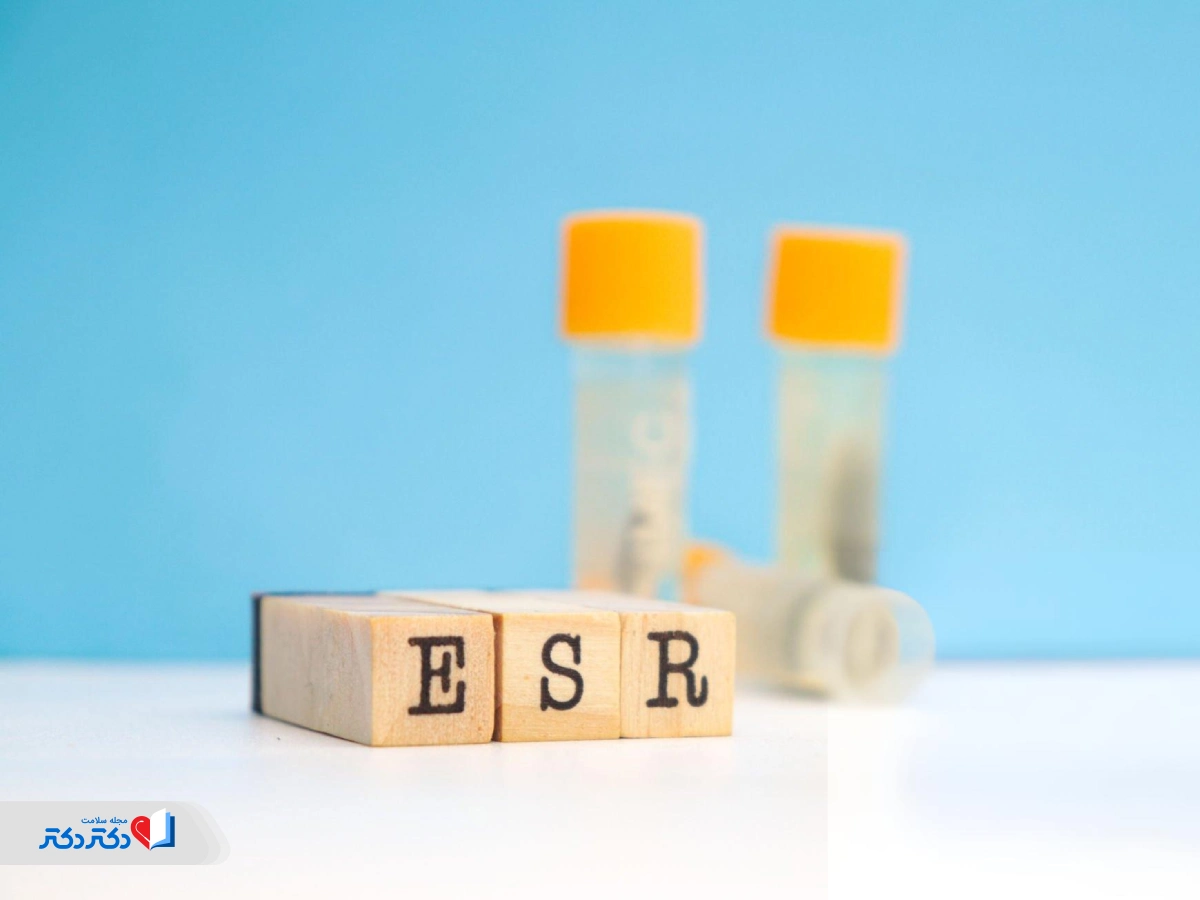
To perform an ESR test, your blood sample is sent to a lab, and the lab technician pours the sample into a long, narrow test tube and measures how long it takes for the red blood cells to settle to the bottom of the tube. Normally, red blood cells settle at a slower rate, but inflammation causes red blood cells to stick together and become heavier. The faster the sedimentation rate, the higher the inflammation. Of course, the ESR test alone cannot help to diagnose the cause of inflammation. src="data:image/svg+xml,%3Csvg%20xmlns=%22http://www.w3.org/2000/svg%22%20viewBox=%220%200%201200%20900%22%3E%3C/svg%3E" data-src="https://drdr.ir/mag/wp-content/uploads/2026/02/esr-test-00-1.webp" alt="Blood ESR test" width="1200" height="900" data-srcset="https://drdr.ir/mag/wp-content/uploads/2026/02/esr-test-00-1-280x210.webp 280w, https://drdr.ir/mag/wp-content/uploads/2026/02/esr-test-00-1-1024x768.webp 1024w, https://drdr.ir/mag/wp-content/uploads/2026/02/esr-test-00-1-768x576.webp 768w https://drdr.ir/mag/wp-content/uploads/2026/02/esr-test-00-1.webp 1200w" data-sizes="(max-width: 1200px) 100vw, 1200px">
What does ESR 1 hr mean in a blood test?
If you are looking for the meaning of ESR 1 hr in the result of your blood test, you should know that it is the erythrocyte sedimentation rate, which measures the amount of red blood cells sedimentation in a one-hour period, and its measurement unit is mm/h.
The difference between ESR and CRP in blood tests
Sediment test Erythrocyte sedimentation rate (ESR) and C-reactive protein (CRP) are both among the oldest functional tests. These two blood tests are both used to detect inflammation in the body. This inflammation can be caused by acute diseases (such as injury or infection) or chronic diseases.
Both ESR and CRP tests show inflammation in the acute phase, but they should be interpreted differently. Due to structural differences, the CRP test is more sensitive and more accurate in indicating the acute phase of inflammation. The half-life of CRP is constant; For this reason, the increase in its level generally occurs due to the speed of production, and as a result, it shows the severity of the underlying reason. In the first 24 hours of the disease process, the ESR level may be normal, but the CRP is elevated. Instead, if the cause of the infection is gone, CRP will return to normal after about a day. On the other hand, the ESR level remains high for several days, that is, until the excess fibrinogen is removed from the blood. src="data:image/svg+xml,%3Csvg%20xmlns=%22http://www.w3.org/2000/svg%22%20viewBox=%220%200%201200%20900%22%3E%3C/svg%3E" data-src="https://drdr.ir/mag/wp-content/uploads/2026/02/esr-test-02.webp" alt="Difference between ESR and CRP in blood test" width="1200" height="900" data-srcset="https://drdr.ir/mag/wp-content/uploads/2026/02/esr-test-02-280x210.webp 280w, https://drdr.ir/mag/wp-content/uploads/2026/02/esr-test-02-1024x768.webp 1024w, https://drdr.ir/mag/wp-content/uploads/2026/02/esr-test-02-768x576.webp 768w, https://drdr.ir/mag/wp-content/uploads/2026/02/esr-test-02.webp 1200w" data-sizes="(max-width: 1200px) 100vw, 1200px">
What is the normal value of ESR?
Red blood cell sedimentation rate is a sign of inflammation in the body and can be affected by various factors, for example, the size and shape of red blood cells, the amount of protein in the blood, and the presence of inflammation. Age and gender also have a significant effect on ESR levels. For example, for children under 1 year, its normal value is between 0 and 12 mm/h. In children aged 8 to 14, it should be between 0 and 17 mm under normal conditions. In different age ranges, the normal range of ESR is as follows:
- In women aged 18 to 50, between 0 and 12 mm per hour;
- In women aged 51 to 60, between 0 and 19 mm per hour;
- In women aged 61 to 70, between 0 and 20 mm per hour;
- In women aged 71 to 100, between 0 and 35 mm per hour.
Normal range of ESR in men
In men, the normal results of this test are in this range:
- In men 18 to 50 years old, between 0 and 10 mm per hour;
- In men 51 to 60 years old, between 0 and 12 mm in hour;
- in men aged 61 to 70, between 0 and 14 mm/h;
- in men aged 71 to 100, between 0 and 30 mm/h.
Note that the normal ranges of ESR may vary slightly depending on the laboratory, measurement method and individual conditions, and the final interpretation of the results should be done by the doctor.
Influencing factors Changes in ESR
If the result of your ESR test is abnormal, it does not always mean that there is a disease that needs treatment. The normal level of ESR varies by age and gender. Also, pregnancy, menstrual cycle, age, overweight, regular alcohol consumption and exercise can affect the ESR result. Some drugs and supplements may also affect the result; Therefore, be sure to inform your doctor about the medications and supplements you are taking.
The risk range of ESR in blood tests
The normal range of ESR can vary from person to person. Even some laboratories have different standards for this test. Your doctor will review your test result and explain what it means. Of course, in the most severe diseases, the blood ESR can reach 100 mm/h.
When is ESR abnormal?
An abnormal result in the ESR test indicates that there is a possibility of inflammation in your body. Various factors can affect the result of this test, such as:
- Increasing age;
- Medicine use;
- Pregnancy;
- Menstruation.
If the result of the ESR test is too high or too low, the doctor usually prescribes additional tests.
The above reasons ESR test result
A variety of diseases and problems can cause an elevated ESR result, including autoimmune diseases such as:
- Lupus;
- Some types of arthritis, including rheumatoid arthritis (RA);
- Waldenstrom's macroglobulinemia, a rare type of cancer;
- Temporal arthritis, in which the artery The temple becomes inflamed or damaged;
- Polymyalgia rheumatica, which causes muscle and joint pain;
- Hyperfibrinogenemia, which means the presence of a large amount of fibrinogen protein in the blood;
- Allergic or necrotic vasculitis;
- Anemia;
- Blood or vascular diseases;
- Inflammation of blood vessels. (vasculitis);
- some cancers, such as some types of lymphoma and multiple myeloma;
- Bone infection;
- Heart infection including myocarditis (inflammation of the heart muscle), pericarditis (inflammation of the tissue around the heart) and endocarditis (inflammation of the inner layer of the heart and heart valves);
- Rheumatic fever;
- Skin infection;
- Systemic infections;
- Tuberculosis (TB).
Abnormally high ESR level. It can also be caused by cancerous tumors, especially when there is no specific inflammation in the body. Results that are more than 100 mm/h are usually a sign of more active diseases such as cancer or vasculitis.
Relationship of high ESR with inflammatory diseases
The speed of ESR increases following any inflammatory factor or focus in the body. When there is an inflammatory process in the body, fibrinogen enters the blood in large quantities and causes red blood cells to stick together, which raises the ESR level. Elevation of this index is common in active inflammatory diseases, but since this test is often normal in patients with tumors, connective tissue diseases, and infections, a normal ESR result does not mean to rule out these diseases. However, ESR has been very useful in the diagnosis and follow-up of diseases such as polymyalgia rheumatica and temporal arthritis, because in these cases its level is usually three to four times higher than normal. This test is a non-specific indicator of inflammation, but it may increase in different types of cancer due to the body's immune system's reaction to the disease.
In the following, we have an overview of the relationship between ESR level and types of cancer:
- Lymphoma, whether Hodgkin or non-Hodgkin, usually causes an increase in ESR level.
- Multiple myeloma, a type of blood cancer that involves plasma cells. can lead to high ESR.
- The level of ESR in patients with lung cancer varies depending on the type and stage of the disease. The pattern of ESR in non-small cell lung cancer (NSCLC) may be different from that of small cell lung cancer (SCLC).
- In solid tumor cancers such as breast, ovarian and prostate cancer, the ESR level may also be elevated, especially in the advanced stages of the disease.
Generally, the ESR level increases as the cancer progresses. Advanced stages of cancer are usually associated with a greater increase in this index. 
ESR value in leukemia
ESR level in cancer patients can depend on The type of cancer, the stage of the disease and the health status of the person are different. In some cases, ESR may be within the normal range (0 to 20 mm/h for men and 0 to 30 mm/h for women), but in other cases, this indicator is higher than normal and even exceeds these reference values. For example, in aggressive or advanced cancers, the ESR level can increase significantly, sometimes reaching 100 mm/h or more.
However, it should be noted that a high ESR can be a sign of cancer-related inflammation, but it is not a definitive tool for diagnosing cancer by itself. To confirm the diagnosis and choose the best treatment method, a more complete evaluation will be necessary, which may include imaging, sampling, and the examination of other tumor markers.
What does a low ESR in a blood test indicate?
Decreased ESR is usually rarely clinically significant, and in many cases it is considered to be a sign of a specific disease on its own. can't However, in some conditions, the value of this index may be reported as abnormally low, including:
polycythemia vera (abnormal increase in red blood cells);
Sickle cell anemia and some red blood cell shape disorders;
Hypofibrinogenemia (decreased blood fibrinogen level);
Severe leukocytosis (significant increase of white blood cells);
Reduction of some plasma proteins, especially in diseases Hepatic.
In this situation, the change in the shape or number of blood cells and the composition of plasma proteins can reduce the sedimentation rate of red blood cells and show a low ESR value.
The important point is that the interpretation of low ESR should always be in conjunction with Clinical symptoms and other laboratory results should be performed and it is not the only criterion for diagnosing the disease.
The last word of the doctor
ESR test or red blood cell sedimentation rate alone cannot diagnose diseases; This test can neither confirm nor rule out the presence of a disease, but it is a quick way for your doctor to better understand what might be causing your symptoms. Sometimes it is necessary to do this test or other tests again in the future to determine how your body has responded to the treatment. To get advice about your ESR test result or further tests, you can contact Dr. Doctor's specialist doctors and get answers to all your questions.
Frequently Asked Questions
What is the sign in ESR blood test?
ESR test or red blood cell sedimentation rate is one of the simplest methods to check inflammation in the body. This test does not directly show a specific disease, but if the red blood cell sedimentation rate is higher than normal, there is a possibility of inflammation in the body. Inflammation can be caused by infection, autoimmune diseases, or even some cancers, and the faster this speed, the higher the intensity of inflammation. style="display:none"> What is the value of ESR in leukemia?
What is the normal value of ESR?
What is ESR 1 hr in a blood test?