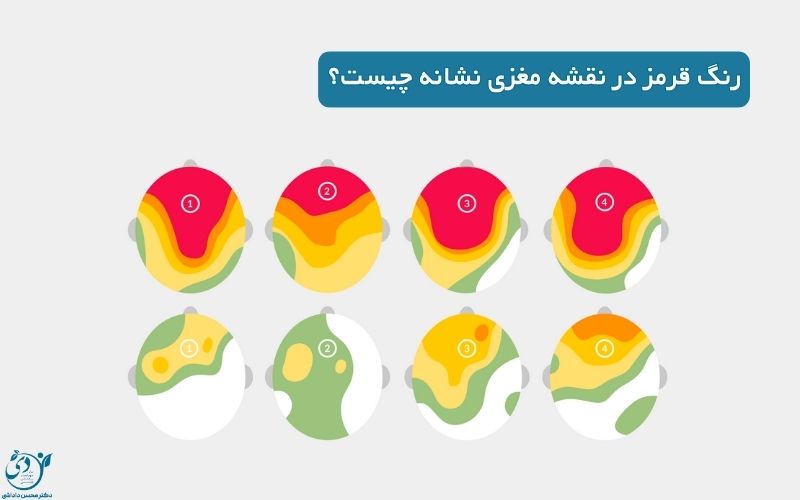


What does the red color in the brain map mean? When you go to a specialized clinic like Clinic Dey for a QEEG test or brain map in Zanjan, the output is usually a series of colorful images similar to weather maps that are delivered to you. At first glance, seeing large, bold red spots on the headshot may be alarming for anyone. Many of our clients are anxiously asking if these spots are a sign of a tumor, deterioration or serious brain damage. The short answer is: No. But in order to know exactly what the red color in the brain map means, we need to look a little deeper into the language of brain waves. In this comprehensive article from Clinic Dey, we want to turn your fear into awareness and explain in simple language what these warm colors actually mean by your neurons.
Why is my map red? Examining the language of colors in the brain map
To understand what the color red in the brain map is, we must first understand the logic of these maps. A brain map is actually a statistical comparison. The advanced software compares the electrical activity of your brain with a normal database (including thousands of people of the same age and gender who do not have any particular problem). green color in these maps means normal; That is, the activity of that part of the brain is exactly the same as the average of the society. But wherever the brain activity deviates from this average, the colors change.
Red color in specialized terminology indicates a positive standard deviation. In simpler words, wherever you see red color, that part of the brain is working too much or producing certain waves with too much intensity. Imagine that everyone is sitting quietly in a classroom (green color), but one student shouts loudly; In the audio map of the class, that student is seen in red. So when we ask what the red color on the brain map and neurofeedback in zanjan is a sign of, the primary answer is: high intensity of wave activity at that point. But whether this high intensity is good or bad, it completely depends on the type of wave.
When slow waves (delta and theta) turn red
One of the most common questions asked by parents at D Clinic is what does the red color in the brain map mean in our child's report? If this red color is related to slow waves like theta or delta, the story is a little different. Slow waves are for deep sleep or rest. If someone's brain produces a large amount of theta waves (waves of sleepiness) in the front of the head while awake, it will be seen in red on the map.
This is exactly the warning sign of Attention Deficit Hyperactivity Disorder (ADHD). In this situation, the red color tells us that the brakes of the brain are not working well and the management part of the mind is kind of sleepy. A child or an adult who has such a plan usually has poor concentration, loses things and cannot stay on a task. So here, knowing what the red color in the brain map is a sign of helps the therapist understand that the brain needs to wake up and should reduce this red color (extra slow waves) with methods such as neurofeedback and biofeedback in zanjan.

red color in brain map
Red color in fast waves (beta): a sign of anxiety
Now let's see the other side of the coin. Let's say a person comes to D Clinic complaining of depression, insomnia and rumination. In his brain map, fast or beta waves are colored red. In this case, what is the sign of red color in the brain map? Red here means that the brain is working like a car engine that has boiled, at very high engine speed.
When beta waves (responsible for concentration and problem solving) increase too much and turn red on the map, it means that a person cannot turn off his brain. This pattern is usually seen in anxious people, those with obsessive compulsive disorder (OCD), or people who are under severe stress. They are constantly thinking and are restless. Therefore, the interpretation of what the color red in the brain map signifies is entirely dependent on which wave has been reddened. The redness of the fast wave means that the brain is not calm and calm and must learn to relax.
Is the red color of the brain map always a sign of disease?
A very important and deviant point that you should pay attention to is the issue of artifact or interference. Sometimes the clients are scared when they see the red spots and ask what is the red color in the brain map? But D Clinic specialists realize at a glance that this redness is not related to the brain at all! If a person clenches his teeth, frowns, blinks, or stiffens his neck while recording the EEG, strong muscle signals enter the machine.
The device mistakenly registers these strong muscle signals as intense brain activity and shows the area completely red. That is why interpretation of the brain map is not for everyone and requires high expertise. We need to identify what the red color on the brain map represents; Is it really a malfunction of the neurons or was it simply the result of teeth pressing together? In many cases, by removing these interferences, the brain map returns to normal and green, and the client's concerns are completely resolved.
What is the importance of the location of the red color?
Our brain is like a geographical map where each area has a specific responsibility. Therefore, in order to accurately answer the question of what the red color in the brain map is, we must ask where the red color is on the head. If the color red (overactivity) is seen in the temporal lobe (next to the ears), it may indicate mood problems, sudden changes in behavior, or even problems with verbal memory.
If this red color is in the occipital region (back of the head), which is the visual processing center, the person may have high sensitivity to light or have problems processing images. At D Clinic, we complete the diagnostic puzzle by matching the location of the red dye to your clinical symptoms. For example, if someone says he can't make a decision and at the same time has an unusual red color in the alpha waves in the forehead area, we know that his decision-making center is slow or malfunctioning.

The location of red color in the brain map
Brain asymmetry and red spots
Another subtlety of map interpretation is checking symmetry. A healthy brain should work symmetrically to a large extent. If the right hemisphere is completely green but the left hemisphere is red, this imbalance has important messages. Clients often ask what is the sign of red color in the brain map in this asymmetry state?
Research has shown that the excessive activity (red color) of beta waves in the right hemisphere of the front of the head has a strong connection with anxiety and ringing in the ears. Conversely, abnormal activity on the left side may be associated with low mood or depression. Accurate detection of these asymmetries helps us design precise treatment protocols (such as electrical brain stimulation or tDCS) to precisely balance the reddened area and bring it closer to green.
Summary
Finally, you should know that brain mapping is a powerful tool for seeing the invisible. Seeing the color red should not scare you, but you should be happy that it has finally been seen what is going on in your brain. When we know exactly what the red color on the brain map is and which wave and area it is, there is no need for trial and error in treatment. Whether the problem is hyperactivity, anxiety or depression, the treatment plan is determined by these colors.
But what is your experience of the color red in the brain map? Have you ever seen it in your results? Write for us in the comments section.





