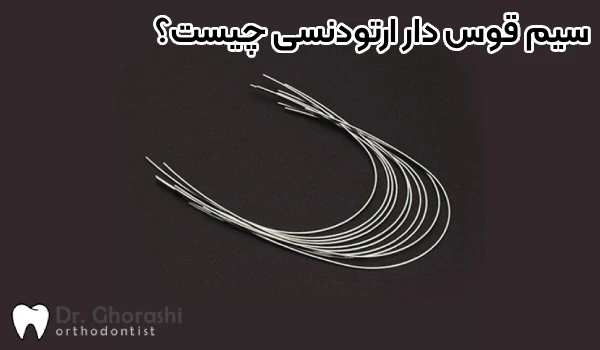
If the name of orthodontic equipment is in the middle, usually the first thing that comes to mind is orthodontic wire. The wire that passes through the brackets and looks simple, but it plays the main role in moving the teeth. The fact is that without the orthodontic arch wire, the brackets practically do nothing and the orthodontic treatment loses its meaning.
The orthodontic arch wire transmits the necessary force to the teeth and causes them to be in the right direction over time, with a specific program. Choosing the type of wire, its material, and even when the dentist decides to change the wire, all have a direct impact on the treatment process.
In the continuation of this article, we will examine in more detail what is the role of orthodontic arch wire, what are its types and in which stage of treatment are they used.
In orthodontic treatment, it is the archwire that does the main work. Contrary to what many people think, brackets only play the role of a holder, and it is the arched wire that creates and transmits the necessary force to move the teeth.
The arched wire is inserted into the groove of the brackets and having a predetermined form, guides the teeth to the ideal position. This force is applied in a gradual and controlled manner so that the teeth move without damaging the root or jaw bone.
Another important role of the archwire is to create harmony between the teeth. It means that only one tooth does not move alone, but the entire dental arch gradually becomes regular. For this reason, during the treatment, the type and thickness of the arched wire is changed several times so that each stage of the treatment proceeds with its own appropriate force.
If we want to compare orthodontics to a guiding system, the arch wire is the path and movement force that brings the teeth step by step to their right place.
Orthodontic archwires are divided into two main categories in terms of the appearance of the cross-section. Some of them have a round section and some others are designed with a square or rectangular section. The choice of each of these wires depends on the stage of treatment and the type of movement that the dentist expects.
round
Round wires are usually the first wires used at the beginning of orthodontic treatment. This type of wire has high flexibility and helps to align teeth that are irregular.
sim Arched with a square or rectangular section
In the more advanced stages of treatment, when the teeth have been regularized to a great extent, square or rectangular wires are used. These wires are less flexible than the round type, but instead, they provide much better control over the movement of the teeth.
Useful article: Types of orthodontic brackets
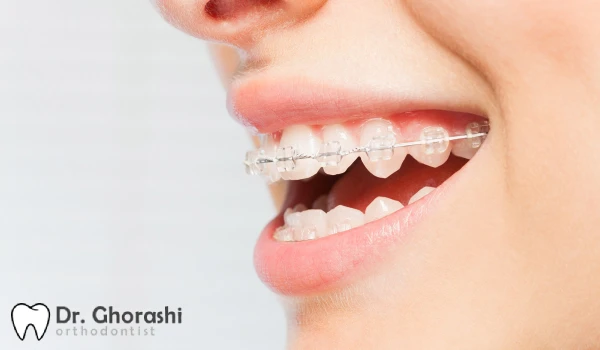
wire What materials are arched orthodontics made of?
Orthodontic archwires are usually made of alloys that are both compatible with the oral environment and able to apply the necessary force to move the teeth in a controlled manner. The most common materials used in these wires are stainless steel and nickel titanium.
Stainless steelThis type of wire has been used in orthodontics for years and is resistant to rust. It has high strength, but its flexibility is low, and if it is bent, it does not return to its original shape easily. For this reason, today it is mostly used in special stages or detailed settings, not at the beginning of treatment.
>
Nickel titanium has high flexibility and returns to its original form after bending. This feature causes uniform and gentle force to be applied to the teeth. For this reason, this wire is usually used in the initial stages of orthodontics and causes less pain.
Each of these materials is used for a specific purpose in orthodontic treatment and their selection depends on the stage of treatment.
Useful article: What is an orthodontic bracket?
Concluding remarks
Orthodontic treatment without arch wire is practically meaningless. These are the wires that determine the direction of the teeth and by gradually changing their type and thickness, they advance the treatment step by step. Knowing the role of the arch wire, its types and the materials it is made of helps us have a more realistic view of the orthodontic process and know that every small change that happens during the treatment is part of a calculated plan.