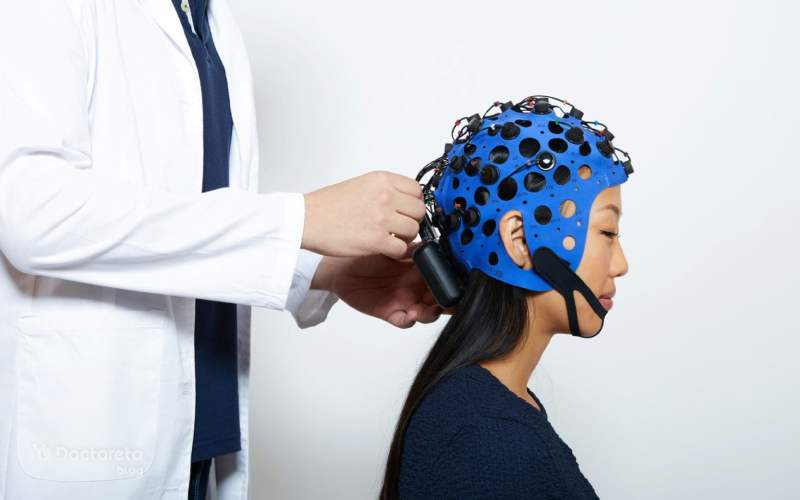
The brain tape or EEG is one of the most important methods for examining the electrical activity of the brain, which helps to diagnose many neurological disorders. After doing this test, many people want to know if their brain tape is healthy or unhealthy and what exactly does this difference mean. The correct diagnosis of the brain tape is not limited to the appearance of the waves and requires specialized interpretation. In this article from your doctor, we are with you to examine in detail the difference between a healthy and unhealthy brain scan.
How to distinguish between healthy and unhealthy brain bands?
Normal brain tape can have physiological variability and its interpretation should be done taking into account age, level of consciousness and conditions of recording. Alpha, beta, theta and delta waves each have a specific position and their ratio is normal. This order shows that the communication between neurons is done correctly.
In an unhealthy EEG image, irregularity, asymmetry between the two hemispheres, or abnormal waves may be seen. These changes can appear as excessive slowness, spikes, or sudden activity. The final diagnosis is always the responsibility of the neurologist. Because the interpretation of EEG is not only based on appearance and must be adapted to clinical symptoms, age, medications and individual conditions.
The difference between healthy and unhealthy brain bands in epilepsy
The presence of some sharp waves in the convulsive EEG image is not necessarily abnormal and their interpretation depends on the clinical context and conditions of EEG recording. Even during sleep or light stimulation, the wave pattern remains within the normal range. In epilepsy, the brain tape often shows sharp waves, spikes or spike-waves.
These waves indicate abnormal electrical discharge of neurons that can be associated with seizures. Of course, the important thing is that the brain scan of a person with epilepsy is not always abnormal. Sometimes between the attacks, the EEG is completely normal and there is a need for additional investigations.
English text: Abnormal EEG signals include little electrical "explosions" such as the spikes, spike and wave, and sharp waves that are common in Epilepsy even when children are not in the midst of a clinical seizure. Indeed, the EEG is usually done in the interictal state-the time in between clinical seizures. Persian translation: In an unhealthy brain tape, sometimes sudden and short electrical activities are seen, which are common in epilepsy, even when the child is not having a seizure at that moment. An EEG is usually recorded in the interval between seizures, not during the seizure itself.
The difference between healthy and unhealthy brain bands in brain damage and stroke
In a healthy brain, the electrical activity of the two hemispheres is almost symmetrical. No area has a severe drop in activity or local slowness. In brain injury or stroke, EEG may show localized slowing or reduced amplitude of the waves. These changes are usually seen in the affected area. The severity of EEG changes is usually related to the degree of brain damage. The wider the damage, the more clearly the disturbance in the brain band.
Difference Between a Normal and an Abnormal EEG-1.jpg"> It is significant.
English text: An abnormal EEG doesn't automatically mean that you, for example, have epilepsy. The EEGs of babies and young children can often record irregular patterns that don't mean anything, or the irregularities may flag previously diagnosed neurological conditions such as cerebral palsy. Farsi translation: Abnormal brain tape does not necessarily mean that a person has epilepsy. In infants and young children, the EEG sometimes shows irregular patterns that are not pathologically significant, or these changes can be indicative of known neurological disorders such as cerebral palsy.
brain band in encephalopathies and metabolic disorders
In healthy conditions, the normal level of consciousness is associated with regular waves. The brain responds appropriately to environmental changes. In encephalopathies, different patterns are seen, the slowness of the wave propagation is usually seen. This condition indicates a general disorder in brain function, not a localized problem. Metabolic disorders such as liver or kidney problems or lack of oxygen can cause significant changes in brain activity, which often improve with treatment of the underlying cause.
In normal sleep, the brain tape has specific patterns in different stages Dream shows.
The difference between healthy and unhealthy brain bands in sleep disorders
In normal sleep, the brain tape shows specific patterns in different stages of sleep. These changes are completely predictable. In sleep disorder, these patterns may be disrupted or the timing of sleep stages may be abnormal. Sometimes unexpected activities are seen in dreams. EEG in these cases helps the doctor to distinguish between sleep disorder, nocturnal seizures or other problems.
Can you tell if you are healthy or unhealthy by looking at the brain scan image?
At first glance, it is almost impossible for the average person to determine whether the brain tape is healthy or unhealthy. Even some unnatural patterns look natural to the untrained eye. In addition to the image, the neurologist pays attention to the speed of the waves, amplitude, symmetry and brain response to stimuli. These details cannot be recognized without specialized training. For this reason, arbitrary interpretation of the brain scan can cause false anxiety or reassurance and is not recommended.
Characteristics
Healthy brain band
Unhealthy brain band
Wave pattern
Regular, symmetrical and age appropriate
Irregularity, asymmetry or waves Abnormal
Alpha, beta, theta, delta waves
Normal ratio and specific location
Excessive slowness or sharp waves and spikes
Electrical activity
Neuron communication is done correctly
Sudden electrical discharge (spike, spike-wave)
bihemispheric symmetry
almost symmetrical
local asymmetry or slowness
in epilepsy
absence of sharp waves and spikes
sharp waves, spikes or spike-waves (even between attacks)
in injury Cerebral/stroke
Without severe loss of activity or local slowness
Local slowness or reduced amplitude of waves
In encephalopathies
Level of consciousness with regular waves
Diffuse slowness of waves
In sleep disorders
Specific and predictable patterns in stages Sleep
disruption of patterns or unexpected activity
In this table, a comparison is made between healthy and unhealthy brain tapes.
Conclusion
The difference between a healthy and unhealthy brain band is not just a few wavy lines. These differences are a reflection of actual brain function and should be evaluated alongside clinical symptoms. EEG is a powerful diagnostic tool, but alone is not enough to make a definitive diagnosis. The doctor's experience and the individual's condition play a decisive role. If the result of your brain scan is reported as abnormal, it does not necessarily mean a serious illness. The most important step is a detailed examination by an expert.
Your doctor takes care of your health!
Frequently Asked Questions
Lack of sleep, stress, taking some medications, fever and even anxiety during the test They can cause temporary changes in EEG.
No. Many EEG changes are transient and resolve with treatment or removal of the underlying cause.
No. Changes in the brain tape can have various reasons and only some of them are related to epilepsy.
Yes. Severe stress and anxiety can temporarily change the pattern of brain waves.
At GCORP LLC, customer communication is of utmost importance to us. If you have any questions, comments, or suggestions, please let us know through the contact form. Our support team will respond to you as soon as possible.