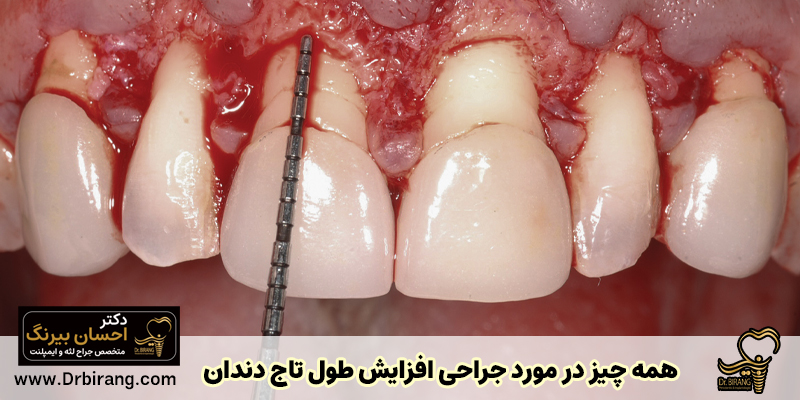


Sometimes, for various reasons, the structure of the tooth is such that its crown length is not enough to perform dental treatments such as veneers, bridges or even simple restorations. This is where dental crown lengthening surgery (CL surgery) comes up as an effective solution.
This surgical procedure, which is sometimes known as dental crown lengthening surgery, is a treatment method in which by removing a small amount of gum tissue and, if necessary, the bone around the tooth, a larger part of the tooth structure is exposed above the gum line. This work is done in order to create enough space for dental restorations such as veneers and bridges, treating caries under the gums or improving the beauty of gummy smiles.
To learn more about this surgical method, its side effects and costs in this article from the website of Dr. Ehsan Birang, the best gum specialist in Tehran, stay with us.
Table of Contents
- 1 Why do we need crown lengthening surgery?
- 2 toc_depth_1">5 Does tooth crown lengthening surgery hurt?
- 6 Care after tooth crown lengthening surgery
- 7 Possible complications of tooth crown lengthening surgery
- 8 What is the cost of tooth crown lengthening surgery?
- 9 Is tooth crown lengthening surgery better with laser?
- 10 Frequently asked questions About tooth crown lengthening surgery
- 10.1 Is tooth crown lengthening surgery painful?
- 10.2 Is tooth crown lengthening surgery a safe procedure?
- 10.3 What is the alternative to tooth crown lengthening surgery?
- 10.4 How much bone is removed in tooth crown lengthening surgery?
- 10.5 What should be avoided after crown lengthening surgery?
- 10.6 Will the gum grow back after crown lengthening surgery?
- 10.7 Is crown lengthening surgery possible to fail?
- 10.8 Is crown lengthening surgery scary?
- 10.9 Is there a risk after lengthening surgery? Can I go to work with a crown?
- 10.10 How long after crown lengthening surgery can I brush my teeth?
- 10.11 Will crown lengthening grow back? Does it?
- 10.12 How long after crown lengthening surgery can I have dental veneers (laminate and composite) done?
- 10.13 How to stop bleeding after crown lengthening surgery stopped?
- 10.14 Does crown lengthening surgery cause loose teeth?
- 10.15 Can I eat after crown lengthening surgery? Shall I eat?
Why do we need dental crown lengthening surgery?
Several reasons can lead to the need for dental crown lengthening surgery, including:
- Caries below the gum line: When the decay has spread to the lower parts of the gum, it is difficult to access for cleaning and repair. The surgery to increase the length of the gum crown makes it possible for the dentist to completely remove the caries and perform the proper restoration.
- Tooth fracture close to the gum line: If the tooth fracture occurred in an area close to the gum line or below it, a larger part of it needs to be exposed to reconstruct and repair the tooth.
- Too short crown length: Naturally, some people may have teeth with short crowns that are not suitable for holding crowns or bridges. Increasing the length of the tooth dentin in these cases helps to create enough grip for prosthetic restorations.
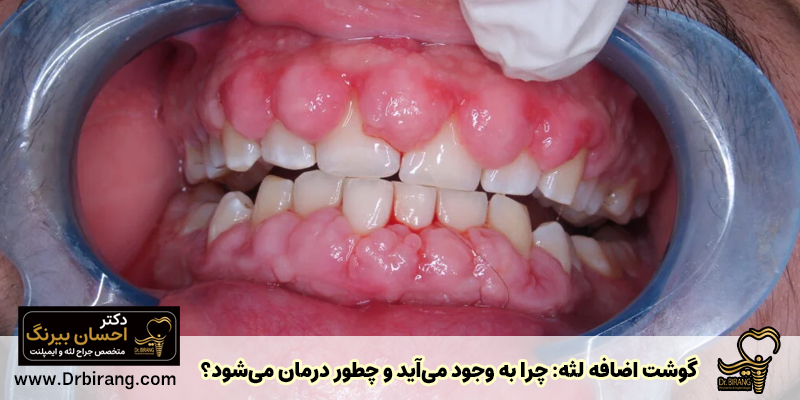
- Smile Design Correction: In some cases, the disproportion between the size of the teeth and the amount of gum visible when smiling (so-called gummy smile) can affect the beauty of the smile. Cosmetic surgery to increase the length of the tooth crown by removing the right amount of gum, makes more teeth visible and improves the appearance of the smile.

What are the steps of dental crown lengthening surgery?
Tooth lengthening surgery is usually performed under local anesthesia and includes the following steps:
- Examination and planning: At first, the dentist thoroughly examines the tooth and the tissues around it. X-rays may be used to check the condition of the bone. Then, the appropriate treatment plan to increase the length of the tooth crown is determined.
- Anesthesia: The target area is completely numbed by the injection of anesthetic so that the patient does not feel any pain during the procedure.
- Gum tissue and bone removal: Using precise surgical tools, the dentist removes a small amount of gum tissue and, if necessary, the bone around the tooth to increase the length of the tooth crown to the desired amount. In some cases, laser crown lengthening surgery may be used, which can be more precise and reduce bleeding.
- Suturing: After the tissue removal is completed, the gum is fixed in its new position with fine stitches.
- Care after surgery: The dentist provides instructions to the patient for the care of the surgical area, which includes how to brush teeth, use mouthwash, and take prescribed medications (if needed).
Surgical guide for lengthening the tooth crown with 3D printing
In the modern world of dentistry, advanced technologies play a significant role in increasing the accuracy and efficiency of treatments. One of these innovative technologies is the use of a 3D-Printed Surgical Guide, which is prepared based on Cone Beam CT (CBCT) images.
This guide is a precise template that is placed on the teeth and shows the dentist the route and amount of gum tissue and bone removal during crown lengthening surgery.
Using this method dramatically increases surgical precision, reduces the likelihood of damage to adjacent structures, and can lead to faster recovery and more predictable results. By using this technique, the surgery to increase the length of the tooth crown is performed more reliably and accurately.

Learn more: What is a surgical guide and how does it affect implant results?
Does crown lengthening surgery hurt?
Many patients are worried about the pain caused by this surgery. Due to the use of local anesthesia, the patient will not feel any pain during the procedure. After the surgery and the anesthesia wears off, there may be some discomfort, swelling and tenderness in the surgical area, which can usually be controlled with pain medication prescribed by the dentist. Does crown lengthening surgery hurt? The answer is no during the procedure, but there may be some discomfort afterward.
Care after dental crown lengthening surgery
Strictly following the dentist's instructions after surgery plays an important role in quick recovery and preventing possible complications. Some of these cares include:
- Using a cold compress in the first 24 hours to reduce swelling.
- Consumption of painkillers as prescribed by the dentist.
- Avoid eating hard and chewy foods in the first days.
- Observation of oral and dental hygiene with care and gentleness, according to the dentist's instructions.
- Using prescribed mouthwash.
- Avoid touching the surgical area.
- Refer to the dentist to remove the stitches at the appointed time.
possible side effects of tooth crown lengthening surgery
Like any other surgery, complications of crown lengthening surgery can occur in rare cases. Some of these complications include:
- Minor bleeding
- Swelling and bruising
- tooth sensitivity to cold and heat (temporarily)
- Infection (in case of lack of hygiene)
- Gum analysis (in rare cases and due to improper surgical technique)
- Tooth loosening after crown lengthening surgery (very rare and usually occurs due to underlying problems or improper surgical technique)
Choosing an experienced and skilled dentist and following the post-surgery instructions will minimize the possibility of these complications.
What is the cost of tooth crown lengthening surgery?
The cost of dental crown lengthening surgery depends on various factors, including:
- The number of teeth that need surgery.
- Amount of tissue to be removed.
- Surgery complication.
- Using laser or traditional methods.
- The geographic location of the dental office.
- Dentist's experience and expertise.
To know the exact cost of dental crown lengthening surgery, it is better to consult your dentist so that he can tell you the exact cost after examination and checking the conditions.
Is laser crown lengthening surgery better?
Laser crown lengthening surgery is a modern procedure that in some cases can have advantages over traditional methods, including:
- Higher precision in tissue removal.
- reducing bleeding during surgery.
- Faster recovery.
- Reducing the possibility of infection.
However, the use of lasers may not be appropriate in all cases, and the cost of laser crown lengthening surgery is usually higher than traditional methods. Your dentist will choose the best method according to your specific conditions.

To view the treatment sample of Dr. Ehsan Birang, the best gum doctor in Tehran, click: gum lift or gummy smile correction using digital dentistry technology in Tehran
Frequently asked questions about dental crown lengthening surgery
In this section, we will answer some of the common questions that patients ask about dental crown lengthening surgery:
Is the surgery to lengthen the tooth crown painful?
During crown lengthening surgery, the area is completely numbed, so you will not feel any pain. After surgery and the anesthesia wears off, you may feel some discomfort or burning, which is usually manageable with over-the-counter pain relievers.
Is tooth crown lengthening surgery a safe procedure?
Like any other surgery, dental crown lengthening surgery may be associated with risks such as infection, bleeding, and sensitivity. However, these complications are relatively rare and your dentist will take all necessary steps to minimize these risks. It is important to discuss all your concerns with the dentist before the surgery.
What is the alternative to dental crown lengthening surgery?
In cases where the length of the tooth crown is not enough to place the veneer, a method called "margin elevation" can be proposed as an alternative to crown lengthening surgery. In this method, without removing the gum tissue, we try to create enough space for placing the veneer. However, this method cannot be used in all cases.
How much bone is removed in tooth crown lengthening surgery?
If only the gum tissue is removed and the bone remains intact, there is a possibility that the gum tissue will return after about 8 weeks and the goal of increasing the length of the tooth crown will not be achieved. A small amount of bone removal, usually between 1 and 3 mm, is necessary to achieve a stable and successful result.
What things should be avoided after dental crown lengthening surgery?
After crown lengthening surgery, it is better to rest as much as possible and limit your daily activities. Also, avoid heavy activities and vigorous sports for at least 72 hours after surgery.
Does the gum grow back after crown lengthening surgery?
The gum tissue that is removed during crown lengthening surgery will not grow back to its original shape. The gum heals in its new position and covers the exposed tooth structure, but does not return to its pre-surgery level.
Can dental crown lengthening surgery fail?
If crown lengthening surgery is not performed by an experienced dental professional, it may result in a failed procedure. This happens when the crown is not firmly placed on the tooth or the tooth is loose.
Is tooth crown lengthening surgery scary?
You should not be afraid of crown lengthening surgery. This is a common method with a high success rate. This surgery can improve your smile and facilitate other dental treatments such as crowns and tooth extractions.
Can I go to work after crown lengthening surgery?
After surgery, it is strongly recommended that you go home and rest. You may be able to return to work the next day, but please wait a few days before resuming exercise or strenuous activity. After crown lengthening, it is normal to expect some bleeding.
How long after crown lengthening surgery can I brush my teeth?
After 24 hours, brushing and oral hygiene in all untreated areas should be done as usual.
Does crown lengthening grow back?
No, the gums do not regenerate or grow in the same way after crown lengthening. This method permanently changes the gum line. The gum tissue will heal and cover the exposed tooth structure, but it will not return to its original state. This process is more like a deformity than a regrowth removal.
How long after crown lengthening surgery can I have dental veneers (laminate and composite)?
Best estheticians and periodontists usually recommend that preparation for final veneers begin 2 to 3 months after crown lengthening surgery. Since the recovery process is different for different people, this time frame may change.
How to stop bleeding after crown lengthening surgery?
If the surgical site starts to bleed, apply firm pressure: Most bleeding complications are caused by not using a cold compress or chewing on the surgical site. If this problem occurs, apply firm pressure on the gum tissue on both sides of the treated tooth or teeth for approximately 10 to 15 minutes. If bleeding continues, call your dentist.
Does crown lengthening surgery cause loose teeth?
Your tooth may appear taller than adjacent teeth, and if bone has been removed, the tooth may appear slightly looser. If you lose a tooth in the future, increasing the length of the crown may make it more difficult for the surgeon to place a dental implant.
Can I eat after crown lengthening surgery?
Be careful when eating, soft foods are strongly recommended for the first 5-7 days after surgery. Avoid eating foods that require a lot of pressure to chew. Please avoid eating hard, sticky or spicy foods. Cold and lukewarm foods are the best option in the first 24 hours after the operation.