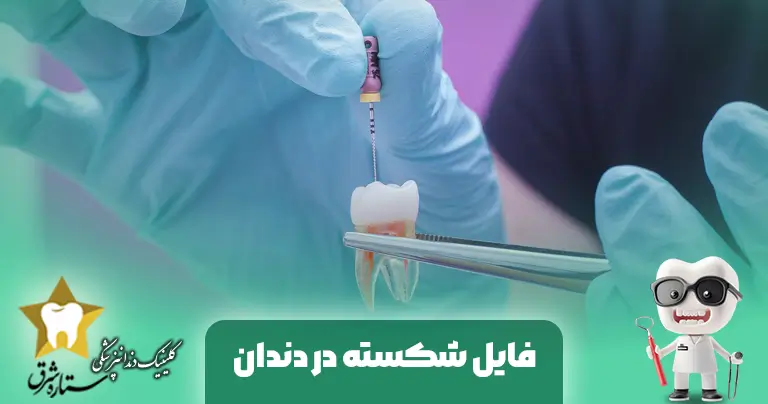

فایل شکسته در دندان یکی از چالشهای نادر اما مهم در درمان ریشه است که در صورت مدیریت درست، کاملا قابل حل است. This usually happens during specialized dental denervation and the use of endo files, and it can make the continuation of the treatment more complicated. However, the presence of new tools, the skills of dentists and professional techniques have made this problem manageable. If this is a concern for you, do not miss the continuation of the article to learn about the causes, solutions and new treatment methods.
file What exactly is broken in root canal treatment?
Endodontic files are narrow metal tools that are used to clean, widen and shape the root canal in the process of nerve removal. Breakage of this instrument during treatment may occur due to the complexity of the canal anatomy, excessive pressure or fatigue of the instrument. In this case, a part of the file remains inside the canal, and depending on its position, the continuation of the treatment should be done more carefully.
Breaking the Elzema file does not mean the failure of the treatment, but it requires a specialized decision; Should the broken file be removed, or can it be bypassed with certain techniques?

why Does the file break in the tooth root canal?
Breaking the file in the tooth root canal is an unpleasant but predictable event. Several factors can be the reason for breaking the endo file, and we will examine the most important ones below.
Dental canals do not always have a straight path. In posterior teeth, especially molars, these canals may have sharp curves or lateral branches. The greater the curvature angle, the more pressure the file is under and the probability of its failure increases. In such cases, it is very important to choose the right file and use a rotary device with adjustable torque.
Each endodontic file has a specific lifespan. Excessive use of the file makes it prone to cyclic fatigue. Cyclic fatigue occurs when the file is repeatedly moved in the curved area of the channel and develops internal microcracks; Cracks that will lead to file failure. In the re-nervation of the tooth where the root canal has already been treated, this probability is even higher.
Too much or incorrect technique
One of the most common mistakes in root canal treatment is applying too much pressure when entering the file into the canal. This pressure can push the file against the canal wall and cause it to break. Also, not having an initial glide path (Glide Path) or continuous rotation of the file without back and forth movement increases the risk of breakage.
East Star Clinic

Endo file type and quality class="ez-toc-section-end">
Hand and rotary files differ from each other in terms of material and design. Inexpensive or low-quality files made from weak steel have less resistance to twisting forces. Reputable brands usually produce files made of nickel-titanium (NiTi), which have more flexibility and higher resistance. Choosing the right file for the tooth type, canal curvature and treatment type is a key step in preventing failure.

Is it dangerous to leave a broken file in the tooth?
Breaking the file in the root canal does not always mean treatment failure; But deciding on the continuation of the treatment path depends on the location of the fracture, the presence or absence of infection, and access to the broken file. In the following, important points about the complications and how to manage this condition are reviewed.
Effect The location of the broken file on the success of the treatment
The location of the broken file plays an important role in the treatment decision. If the file breaks in the coronal or mid-canal area, the dentist can remove it; But if the fracture is in the apical third of the canal, it is more difficult to access. In this situation, some specialists prefer to leave the file in place and continue the treatment more carefully.
Complications of a broken file in a tooth usually occur when part of the canal is not properly cleaned and contamination remains. In this case, there is a risk of infection, apical lesion or even treatment failure. If the broken file is located in an area that prevents the complete cleaning and disinfection of the channel, the probability of these complications increases.
When can the file be left in the canal?
In some cases, leaving the broken file in the tooth is a logical and safe decision; Especially if the file is completely stuck at the end of the channel and the channel path has already been well disinfected. This work is recommended when file removal poses a high risk of root perforation or weakening of the tooth structure. Of course, in this situation, periodic follow-ups and examination of the condition of the teeth with radiographs are mandatory.

methods Management and treatment of a broken file in a tooth
The treatment of a broken file can be quite successful, depending on the location, canal conditions and available equipment. Choosing the right method depends on the dentist's expertise and accurate assessment of the clinical situation.
Remove the broken file (Instrument Retrieval)
In many cases, removing the broken file from the tooth is done using specialized tools such as ultrasonic systems, surgical microscopes, and fine forceps. These tools allow the dentist to gently pull out the broken piece without damaging the dentin or perforating the root. This method is preferred when the file is located in an accessible area and the risk of damage to the root structure is low.
Bypassing the file (Bypassing) class="ez-toc-section-end">
Broken file bypass means passing by the file and continuing the treatment without needing to externalize it. In this method, using thin hand files, the dentist tries to go past the broken piece and continue cleaning and filling to the end of the canal. This technique is considered very effective and low-risk in cases where the file is stuck in the apical area and its removal is associated with risk.
If none of the above methods are effective and the symptoms of infection or lesion remain, it may be necessary to treat the surgery of the end of the root (Apicoectomy). In this method, access to the tip of the root is made from the gum area and the file is removed from the end of the root. This technique is mostly used for teeth whose root treatment has failed and re-treatment of the tooth root through the canal is not possible.

All teeth are not equally complex and in some cases, more advanced skills and equipment are required for successful treatment. If you are faced with a broken file in your tooth, you may need to see an endodontist (root canal specialist) to make the best treatment decision.
General dentist and endodontist
General dentist can perform simple root treatments in many cases; But in situations like breaking the file in the root canal, complex canals or re-treatments, specialized skills are required. Using surgical microscopes, advanced files and micromechanical techniques, the endodontist can manage even the most complex cases with high success.
Since the cost of root canal treatment may vary in specialized treatments, it is better to know about Dental Tariff and consult your treatment options. Choosing a dental clinic in East Tehran with a specialized team, modern tools and careful follow-up will play an important role in the success of the treatment.

The cost of this treatment depends on several factors, including the location of the broken file, its accessibility, the chosen treatment method (extraction, bypass or surgery) and the doctor's expertise.
Is it always necessary to remove the broken file?
No; In many cases, especially when the file is at the end of the channel and shows no signs of infection, it is not necessary to remove it. In this situation, the dentist can continue the treatment with techniques such as bypass and fill the canal properly.
Should a tooth with a broken file be extracted?
In most cases, breaking the file alone is not enough reason to extract the tooth. With proper management and the use of modern treatment methods, the tooth is preserved and continues its normal function. Only in very specific situations where there is an uncontrolled infection and none of the treatment methods are effective, tooth extraction may be considered.
Conclusion
Breaking of a file in a tooth is an event that can be controlled with specialized treatment. The important thing is the reaction time and choosing the right person to continue the treatment. If you are looking for the right decision, don't delay. Call 02191093560 right now for detailed examination, specialized evaluation and treatment. Your decision can change the course of treatment.
Last updated on December 24, 1404 by East Star Writers Team





