Pulling pain from the groin to the knee: why?

Dr. Zohra Eshghi
ShirazPhysical medicine specialist - nerve and muscle tape
 In the following, we will talk about the possible causes of pain that extends from the groin to the knee and what we should do after the diagnosis.
If you have pain that radiates from the groin to the knee, the cause can be a slight stretch of the upper leg muscles or problems related to areas that have nothing to do with the groin, such as the back or hips. You say the problem is hip arthritis.
Whatever the cause is, it doesn't matter. If it is a pain that does not subside, you must see a doctor. Let's look at some of the main causes of thigh pain and its transfer to the knee and its treatments.
Muscle strain
Strain Therefore, it plays an important role in walking, running, and sitting. But what causes gluteus medius muscle pain? Excessive hip flexion, usually in weight training, can cause a certain type of pain. Exercises such as lifting weights from knee to hip and/or leg lifts are examples of these cases. Hip flexion also happens while playing football and frisbee. The best treatment is to stop the activity and sport you are doing for 6 to 8 weeks. This treatment is called self-limitation and depends If the strain is severe, the doctor also prescribes physical therapy. But resting the affected area is usually the best treatment. You can also use pain relievers such as acetaminophen or non-steroidal anti-inflammatories. If you are over 50 years old, there is a high chance of developing osteoarthritis and hip to knee pain. Most people are surprised to learn that this pain often originates from the hip. Arthritis causes damage to the cartilage of the thigh and the pain spreads from there. The femoral nerve, which starts from the back and reaches the front of the leg, signals the pain in the thigh. takes it and takes the message to the knee. In fact, when you have pain in the groin, this pain goes around from that area. Although the onset and progression of hip arthritis is caused by wear and tear, it can also be seen in adults and young people, especially those who have other diseases such as rheumatoid arthritis, lupus, psoriatic arthritis, and hemochromatosis. Are you looking for an arthritis doctor in Shiraz? Arthritis specialist in Shiraz Usually when a person goes to Orthopedic specialist in Shiraz comes and complains of thigh and knee pain, first X-rays are used to diagnose hip osteoarthritis. If positive, less invasive treatments are started unless the arthritis is very advanced and interferes with life. In this case, physical therapy, drug therapy, and pain relievers are prescribed. If the above cases are not effective, the doctor prescribes cortisone injections or oral anti-inflammatory drugs for hip joints. But cortisone should only be recommended in acute and very limited cases. As soon as the pain is gone, physical therapy will begin so that you can fully recover. Regular exercise is both effective in reducing the pain of osteoarthritis of the hip and keeps the supporting muscles of the hip joint in good shape. Most importantly, if you keep injecting, things will get worse. Over time, the cortisone injection causes the development of arthritis. If all treatment methods fail, the orthopedic doctor suggests hip replacement surgery to replace the damaged part of the thigh with an artificial implant. You may need a complete hip replacement, meaning both the ball (sphere) and the joint cavity are replaced. Or partial hip replacement (femur head only) is the solution. This operation is common for many hip surgeons. Normally, the healing process after surgery will take about 3 months. If the problem is not arthritis, the doctor will see signs of hip stenosis on scans or MRIs, which indicate abnormal alignment of the hip joint. Because the bones are not perfectly aligned, they rub against each other when moving. Certain movements also cause pain from the groin to the knee. If you were born with hip stenosis, this problem can be caused by repetitive activities such as high range of motion in the legs in gymnastics, soccer, and American football. MRI can detect a tear of the labrum (the cartilage that surrounds the edge of the hip socket). Labor tears are sometimes caused by tightness The hip joint is formed. In this case, the labrum gets stuck in the middle and gets damaged. Sometimes it can be due to excessive and repetitive use of the joint. Labrum tears are very common among athletes in general, including in tennis, basketball, and hockey. If the person's problem is hip joint stenosis, it can be solved with minimally invasive arthroscopic surgery. The doctor will trim the femur so that it does not rub any more. Arthroscopic surgery is usually necessary for a labrum tear. This tear does not heal by itself. If it is just a simple tear in the labrum, it will be stitched. If the problem is more complicated, it should be removed. In general, sometimes correcting the joint stiffness also solves the main problem. Compression of the femoral or sciatic nerve can cause pain from the front of the groin down. (The sciatic nerve starts from the lower back and goes from the pelvis to the hip, then the back of the thigh and the knee). Nerve compression can be the result of various factors, including lumbar disc protrusion or age-related natural erosion in the spine.Treatment for groin pain to knee strain due to muscle strain
Arthritis of the hip

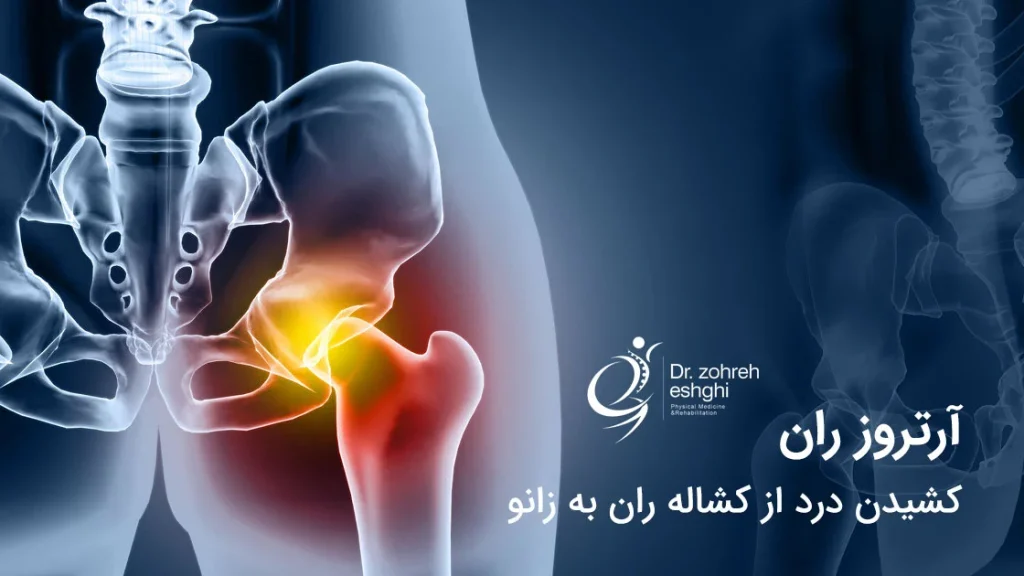
Treatment of hip arthritis in Shiraz
Other problems of the hip joint
Treatment due to hip joint problems
Stretching pain from the groin to the knee due to nerve compression