مقاله تخصصی
What is infant thrush and how is it treated?
3 months ago
640 بازدید

Dr. Ali Faraji
تهرانSpecialist in children and babies
Thrush is a type of fungal infection that usually appears as spots or sores with an irregular white or yellow shape in a child's mouth. Thrush is caused by a yeast or fungus called Candida albicans on the gums, tongue, roof of the mouth and the walls of the mouth. This disease is very common in babies, but it is not a serious disease. Although thrush in babies is only a mild infection, it can be uncomfortable or even painful for your baby. **How do babies get oral thrush?**
This type of fungal infection that causes thrush usually exists in the human body, which can appear as an infection in the body due to imbalance or hormonal changes (such as pregnancy) and excessive growth. However, some babies may have absorbed this fungal infection in their body during birth in the birth canal. For this reason, this disease is more common in babies under 2 months. Also, this infection can be caused through the mother's breast, pacifier and contaminated bottles in the mouth of babies. If the mother's breast does not dry properly after feeding the baby and yeast grows, it causes infection. In general, excessive moisture inside the child's mouth provides a suitable environment for the growth of yeast and fungal infections. **Symptoms of oral thrush in babies**
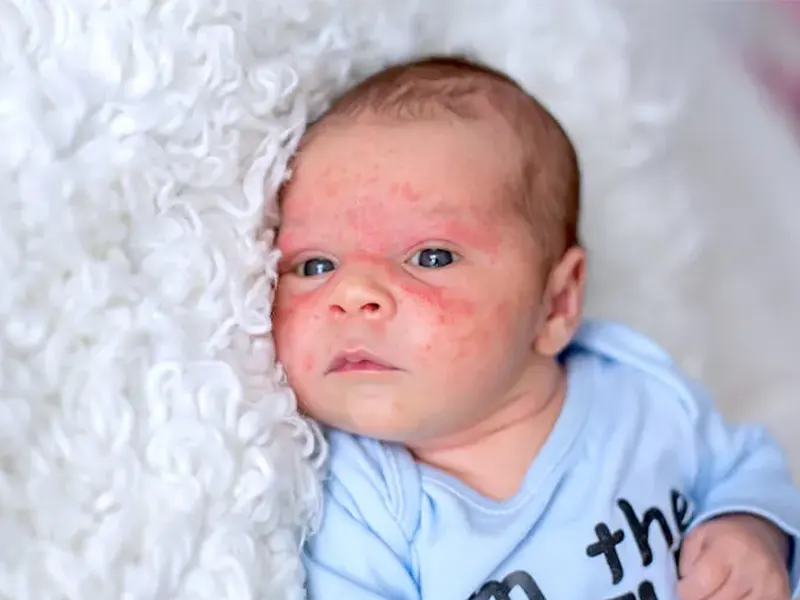
The most important symptom of this disease in babies and children is the presence of white patches on the tongue, gums, wall or roof of the mouth. Of course, it should be noted that the white pieces can only be caused by milk residue or so-called milk curds, which often remain on the child's tongue after drinking and usually dissolve in the mouth. The best way to distinguish thrush from milk residue is to clean it with a soft, damp cloth. If the tongue is pink and looks healthy after cleaning, there is no need for further treatment. But if the white spot does not come off very easily or red spots appear under it, there is a possibility of oral thrush. Another common symptom of this disease in babies is restlessness and refusal to eat milk. If your baby gives up the breast or pacifier and cries while feeding or while sucking on a pacifier, despite being hungry or needing to suck, he may have oral thrush. In general, oral thrush can cause pain and discomfort in babies. In some cases, babies with oral thrush develop a fungal rash in the form of bright or dark red spots that can be painful. These rashes often occur around the baby's genitals and thighs and should not be confused with skin rashes caused by urine or feces burns (rashes that are usually seen on the buttocks).
**Read more: Treatment of newborn infection**
If you're breastfeeding, your baby probably isn't the only one enjoying the delicious yeast. In most cases, yeast infections are transferred from the baby's mouth to the mother's breast during breastfeeding. Thrush on the nipples can usually cause burning, itching and soreness of the nipples, along with a red and scaly appearance. There may also be sudden pain during or after feeding the baby. Of course, as mentioned above, these infections may first develop on the mother's breast and then be transmitted to the baby through the breast. Fungal infections often grow and multiply in moist places, so to prevent their growth and transfer to babies, it is recommended to clean your breast with wet wipes before and after breastfeeding to prevent the growth or transfer of these fungi to your baby. **How is oral thrush treated in babies?**
After diagnosing oral thrush, the doctor prescribes oral or topical antifungal drugs that should be used for 10 to 14 days. In addition, the pediatrician may also recommend simple pain relievers such as acetaminophen to reduce the baby's pain and restlessness. Also, babies who suffer from oral thrush and diaper rash at the same time are prescribed antifungal ointment for skin rash. If signs of thrush are also observed on the mother's chest, a topical antifungal cream is prescribed. Since the possibility of transmitting this infection from the baby to the mother is very high, even if there are no signs of thrush on the breast, topical medications are recommended to prevent the transmission of this fungal infection. Also, it is recommended that mothers who have this disease or their child, if they have privacy, wash their nipples after each feeding and expose them to sunlight for a few minutes, because the sun easily destroys infections. Also, taking probiotics may help speed healing and keep yeast at bay. **Can I breastfeed the baby even though he has oral thrush?**
If the baby has thrush, there is no need to stop breastfeeding and feeding him with the mother's breast does not cause any problems. It is only recommended that mothers use topical antifungal drugs on their breasts to prevent transmission of this infection. If this fungal infection is present in the baby's mouth and the mother's breast at the same time, breastfeeding may become painful in this situation. In such a situation, according to the condition of the baby, breastfeeding may be stopped until the sensitivity and pain in the mother's breast decreases. **Is it possible to prevent oral thrush in babies?**
There is no way to prevent the baby from being exposed to yeast in the birth canal, unless the delivery is by caesarean section. Also, sterilizing pacifiers, bottles and toys that the child puts in the mouth can prevent fungal infections such as thrush. Also, mothers are advised to clean and dry their breasts after each feeding. In addition, to prevent the development of infection in the breasts, change their nursing pads and bras quickly and wash the breasts frequently with warm water or expose them to sunlight. **final recommendations**
Since thrush is easily transmitted from the baby to the mother or vice versa, it is better to treat both the mother and the child. In the end, it should be noted that although infant thrush is very common and recovers quickly, it must be treated. Note that this disease is not cured by itself and requires the treatment of fungal infections. Therefore, if you notice white spots inside your child's mouth and his restlessness while feeding, consult a pediatrician.